🕷️ Plain Tiger (Danaus chrysippus): wide tropical range
🧾 Quick Facts
The Plain Tiger, scientifically known as Danaus chrysippus, is a widely distributed butterfly species found across tropical regions. Known for its striking colors and patterns, it is a favorite among butterfly enthusiasts.
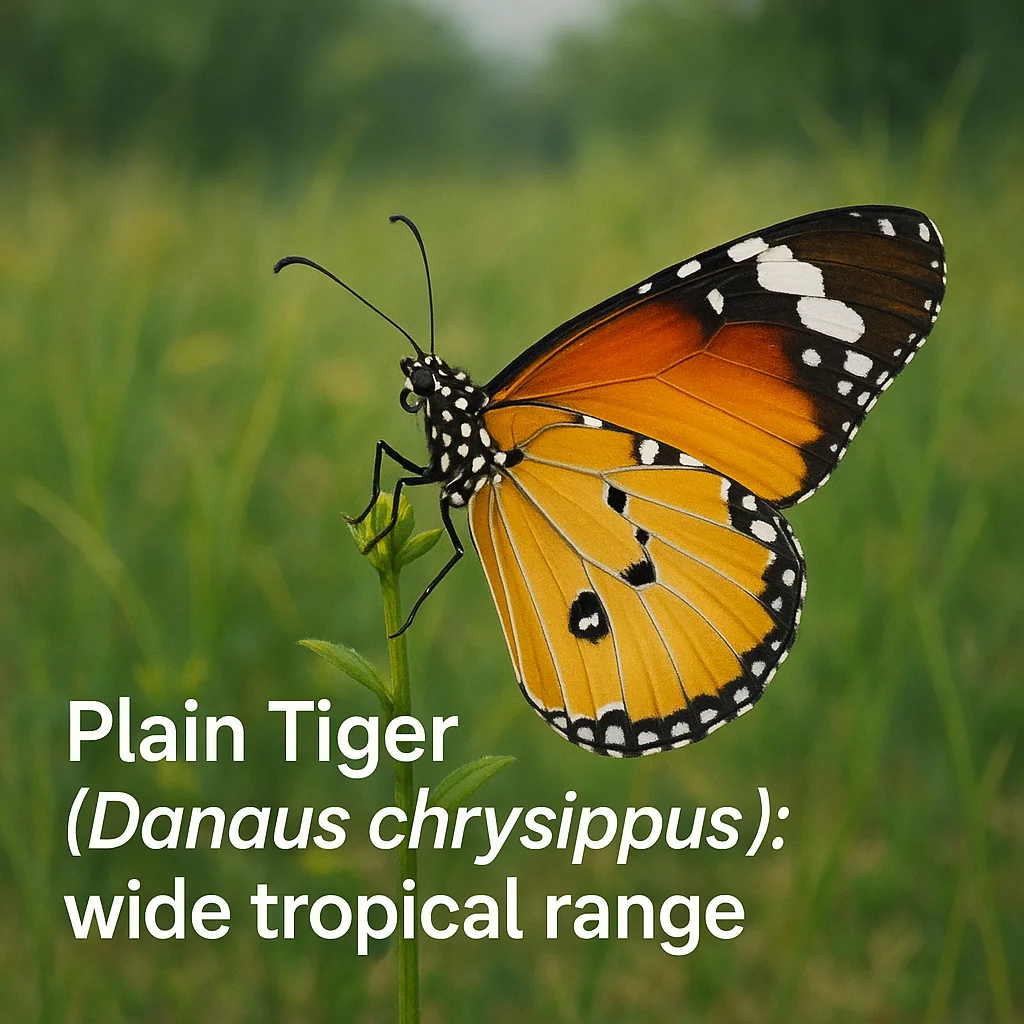
- Common names: Plain Tiger, African Monarch
- Scientific name: Danaus chrysippus
- Insect: Yes, it is an invertebrate
- Order / family: Lepidoptera / Nymphalidae
- Typical size range: Wingspan of 70–80 mm
- Key colors/patterns: Orange and black with white spots
- Activity: Diurnal (active during the day)
- Typical habitats: Grasslands, gardens, urban areas
- Where in the world it occurs: Africa, Asia, Australia
- Seasonality: Year-round in tropical climates
🔍 Identification
The Plain Tiger is easily recognized in the field by its distinct body shape and coloration. It has a robust silhouette with broad wings. Its antennae are clubbed, typical of the butterfly family.
The wings present a characteristic bright orange color with black and white patterns. Its movement is characterized by a slow, gliding flight interspersed with short bursts of rapid wing beats.
Common confusion may arise with other Danaus species, like the Monarch, but the Plain Tiger is smaller with more angular wing outlines.
- Top ID Tips:
- Entire insect visible in frame: display all details
- Bright orange wings with broad black borders
- White spots on both forewings and hindwings
- Black veins on the forewings
- Body color is dark, with orange hue underneath
- Slow, steady flight pattern
- Clubbed antennae distinct in butterflies
- Mimics appearances to avoid predation
🧠 Basic Body Structure
The Plain Tiger shares the fundamental features of butterflies, including a segmented body divided into the head, thorax, and abdomen. Each of these parts plays essential roles in its survival.
Its six legs emerge from the thorax, along with the wings. The exoskeleton provides structure and protection, and butterflies, including the Plain Tiger, undergo molting as they grow.
As an invertebrate, it lacks a backbone, which means its structural integrity is maintained by the exoskeleton that encases its body.
🌍 Habitat & Distribution
The Plain Tiger is found in diverse environments ranging from tropical forests to urban gardens. It thrives in grasslands and open areas where host plants are available.
Microhabitats include sunny patches with flowering plants, essential for nectar feeding, along with areas under leaves or logged wood for protection during rest.
Geographically, it inhabits continents such as Africa, parts of Asia, and extends to Australia. Its adaptability to warm climates means it can be found in both humid and arid regions.
Habitat changes, such as urbanization and agricultural expansion, affect Plain Tiger sightings and distribution.
📅 Seasonal Appearance & Activity
Due to its preference for tropical climates, the Plain Tiger is often visible year-round in regions without harsh winters. It is primarily active during the day, seeking out flowers for nectar.
Their activity may increase during warmer months in subtropical regions, coinciding with increased flowering of host plants.
- Best Time to Spot It:
- During the day in open, sunny locations
- In months with abundant flowering plants
- In regions with mild, seasonal climates
- After the rainy season when plant growth peaks
🥚 Reproduction & Egg-Laying
The Plain Tiger engages in fascinating courtship rituals, with males showcasing vibrant displays to attract females. Eggs are typically laid on host plants, including milkweeds, known for providing the caterpillars with essential nutrients.
Females carefully deposit eggs on the underside of leaves, where they remain protected. While typical egg counts per laying are not well documented, they may vary greatly depending on environmental conditions.
🌀 Metamorphosis & Life Cycle
The Plain Tiger undergoes complete metamorphosis, comprising four distinct stages: egg, larva (caterpillar), pupa (chrysalis), and adult.
During the larval stage, caterpillars feed avidly on milkweed plants, fostering growth and contributing to chemical defense strategies. The pupal stage is a transformative period where metamorphosis occurs, leading to the emergence of the adult butterfly.
Life stages' duration varies with climate, generally ranging from a few weeks for caterpillars to multiple months for whole life cycles.
🍽️ Diet & Feeding Behavior
As larvae, Danaus chrysippus caterpillars feed exclusively on specific host plants, particularly those in the milkweed family. This diet incorporates toxic compounds that caterpillars sequester for defense.
Adults primarily consume nectar from various flowering plants, equipped with a proboscis adapted for sipping liquid nutrients.
The caterpillar is an herbivore, with the adult butterfly playing a critical pollinator role among flowering plants.
🦉 Predators & Defense
Various natural enemies target the Plain Tiger, including birds, spiders, and insects like wasps. To evade these threats, it employs several defense mechanisms.
Camouflage and mimicry are significant strategies, where its coloration resembles distasteful species, deterring predators. The toxic compounds ingested during the larval stage render it unpalatable to many of its would-be predators.
- Defense Highlights:
- Bright coloration serves as a warning
- Mimicry to resemble toxic counterparts
- Sequestering toxins from host plants
- Displays of erratic flight to confuse predators
👥 Social Behavior & Swarms
The Plain Tiger is generally solitary in its behavior, with interaction limited to mating activities and territorial disputes among males. It does not form swarms or colonies like some other insects might.
Occasional aggregations may be seen at prime feeding sites, but these are typically due to resource availability rather than social structuring.
🧭 Senses & Communication
Butterflies, including the Plain Tiger, rely heavily on their robust vision, tuned to perceive a variety of colors, aiding in nectaring and mate selection. Their antennae have olfactory sensors for detecting pheromones used in communication.
Though lacking in auditory capabilities, they use visual cues and chemical signaling to interact with others and navigate their environments.
🌱 Role in the Ecosystem
The Plain Tiger plays a vital role as a pollinator, contributing to the reproduction of various flowering plants. Its larval feeding habits indirectly control plant populations by consuming specific host plants.
This butterfly also functions as part of a complex food web, providing sustenance to its predators despite its unpalatable reputation.
Though it has limited direct impacts on human activities, the presence of the Plain Tiger indicates a healthy, biodiverse environment, benefiting ecological balance.
📉 Population & Conservation Notes
The Plain Tiger is often reported as common in its suitable habitats, thriving in areas with abundant host plants. However, habitat degradation due to agriculture and urban expansion presents challenges to its distribution.
While it isn't currently under significant threat, ongoing monitoring is crucial to understanding population dynamics amidst environmental changes.
- How to Help (Low-Impact):
- Plant native milkweed species in gardens
- Avoid pesticide use in areas hosting butterflies
- Promote conservation of natural habitats
- Encourage organic farming practices
⚠️ Human Interaction & Safety
Given its non-aggressive nature, the Plain Tiger poses no direct threat to humans. It does not bite or sting, making it an ideal subject for observation and photography.
For ethical wildlife engagement, observers should avoid capturing and handling these butterflies, allowing them to continue their ecological roles unperturbed.
📌 Summary
- Plain Tiger, Danaus chrysippus, is easily identified by orange and black wings.
- It inhabits tropical regions across Africa, Asia, and Australia.
- The species is active during the day, feeding on flower nectar.
- Complete metamorphosis involves egg, caterpillar, pupa, and adult stages.
- It is a herbivore as a caterpillar and a pollinator as an adult.
- Predators include birds and insects; defense strategies include mimicry.
- Common in suitable areas, but habitat loss poses a potential threat.
- Ideal for respectful observation due to its harmless nature to humans.