🕷️ Queen Butterfly (Danaus gilippus): ID vs monarch
🧾 Quick Facts
The Queen Butterfly (Danaus gilippus) is a fascinating insect that often gets confused with its relative, the Monarch Butterfly. Here's a quick overview to get to know this elegant butterfly better.
- Common Names: Queen Butterfly, Soldier Butterfly
- Scientific Name: Danaus gilippus
- Insect: Yes, it is a true insect and thus, an invertebrate
- Order / Family: Lepidoptera / Nymphalidae
- Typical Size Range: About 70–86 mm (2.8–3.4 inches) wingspan
- Key Colors/Patterns: Orange wings with black and white spots
- Activity: Primarily diurnal
- Typical Habitats: Open fields, gardens, meadows
- Where in the World: Southern United States, Central America, South America
- Seasonality: Mostly visible during spring to early fall
🔍 Identification
Identifying the Queen Butterfly involves observing its distinct features. The butterfly has a robust body shape with broad wings compared to its relatives. It possesses clubbed antennae, typical of most butterflies.
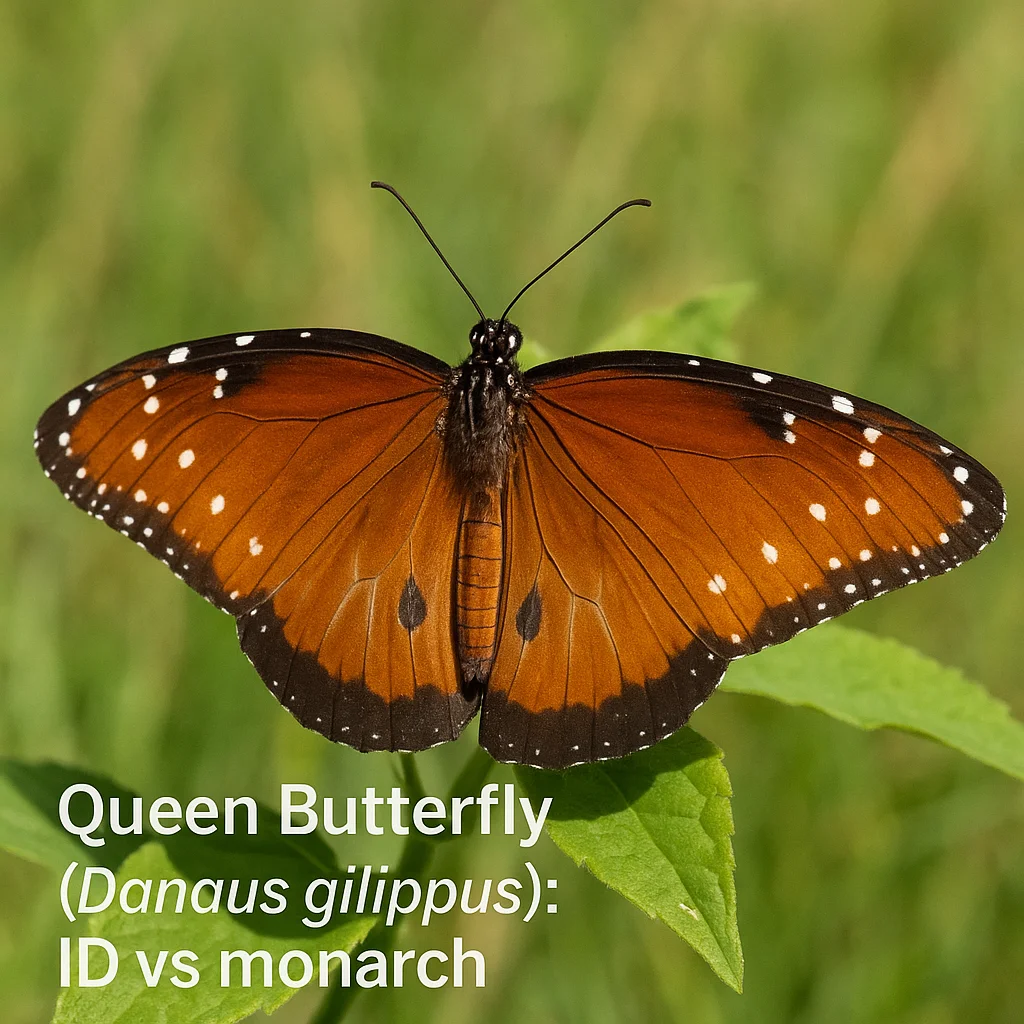
Their wings are a deep orange, similar to Monarchs, but Queens usually lack the thin black veins found on Monarch wings. Instead, they showcase a more uniform color pattern with white spots decorating the outer edges.
In terms of movement, the Queen Butterfly displays graceful flying behavior, often seen gliding serenely across open fields.
- Rounded wings with spotted patterns
- Orange color with fewer black veins compared to Monarchs
- Smaller wingspan than the Monarch Butterfly
- White spots along the black margins
- Robust body and clubbed antennae
- Entire insect visible in a centered frame reveals full-body color distinction
🧠 Basic Body Structure
Like all insects, the Queen Butterfly's body is divided into three main parts: the head, thorax, and abdomen. As an insect, it has six legs attached to the thorax and features an exoskeleton, which provides structural support and protection.
The Queen Butterfly undergoes molting during its larval stages to accommodate growth. As a true invertebrate, it lacks a backbone, relying on its exoskeleton for support, molting as it grows.
🌍 Habitat & Distribution
The Queen Butterfly thrives in open environments such as grasslands, meadows, and gardens. It is commonly found in sunny areas where host plants like milkweed are abundant. This butterfly is adaptable to various microhabitats including edges of water bodies and flowering stands.
Geographically, Queen Butterflies populate the southern parts of the United States, extending through Central America and into parts of South America. They prefer warm, temperate climates, and their presence can vary with habitat modifications and climate changes.
📅 Seasonal Appearance & Activity
The best time to observe Queen Butterflies is from spring through early fall. During these months, they are most active during the warm, sunny days. Diurnal by nature, they bask in the sunlight and are sensitive to adverse weather conditions such as rain and cold temperatures.
- Most visible during late spring to early fall
- Active during daylight hours
- Prefer warm, sunny days
- Reduced activity in cooler or rainy climates
🥚 Reproduction & Egg-Laying
The courting process of the Queen Butterfly involves aerial displays and pheromones. Females lay eggs singly, primarily on milkweed plants, which serve as both a habitat and food source for the larval stage.
Egg-laying strategy consists of depositing eggs in small clusters, ensuring larvae have immediate access to food upon hatching. Egg counts can vary greatly based on environmental conditions and food plant availability.
🌀 Metamorphosis & Life Cycle
The Queen Butterfly undergoes complete metamorphosis, progressing from egg to larval (caterpillar) stage, then pupating into adulthood.
During the larval stage, Queen caterpillars munch on milkweed leaves, which provides them with an advantage in toxicity—detering predators. Caterpillar development lasts about two weeks on average, varying with temperature and food availability.
The pupal stage, also known as the chrysalis, is where transformation occurs, usually lasting approximately 10-14 days before emerging as an adult butterfly.
🍽️ Diet & Feeding Behavior
Queen Butterflies are herbivorous during their larval stage, feasting exclusively on milkweed plants. The adult butterflies exhibit nectivorous feeding behavior, favoring flowers from which they can easily access nectar with their proboscis—an elongated mouthpart designed specifically for sipping fluid.
Their feeding habits contribute significantly to pollination, assisting plants in transferring pollen after visits, thus playing a crucial role as pollinators in their ecosystems.
🦉 Predators & Defense
Natural predators of the Queen Butterfly include birds, reptiles, and certain mammals. A primary defense strategy involves utilizing the toxic compounds from milkweed ingested during the larval stage, rendering them unpalatable to many predators.
Their wing coloration serves as a warning, a defensive adaptation known as aposematism. Furthermore, they may utilize mimicry to escape predators by appearing similar to other unpalatable species.
- Unpalatable due to milkweed toxins
- Aposematic coloration deters predators
- Mimicry offers additional protection
- Quick, erratic flight patterns evade capture
👥 Social Behavior & Swarms
Although primarily solitary, Queen Butterflies engage in social interaction predominantly during mating or during resource abundance. However, they do not form swarms or partake in significant migratory behavior like their Monarch counterparts.
Seasonal gatherings occur around abundant nectar sources, signaling temporary sociality driven by food availability rather than innate social structure.
🧭 Senses & Communication
Sense and communication in Queen Butterflies rely heavily on visual cues and chemical signaling. They utilize vision to locate flowers and identify mates—a critical aspect of their lifecycle.
Pheromones play a fundamental role in mating behavior, as Queen Butterflies release chemical attractants to draw potential partners, facilitating successful reproduction.
🌱 Role in the Ecosystem
The Queen Butterfly is vital in ecosystems due to its role in pollination. As an active pollinator, it aids in the reproduction of various flowering plants, sustaining biodiversity.
This mutualistic relationship highlights their ecological importance and ensures the perpetuation of essential plant species. Additionally, by serving as a food source for predators, they integrate into food webs as prey, maintaining ecological balance.
📉 Population & Conservation Notes
The Queen Butterfly is generally common within its suitable habitats, though local abundance varies. Threats include habitat loss due to urbanization, pesticide use which affects host plants, and climatic shifts altering their environment.
- Plant native milkweed to support their lifecycle
- Avoid pesticide usage in garden settings
- Maintain garden diversity to support various pollinators
- Allow natural leaf litter to provide breeding areas
⚠️ Human Interaction & Safety
Queen Butterflies pose no threat to humans as they do not bite or sting. When observing them, it's best to respect their natural habitat, and refrain from collecting specimens to prevent disrupting ecological balances.
If you come in contact and experience skin irritation, gently clean the area with soap and water, avoiding scratching. Seek professional advice for severe reactions.
📌 Summary
- Queen Butterflies have distinct orange and black patterns, setting them apart from Monarchs.
- They prefer open areas like meadows and gardens.
- Active from spring to early fall during warm, sunny days.
- Life cycle stages include complete metamorphosis from egg to adult.
- Feed on nectar as adults, crucial pollinators in ecosystems.
- Defense through toxic ingestion and visual mimicry.
- Population influenced by habitat changes, resource availability.
- Safe for human interaction, essential to conserve natural environments.