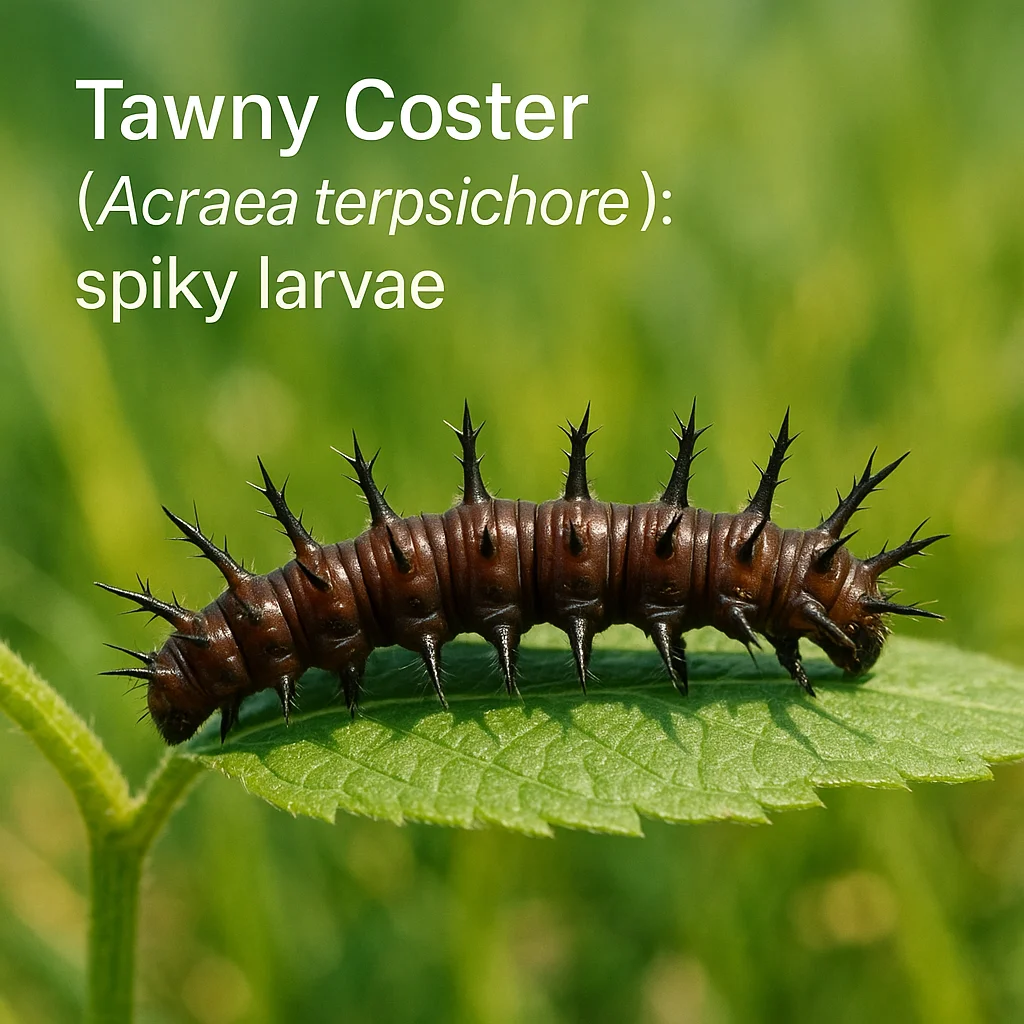
🕷️ Tawny Coster (Acraea terpsichore): spiky larvae
🧾 Quick Facts
The Tawny Coster, scientifically known as Acraea terpsichore, is a fascinating butterfly species notable for its spiky larvae. This butterfly is a captivating subject for nature enthusiasts, especially for its unique appearance and intriguing life cycle.
- Common names: Tawny Coster
- Scientific name: Acraea terpsichore
- Insect or not: Yes, it is an insect (an invertebrate)
- Order / family: Lepidoptera / Nymphalidae
- Typical size range (adult): Wingspan of 53-64 mm
- Key colors/patterns: Tawny orange with black spots and margins
- Activity: Diurnal (active during the day)
- Typical habitats: Grasslands, gardens, edges of forests
- Where in the world it occurs: South Asia to Southeast Asia and Australia
- Seasonality: Most visible during the warm months
🔍 Identification
The Tawny Coster is recognized by its distinctive orange coloration with black spots that adorn its wings. Its wings have a leathery appearance due to the absence of scales. The shape of its wings is elongated and slightly pointed. Its antennae are clubbed, a typical characteristic of butterflies. The legs are long and slender, enabling it to grip onto leaves and flowers.
This butterfly can be confused with other Acraea species, but its unique combination of color patterns helps distinguish it. The Tawny Coster's silhouette, with its wings spread, resembles a gliding style which aids in easy identification.
- Top ID Tips:
- Look for tawny orange color
- Check for black spots and margins
- Observe leathery wing texture
- Note the clubbed antennae
- Check elongated wing shape
- Observe sun-basking behavior
- Spot it in grasslands and gardens
- Compare with other Acraea species
- Look for its distinctive flight pattern
🧠 Basic Body Structure
Like all insects, the Tawny Coster has three primary body segments: the head, thorax, and abdomen. It possesses six legs and is supported by an exoskeleton that offers protection and structure. This exoskeleton molts multiple times as the butterfly transitions from larva to adult. As an invertebrate, the Tawny Coster lacks a spinal column.
It undergoes complete metamorphosis, featuring wings in its adult form. These wings facilitate flight which is crucial for feeding, mating, and evasion of predators.
🌍 Habitat & Distribution
The Tawny Coster typically inhabits open areas like grasslands and gardens. These environments provide ample sun exposure for thermoregulation and an abundance of host plants for the larvae. Urban gardens also serve as vital habitats, showing the butterfly's adaptability.
Its geographic range extends from South Asia through Southeast Asia to parts of Australia. The climates in these regions can vary from tropical to subtropical, providing ideal conditions for the Tawny Coster to thrive. Human activities that alter these habitats, such as urban development, can affect sightings significantly.
📅 Seasonal Appearance & Activity
The Tawny Coster is most visible during warmer months, usually from spring to late summer when adults emerge in significant numbers. As a diurnal species, it is active throughout the daylight hours, especially during sunny weather when it is seen basking with its wings spread wide.
- Best Time to Spot It:
- Spring months
- Early summer
- Late summer warmth
- Midday when the sun is high
- After rainfall in tropical regions
🥚 Reproduction & Egg-Laying
The Tawny Coster exhibits courting behavior where males often present themselves to females through visual displays. Territories aren’t typical, but males may chase rivals away from prospective mates. Females lay eggs singly on the underside of host plant leaves such as Passifloraceae species.
The exact number of eggs laid can vary greatly, influenced by factors such as environmental conditions and plant availability, reflecting a common trait among butterfly species where reproduction strategies are adaptable to conditions.
🌀 Metamorphosis & Life Cycle
The Tawny Coster undergoes complete metamorphosis which encompasses four distinct stages: egg, larva, pupa, and adult. The larvae are noted for their spiky appearance and feed voraciously on host plants.
The egg stage lasts about one to two weeks before hatching into larvae. The larval stage, lasting a few weeks to over a month, involves intense feeding and growth. Pupation occurs in a chrysalis which lasts two weeks to a month, eventually emerging as a striking adult butterfly prepared for reproduction and continuing the cycle.
🍽️ Diet & Feeding Behavior
The Tawny Coster has varying diets across its life stages. The larvae are primarily herbivorous, feeding on host plants such as species within the Passifloraceae family. As adults, Tawny Costers feed on nectar, using their proboscis, which allows them to benefit as pollinators within their ecosystems.
This diet contributes significantly to their role as herbivores and pollinators, forming part of a broader food web where they act as both consumer and resource for other species.
🦉 Predators & Defense
The Tawny Coster faces predation from birds, lizards, and spiders. Their primary defense strategies include aposematic coloring, warning potential predators of unpalatability. The larvae feature physical defenses such as spikes that deter some predators.
- Defense Highlights:
- Aposematic coloration
- Spikes on larvae
- Flight to escape threats
- Feign death when threatened
- Camouflage when wings are closed
👥 Social Behavior & Swarms
The Tawny Coster is primarily solitary except during mating and when feeding at rich nectar sources. Swarming behavior isn’t typical, but during population booms, it might appear that way due to high local densities.
Mating encounters occur when males actively seek out females for copulation, but otherwise, these butterflies are not considered social insects.
🧭 Senses & Communication
The Tawny Coster possesses a range of senses that help it survive. Vision is prevalent, allowing detection of colors and movement, while chemoreception enables the detection of pheromones for mating. Sound and vibration play minor roles due to their typical behavioral needs, with visual and smell being more prominent.
Pheromone signaling is key in communication, especially during mating seasons, enabling them to locate and identify mates efficiently.
🌱 Role in the Ecosystem
The Tawny Coster contributes to its ecosystem predominantly as a pollinator, aiding in plant reproduction. It also serves as prey for a range of predators, thus maintaining ecological balance. Its larval host plants are vital for its development and, in return, the butterfly assists in the proliferation of these plants via pollination.
Relationships with plants, particularly within Passifloraceae, highlight mutualistic interactions, where the plant provides resources, and the butterfly aides in its lifecycle.
📉 Population & Conservation Notes
The Tawny Coster is generally considered common in its suitable habitats, although local abundance can vary. Urbanization and habitat loss present threats, alongside potential impacts from pesticides and climate changes.
- How to Help (Low-Impact):
- Plant native nectar flora
- Avoid pesticide use
- Establish butterfly gardens
- Conserve natural grasslands
- Promote awareness on butterfly roles
⚠️ Human Interaction & Safety
The Tawny Coster is not known to bite or sting humans, making it safe for observation and enjoyment in natural settings. Best practice involves observing these butterflies respectfully, avoiding interference with their natural behaviors or habitats. Handling isn't recommended, as it could harm the butterflies and their delicate wings.
If butterfly larvae cause irritation to skin due to spines, wash gently with water and avoid further contact. Seek professional advice if significant reactions occur.
📌 Summary
- Recognizable by tawny orange wings with black patterns
- Found in grasslands, gardens, and forest fringes
- Most active during warm, sunny months
- Undergoes complete metamorphosis (egg, larva, pupa, adult)
- Feeds on Passifloraceae plants and adult nectar
- Predators include birds and spiders; defense through coloration
- Crucial role as a pollinator
- Adverse human impacts mitigated by conservation efforts