🕷️ Viceroy Butterfly Limenitis Archippus Mimicry And Lookalikes
🧾 Quick Facts
The Viceroy butterfly, scientifically known as Limenitis archippus, is renowned for its striking resemblance to the Monarch butterfly. This mimicry is a fascinating example of how species evolve strategies for survival. While the Viceroy is primarily native to North America, its range and adaptability demonstrate its ecological versatility.
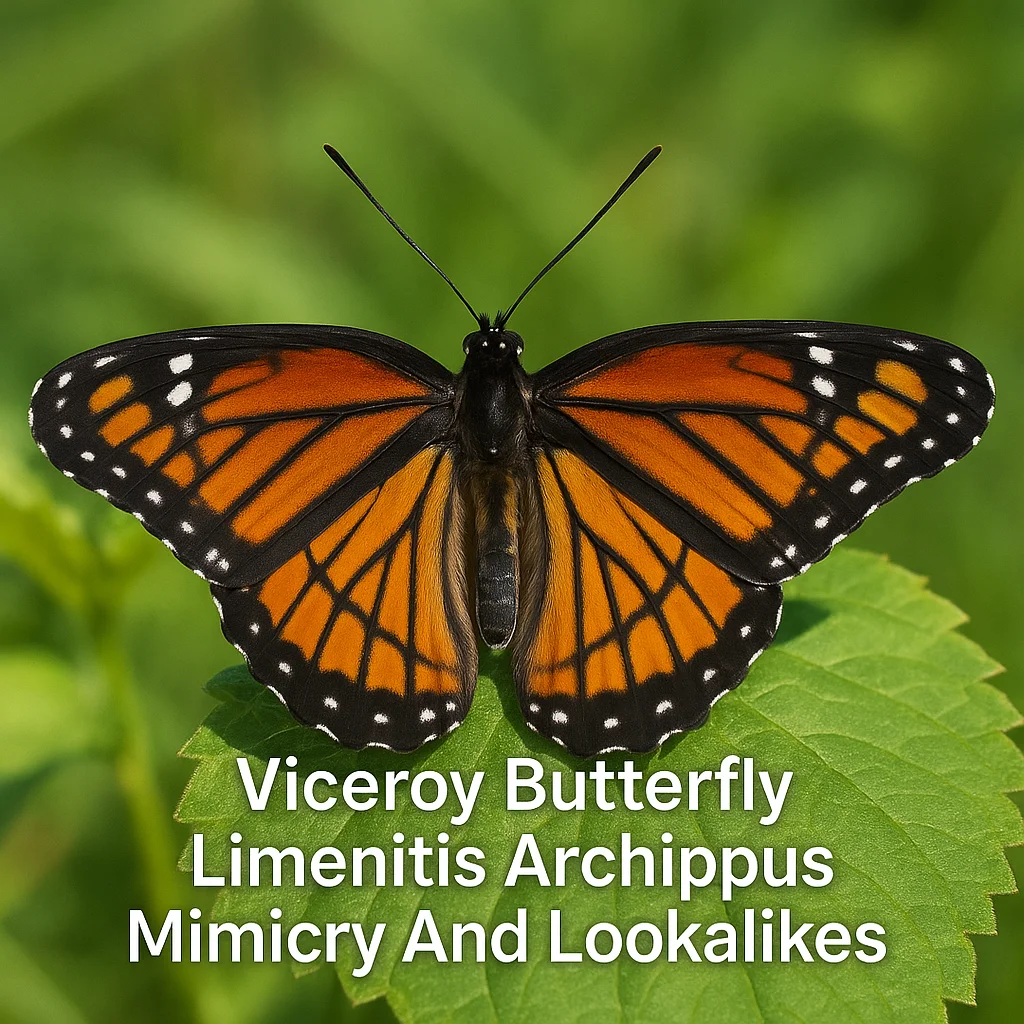
- Common names: Viceroy butterfly
- Scientific name: Limenitis archippus
- Insect or not: Yes, an invertebrate and a true insect
- Order / family: Lepidoptera / Nymphalidae
- Typical size range: 53-81 mm wingspan
- Key colors/patterns: Orange with black lines and a distinct horizontal black line on the hindwings
- Activity: Diurnal (active during the day)
- Typical habitats: Wetlands, meadows, and open areas near water
- Where in the world it occurs: Predominantly North America
- Seasonality: Primarily visible from spring to fall, depending on the region
🔍 Identification
Recognizing the Viceroy in the field involves understanding its mimicry with the Monarch. The Viceroy's body is slightly smaller and more compact than that of the Monarch. Its silhouette is defined by broad wings and a narrow abdomen. This butterfly boasts antennae typical of the Nymphalidae family, generally clubbed at their tips.
The Viceroy's wings are adorned with an orange background and black lines, with the distinguishing horizontal black band on the hindwings that sets it apart from the Monarch. Its legs are delicate and aid in its graceful, fluttering flight. While often confused with the Monarch, the Viceroy can be distinguished by its smaller size and the distinctive black line crossing the hindwings.
- Look for the horizontal black line on the hindwings.
- Size is generally smaller than the Monarch.
- Notice the slightly more curved wing shape.
- Broad wings and narrow abdomen.
- Clubbed antennae typical of butterflies.
- Bright orange and black coloration but less vibrant than the Monarch.
- Graceful, fluttering flight pattern.
- Prefers habitats near water and moist environments.
- Often seen feeding on flowers and near puddles.
🧠 Basic Body Structure
The Viceroy butterfly, like all insects, consists of three main body parts: the head, thorax, and abdomen. It has six legs attached to the thorax, which is typical for insects. Covered in an exoskeleton, the Viceroy undergoes molting to grow.
Its wings, covered in tiny scales, are vital for its flight capabilities and display the characteristic colors. As an invertebrate, it lacks a backbone, supported instead by its tough exoskeleton which offers protection and structural support.
🌍 Habitat & Distribution
Viceroy butterflies thrive in a variety of habitats including wetlands, meadows, and open woodland areas, often preferring locations near water sources. They can be found in the leaf litter and understory vegetation of these ecosystems.
Geographically, the Viceroy is heavily concentrated in North America, extending from southern Canada through the United States and into northern Mexico. This distribution means the butterfly experiences a range of climates from temperate to subtropical, impacting their local population distributions.
📅 Seasonal Appearance & Activity
The Viceroy butterfly is most likely to be observed from spring to fall, with exact months varying by location within its broad range. Generally, it is active during the day (diurnal) and more likely to be seen during warm, sunny conditions.
Weather conditions such as temperature, rain, and humidity levels can significantly influence its daily activities, often seeking shelter during adverse weather.
- Best seen in late spring through early fall.
- Peak activity during warm, sunny days.
- More prevalent in morning to afternoon timeframes.
- Increased likelihood after rain when puddles form for feeding.
🥚 Reproduction & Egg-Laying
Mating behaviors of the Viceroy butterfly involve aerial displays and pheromone communication whereby females evaluate mates based on vigor and territory. Once copulation occurs, females lay eggs singly on the leaves of host plants like willows and poplars.
The egg count per female can be quite variable but typically involves hundreds of eggs over the reproductive season. The eggs hatch after a few weeks, which is dependent on specific temperature and environmental conditions.
🌀 Metamorphosis & Life Cycle
The Viceroy butterfly undergoes complete metamorphosis, transitioning through the stages of egg, larva (caterpillar), pupa (chrysalis), and adult butterfly. This life cycle takes approximately 4 to 6 weeks, though this can vary with environmental conditions.
The larvae feed on the leaves of host plants, spending weeks growing and moulting. They eventually form a chrysalis, where substantial transformation occurs, lasting about two weeks. Upon emergence, the adult butterfly focuses on feeding, mating, and reproduction.
🍽️ Diet & Feeding Behavior
As caterpillars, Viceroy larvae consume the leaves of specific host plants, primarily willows and poplars. Their mandibles adapt for chewing and breaking down leaf matter.
Adult Viceroys feed on nectar from flowers through their proboscis, a specialized sucking mouthpart. They contribute to pollination while subsisting on a variety of flowering plants. They may also obtain fluids and nutrients from moist ground surfaces and animal droppings.
🦉 Predators & Defense
Predators of the Viceroy butterfly include birds, amphibians, reptiles, and spiders. However, its primary defense strategy is mimicry. By resembling the Monarch butterfly, which is toxic to predators, the Viceroy often evades predation.
In addition to mimicry, they utilize camouflage and swift flight to escape threats. The bright, conspicuous colors can serve as a deterrent to potential predators unfamiliar with their mimicry or toxicity.
- Mimics toxic Monarch butterfly.
- Swift, erratic flight patterns to evade capture.
- Camouflage utilizes habitat surroundings.
- Warns predators with bright coloration.
👥 Social Behavior & Swarms
Viceroy butterflies are generally solitary insects, although they may often be found in proximity to one another in favorable habitats due to shared resources. They do not form colonies or swarms under normal circumstances.
Interactions between individuals usually occur during the mating season, where males can be seen engaging in territorial battles for access to mates. Despite their occasional gatherings, they do not exhibit complex social structures.
🧭 Senses & Communication
Viceroy butterflies rely heavily on their visual and olfactory senses for communication and environmental awareness. Their compound eyes are adept at detecting movement and color, which is crucial for identifying partners and predators.
Chemical communication through pheromones is fundamental for mate attraction. These chemical signals are essential during mating rituals. They lack specific auditory communication but may detect vibrations as tactile signals using their body and legs.
🌱 Role in the Ecosystem
The Viceroy butterfly plays a significant role in the ecosystem as both a pollinator and as part of the food web. By visiting flowers for nectar, they facilitate cross-pollination for various plant species.
Additionally, as prey, they contribute to the diet of many vertebrates and invertebrates, thus supporting biodiversity. Their presence often indicates a healthy, balanced ecosystem, particularly in wetlands and riparian zones.
📉 Population & Conservation Notes
In general, the Viceroy butterfly is often reported as common in suitable habitats. However, local abundance can vary significantly with ecological changes. Issues like habitat destruction, pesticide use, and climate change pose potential threats to their populations.
- Grow native plants to provide habitat and food sources.
- Avoid using pesticides that reduce host plants and nectar sources.
- Promote wetland conservation to preserve essential environments.
- Participate in citizen science projects to monitor butterfly populations.
⚠️ Human Interaction & Safety
The Viceroy butterfly poses no risk to humans, as it does not bite or sting. Should accidental contact occur, simply washing the area is sufficient. Respectful observation is encouraged—avoid handling or collecting them, which can disrupt their life cycle.
Fostering a butterfly-friendly habitat can enrich gardens with the beauty and ecological benefits these butterflies provide, emphasizing observation over interference.
📌 Summary
- Viceroy butterflies mimic Monarchs for defense.
- They are primarily found in North American wetlands and meadows.
- Visible from spring to fall during warm, sunny days.
- Undergo complete metamorphosis with a notable mimicry strategy.
- Feed on nectar as adults, contributing to pollination.
- Utilize mimicry and flight for defense.
- Solitary, with interaction primarily for mating.
- Visual and pheromonal communication rather than auditory.
- Key ecological roles as pollinators and prey species.
- Conservation status generally secure with local variations.