🕷️ Leaf-roller moths: plant damage signs
🧾 Quick Facts
Leaf-roller moths belong to a diverse group of insects known for their characteristic behavior of rolling leaves. This action not only serves as a protective shelter but also can cause visible damage to plants. They are part of the Tortricidae family, which includes a wide range of species varying in size, appearance, and habits across different regions of the world.
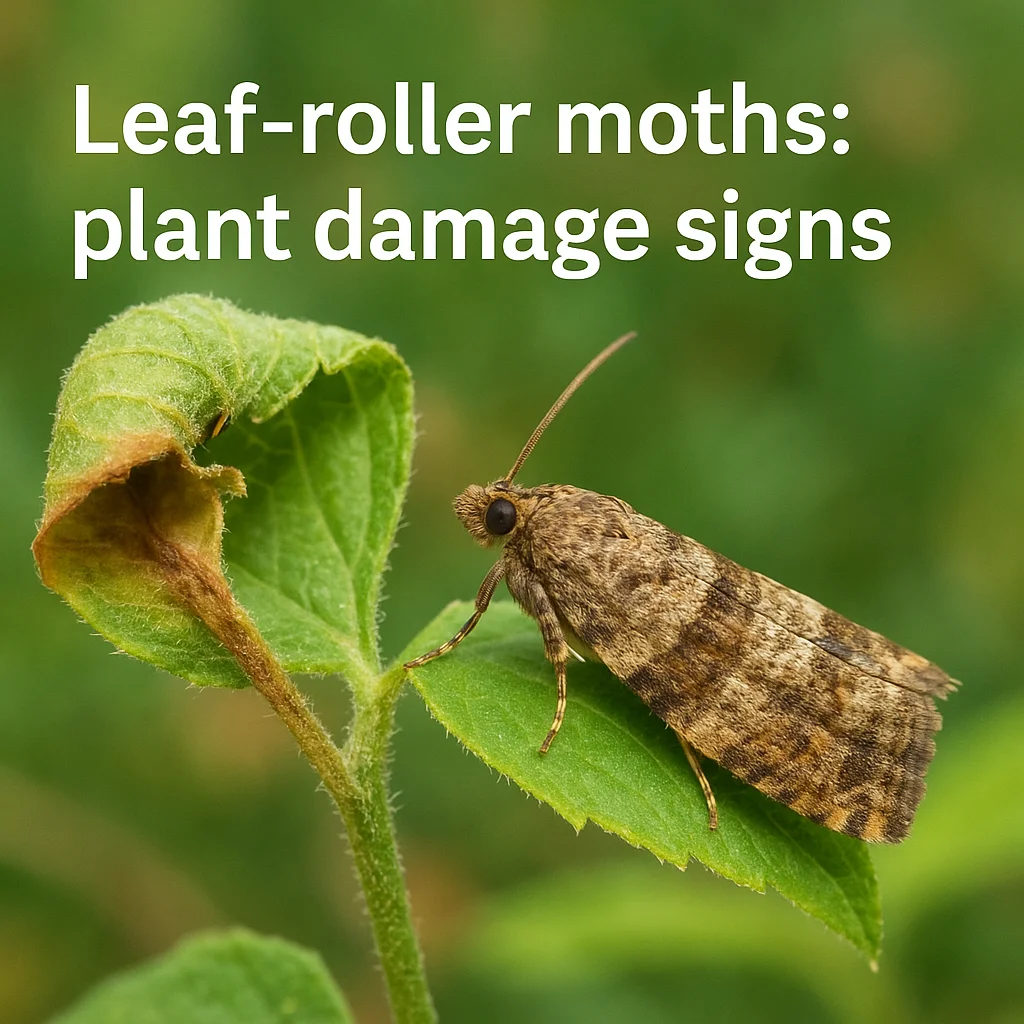
- Common names: Leaf-roller moths, tortricid moths
- Scientific name: Varies by species
- Insect: Yes, these are invertebrates
- Order / Family: Lepidoptera / Tortricidae
- Typical size range: 1 to 2 cm (wingspan in adults)
- Key colors/patterns: Typically brown, grey, green with cryptic patterns
- Activity: Mostly nocturnal
- Typical habitats: Forests, orchards, gardens
- Where in the world it occurs: Globally, particularly in temperate and tropical regions
- Seasonality: Most active in late spring to early autumn
🔍 Identification
To recognize leaf-roller moths, observe their small and compact body shape. They typically exhibit slender antennae and tightly folded wings over their abdomen at rest. The wings often feature subtle patterns that camouflage them against bark and foliage. Their movement style tends to be quick and fluttery.
- Body shape and silhouette: Compact with a tent-like resting posture
- Antennae type: Slender and simple, without notable features
- Wing features: Tightly folded, often camouflage-patterned
- Leg traits and movement style: Quick, fluttery movement
- Distinguishing look-alikes: May be confused with small moths but the leaf-rolling behavior is unique
- Top ID Tips:
- Look for small size
- Check for cryptic wing patterns
- Observe leaf-rolling behavior
- Note presence in gardens or orchards
- Typically found on or near host plants
- Mostly active at night
🧠 Basic Body Structure
As insects, leaf-roller moths possess a head, thorax, and abdomen, with three pairs of legs attached to the thorax. They have an exoskeleton which protects their internal organs and must molt as they grow. Their wings are an essential aspect, allowing for flight and mating displays.
Leaf-roller moths are invertebrates, meaning they do not have a backbone, differing from vertebrates like mammals, birds, and reptiles.
🌍 Habitat & Distribution
Leaf-roller moths are adaptable to various environments, with a preference for areas where host plants are abundant. This includes forests, orchards, agricultural fields, and suburban gardens. They can also be found in microhabitats such as under bark and amidst leaf litter, avoiding predators.
Their geographic range is widespread, with species present on every continent except Antarctica, predominantly in temperate and tropical climates. Changes in habitat, such as urbanization or deforestation, can influence their presence locally.
📅 Seasonal Appearance & Activity
Leaf-roller moths are typically observed from late spring through early autumn. They are most active during the warmer months when vegetation is lush, providing ample resources for shelter and feeding.
- Best Time to Spot It:
- During warm months
- At night, using a light source to attract them
- During evenings in gardens or near lights
- On overcast summer nights
🥚 Reproduction & Egg-Laying
Leaf-roller moths engage in simple mating rituals, often involving pheromone secretion to attract mates. Females lay eggs on suitable host plants. The eggs are generally deposited on the undersides of leaves or in the crevices of bark, depending on the moth species.
The number of eggs laid can vary significantly between species, with some laying a few dozen to several hundred eggs, depending on environmental conditions and resource availability.
🌀 Metamorphosis & Life Cycle
Leaf-roller moths undergo complete metamorphosis, consisting of four distinct stages: egg, larva, pupa, and adult. This life cycle allows them to exploit different ecological niches.
Egg Stage: Eggs hatch into larvae after a few days to weeks.
Larva Stage: The larva, or caterpillar, is the most active stage, feeding on plant material and causing leaf damage. This stage lasts several weeks.
Pupa Stage: The larvae transform into pupae within rolled leaves or other concealed locations, remaining dormant while undergoing transformation.
Adult Stage: Adults emerge to mate and lay eggs, living only a short period dedicated to reproduction.
🍽️ Diet & Feeding Behavior
Caterpillars of leaf-roller moths feed on a variety of plant materials, primarily leaves and young shoots. They use chewing mouthparts to consume plant tissues, causing visible damage commonly consisting of rolled or folded leaves. As adults, most leaf-roller moths do not feed significantly and instead focus on reproduction.
In their larval stage, they act predominantly as herbivores, sometimes becoming pests in agricultural and horticultural settings due to their feeding habits.
🦉 Predators & Defense
Natural enemies of leaf-roller moths include birds, spiders, parasitoid wasps, and small mammals. They have evolved several defense mechanisms, such as camouflage, which helps them blend in with their surroundings, reducing the likelihood of detection by predators.
Some species have developed startle displays or might release chemicals to deter predators when threatened. Their primary mode of defense remains the ability to remain inconspicuous.
- Defense Highlights:
- Camouflage coloration
- Leaf-rolling for shelter
- Quick flight to evade capture
- Startle response when disturbed
👥 Social Behavior & Swarms
Leaf-roller moths are mostly solitary. They do not exhibit social behavior like bees or ants. Interactions typically occur during mating, and they do not form colonies or social groups. Adults may sometimes be seen in groups around light sources at night, but these are gatherings rather than coordinated swarms.
🧭 Senses & Communication
Leaf-roller moths rely heavily on their senses of smell and touch to interact with their environment. Pheromone communication is critical during mating, with males following scent trails emitted by females. They do not rely heavily on sound or vision, as many species are nocturnal.
Their antennae play a key role in detecting chemical signals, which is vital for finding mates and navigating their environments at night.
🌱 Role in the Ecosystem
Leaf-roller moths play several roles in the ecosystem. As herbivores, they influence plant health and growth, potentially controlling plant populations and fostering diversity. Their feeding activity can help aerate soil and recycle nutrients.
They also serve as a food source for higher trophic levels, including birds and small mammals, thus contributing to the food web. However, they can impact agriculture negatively by damaging crops, although they provide balance by controlling excessive plant growth.
📉 Population & Conservation Notes
The population status of leaf-roller moths varies widely among species, with some being common while others may be declining due to habitat loss, pesticide usage, and climate change. Specific conservation efforts might be needed for at-risk populations, focusing on habitat preservation and careful pesticide management.
- How to Help (Low-Impact):
- Plant native vegetation in gardens
- Avoid pesticide use
- Create habitats like hedgerows
- Support organic farming practices
⚠️ Human Interaction & Safety
Leaf-roller moths do not pose a direct threat to humans, as they do not bite or sting. While they can be agricultural pests, their role in natural gardens is mostly balanced by feeding on excess vegetation. It is important to respect these insects and observe them without disturbing their natural behaviors. If gardening or farming is heavily impacted by leaf-roller moth larvae, integrated pest management practices are recommended, favoring natural solutions over chemical treatments.
📌 Summary
- Leaf-roller moths are identifiable by their compact bodies and camouflage patterns
- They are most active during warm months at night
- Undergo complete metamorphosis: egg, larva, pupa, adult
- Primarily herbivorous, feeding on leaves
- Defend themselves through camouflage and quick flight
- Play a role in ecosystems as herbivores and prey
- Population analysis varies; some species face threats
- Interaction with humans is predominantly benign