🕷️ Tussock moths: hairy larvae safety tips
🧾 Quick Facts
Tussock moths are fascinating creatures known for their hairy larvae which can cause irritation upon contact. This is a broad group of moths with variations across different regions of the globe.
- Common Names: Tussock moth, Gypsy moth (specific species), Lymantriini moth
- Scientific Name: Varies by species
- Insect or Not: Insect; they are invertebrates with three main body parts and typically six legs
- Order/Family: Lepidoptera/Erebidae
- Typical Size Range: Adults range from 2 to 4 cm in wingspan
- Key Colors/Patterns: Usually white, grey, brown; some with distinctive tufts on larvae
- Activity: Nocturnal; most active at night
- Typical Habitats: Forests, gardens, orchards
- Where in the World: Widely distributed across Europe, Asia, North America, and parts of Africa
- Seasonality: Adults typically visible during summer and early autumn
🔍 Identification
Identifying tussock moths involves noting their distinct larval characteristics as well as the adult moth's appearance.
Adult moths of this family often have a simple body shape with robust thoraxes and relatively broad wings. Their antennae tend to be feathered in males, aiding in detecting pheromones.
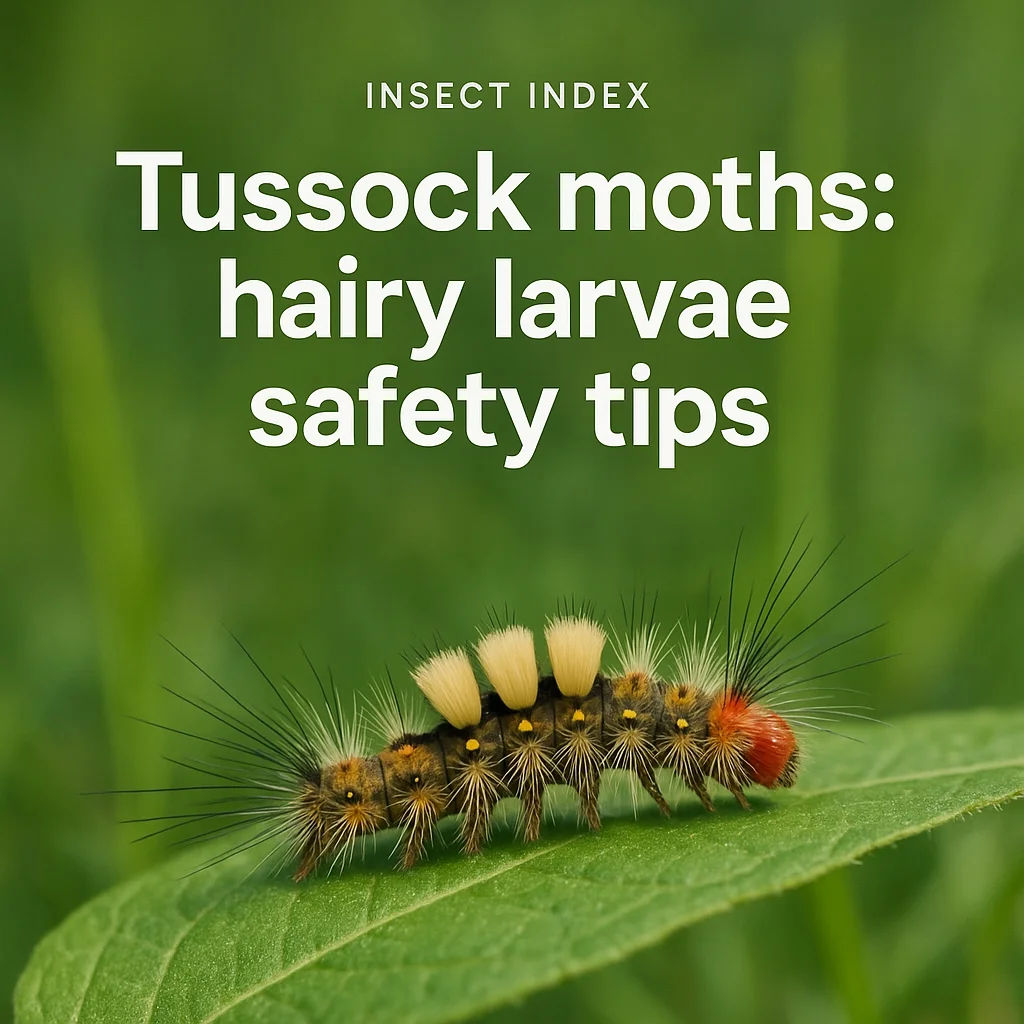
Wings are often muted in color with subtle patterns. In contrast, their larvae are quite distinct with dense tufts of hair that are sometimes brightly colored. The movement of caterpillars is slow and deliberate, often spanning the foliage they consume.
Look-alikes include other hairy caterpillars, but their unique tuft formations help in distinguishing them.
- Top ID Tips:
- Look for hairy larvae with distinct tufts
- Adults have muted wing patterns and feathered antennae in males
- Found on host plants in forests or gardens
- Larvae sometimes display bright warning colors
- Generally small to medium-sized moths
- Look for irritated skin as a possible sign of contact
🧠 Basic Body Structure
Tussock moths, like all insects, possess three main body segments: the head, thorax, and abdomen. They are characterized by having an exoskeleton, which provides protection and support.
This group undergoes molting, especially during their larval stages, to allow for growth. Adult moths have two pairs of wings, which they use to fly short distances.
Tussock moths are invertebrates, meaning they do not have a spine or internal skeleton.
🌍 Habitat & Distribution
Tussock moths can be found in various environments, ranging from dense forests to urban gardens. In forests, they often inhabit areas with abundant foliage, which serves as a food source for their larvae.
Microhabitats like under leaves and in bark crevices are also used by the larvae. Their distribution spans across Europe, Asia, North America, and parts of Africa, occupying regions with temperate climates.
Changes in habitat, such as deforestation and urban expansion, may affect their distribution and sighting frequency.
📅 Seasonal Appearance & Activity
These insects are primarily seen during the warmer months, especially in late spring to early autumn.
Being nocturnal, tussock moths are mostly active during the night. Their activity can be influenced by weather conditions such as temperature and humidity. They tend to be less active during heavy rains.
- Best Time to Spot It:
- Late spring to early autumn
- Nights with mild temperatures
- In forests or garden areas rich in plant life
- Avoiding rainy conditions for better chances
🥚 Reproduction & Egg-Laying
Mating behaviors in tussock moths include male attraction to females through pheromones. Courtship is usually brief and driven by pheromone cues.
Females lay eggs on host plants, and these are often in clusters. The number of eggs laid can vary significantly, often depending on the specific moth species and environmental conditions.
🌀 Metamorphosis & Life Cycle
Tussock moths undergo complete metamorphosis, comprising the stages of egg, larva (caterpillar), pupa (cocoon), and adult moth.
Eggs hatch into larvae that feed voraciously on plant leaves. The larval stage is where most growth occurs, and it is marked by several molts.
The pupal stage is spent in a cocoon, which the larva spins using silk. This is a transformation period leading to the emergence of the winged adult moth that, unfortunately, lives only to reproduce before dying.
🍽️ Diet & Feeding Behavior
Throughout its larval stage, the tussock moth feeds primarily on leaves of various host plants. It serves as a herbivore within its ecosystem.
The larvae use chewing mouthparts to consume foliage, often causing noticeable damage to plants.
Adults, on the other hand, generally do not feed or feed minimally given their short lifespan post-emergence from the cocoon.
🦉 Predators & Defense
Tussock moths face various predators, including birds, reptiles, amphibians, and spiders. Their larvae are especially targeted due to their plant-eating habits.
Defense strategies of tussock moths include the irritating hairs found on larvae, which can deter predators. Some larvae also exhibit warning coloration as a signal of their unpalatability.
- Defense Highlights:
- Irritating hairs on larvae
- Bright warning coloration in some species
- Camouflage among foliage
- Rapid movement away from predators
👥 Social Behavior & Swarms
Tussock moths are generally solitary creatures, especially during their larval stage, as they tend to fend for themselves as they feed and molt.
The adult moths, however, may encounter each other during mating seasons, but they do not form swarms or colonies like some other insect species.
🧭 Senses & Communication
The senses of tussock moths are well-adapted to their environmental interactions. They exhibit keen senses of smell, primarily through the use of antennae, which are particularly developed in males for detecting female pheromones.
The larvae and moths use tactile feedback to navigate their environments, especially when moving from leaf to leaf during feeding.
Pheromone communication is prevalent, especially during reproduction, helping males locate females over distances.
🌱 Role in the Ecosystem
Tussock moths play crucial roles in the ecosystems they inhabit. As herbivores, they aid in controlling plant growth, inadvertently facilitating the recycling of nutrients through their defoliating activities.
They also form crucial links in the food web, serving as prey for various animals ranging from birds to small mammals.
Their populations, however, if unchecked, can lead to significant defoliation, impacting agricultural yields. Thus, they are sometimes seen as pests, necessitating careful management to balance ecosystem benefits and economic impacts.
📉 Population & Conservation Notes
These moths are often reported as common in suitable habitats, although their numbers can fluctuate based on environmental factors. While not typically endangered, factors such as pesticide use, habitat destruction, and climate change pose threats to their populations.
- How to Help (Low-Impact):
- Plant native trees and shrubs to provide habitat
- Reduce pesticide usage
- Leave areas of leaf litter for larvae habitat
- Participate in citizen science insect tracking
⚠️ Human Interaction & Safety
Contact with tussock moth larvae should be minimized due to the possibility of skin irritation from their hairs. Though most encounters are harmless, some individuals may experience allergic reactions.
In the event of contact, washing the area with soap and water is advisable, and avoiding scratching can prevent further irritation. Seek professional advice if severe reactions occur.
As with all wildlife, observation should be respectful, avoiding handling or collecting wild specimens to conserve their natural populations.
📌 Summary
- Tussock moths are nocturnal, with hairy larvae known for causing irritation
- They prefer habitats with abundant plant life, especially forests and gardens
- Most visible from late spring to early autumn
- Undergoes complete metamorphosis: egg, larva, pupa, adult
- Feed mainly as larvae on plant foliage, serving as herbivores
- Natural enemies include birds and spiders; larvae have defensive hairs
- Important roles in ecosystems as both herbivores and prey
- Encourage native planting and reduced pesticide use for conservation
- Handling larvae can cause irritation; respect wildlife from a distance