🕷️ Whites And Cabbage Butterflies Common Backyard Species
🧾 Quick Facts
Whites and Cabbage butterflies are a group of commonly observed butterflies, frequently seen fluttering around gardens, fields, and meadows. Known for their delicate wings adorned with simple patterns, these butterflies are often found in temperate regions across the globe.
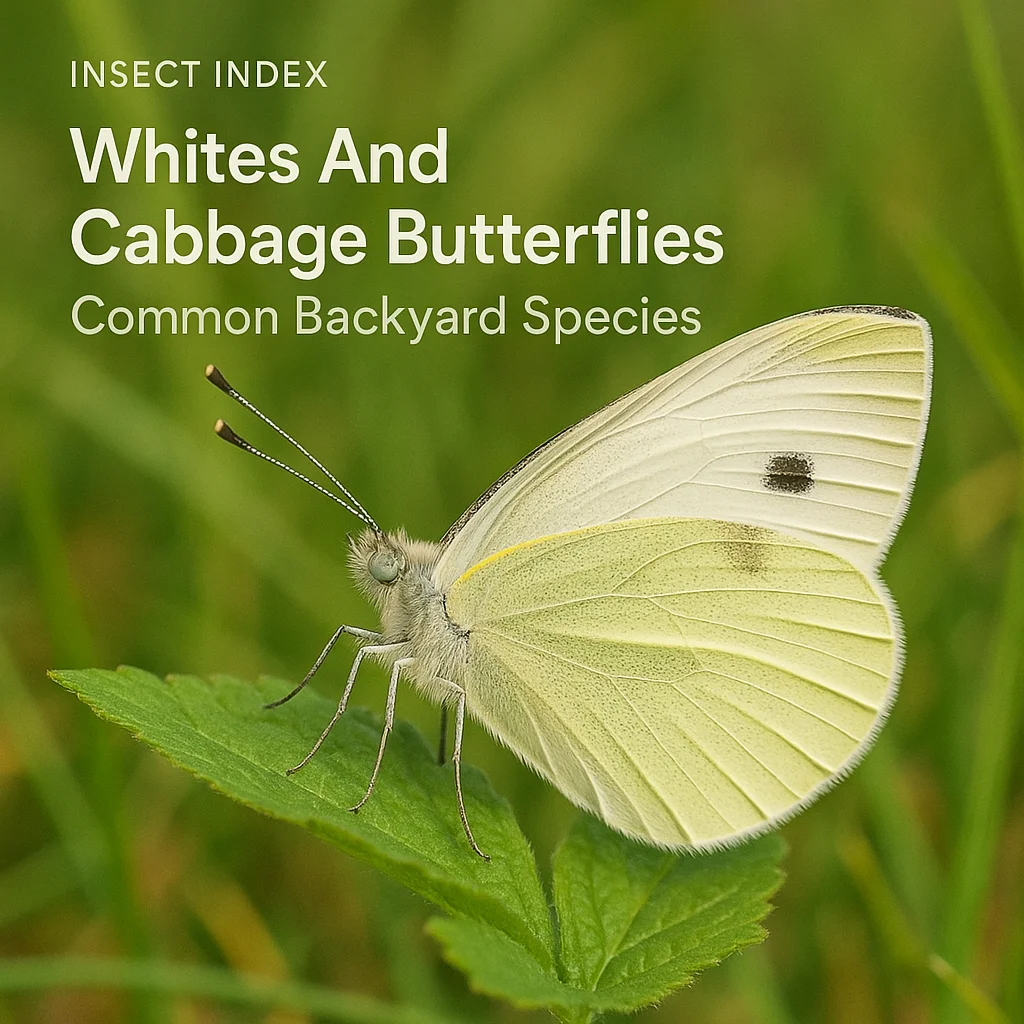
- Common names: Whites, Cabbage butterflies, Small White, Large White
- Scientific name: Varies (e.g., Pieris rapae for the Small White)
- Insect: Yes, they are invertebrates
- Order / family: Lepidoptera / Pieridae
- Typical size range (adult): 4-6 cm wingspan
- Key colors/patterns: White or pale yellow wings with black spots
- Activity: Diurnal, active during the day
- Typical habitats: Gardens, fields, meadows, and urban parks
- Where in the world it occurs: Primarily in temperate regions worldwide
- Seasonality: Most visible during spring and summer
🔍 Identification
Identifying Whites and Cabbage butterflies involves observing key physical traits and behaviors. They possess a slender body and broad wings that are usually white or pale yellow with black markings. The antennae are club-shaped, aiding in balance and navigation. Their flight is characterized by a fluttering movement, making them easily distinguishable from other butterfly species.
- Body shape and silhouette: Slender with broad, rounded wings
- Antennae type: Club-shaped
- Wing features: White or pale yellow with distinct black spots
- Leg traits and movement style: Six legs, used for perching on plants
- Distinguishing look-alikes: Differentiated from moths by diurnal activity and clubbed antennae
- Top ID Tips:
- Look for white or yellow wings with black spots
- Check for club-shaped antennae
- Observe diurnal activity
- Note the fluttering flight pattern
- Commonly seen in gardens and meadows
- Smaller size compared to many other butterfly species
🧠 Basic Body Structure
As insects, Whites and Cabbage butterflies consist of three main body parts: the head, thorax, and abdomen. They have six legs, which is a characteristic feature of insects, and are equipped with an exoskeleton that provides support and protection. They undergo molting as they grow. Their wings are essential for flight, and these butterflies are invertebrates, meaning they lack a backbone.
🌍 Habitat & Distribution
These butterflies thrive in open, sunny environments such as gardens, fields, and meadows. They can also be found in urban parks, where they utilize various flowering plants for nectar. Whites and Cabbage butterflies occur widely across temperate regions, including North America, Europe, Asia, and parts of Africa. Habitat changes, like urbanization, can impact their sightings, but they are adaptable to garden settings.
📅 Seasonal Appearance & Activity
Most people are likely to spot Whites and Cabbage butterflies during the warmer months, primarily in spring and summer. Their activity is heavily influenced by weather, preferring sunny days with mild temperatures. During inclement weather, they tend to hide among foliage to protect themselves from adverse conditions.
- Best Time to Spot It:
- During mid-morning to late afternoon
- On sunny days
- In garden areas with flowering plants
- Throughout spring and summer months
🥚 Reproduction & Egg-Laying
Whites and Cabbage butterflies engage in courtship that involves aerial displays by males to attract females. Female butterflies lay their eggs on the leaves of host plants, such as members of the Brassicaceae family, including cabbage and broccoli. The number of eggs laid can vary based on environmental conditions, with females targeting plants that provide ample food for their future larvae.
🌀 Metamorphosis & Life Cycle
These butterflies undergo complete metamorphosis comprising four stages: egg, larva (caterpillar), pupa (chrysalis), and adult. After hatching, caterpillars feed on host plants, growing and molting several times over a few weeks. They then form a protective chrysalis to undergo transformation into an adult butterfly, which emerges after approximately 10-14 days, ready to begin the cycle anew.
🍽️ Diet & Feeding Behavior
In their larval form, Whites and Cabbage butterflies are herbivores, feeding on the leaves of host plants like cabbage. As adults, they primarily consume nectar from a variety of flowering plants. Their feeding is facilitated by proboscis, a tube-like structure used for sucking nectar. They play an important role as pollinators in the ecosystems they inhabit.
🦉 Predators & Defense
These butterflies face predation from numerous natural enemies, including birds, reptiles, amphibians, and spiders. To defend against predators, they employ camouflage and mimicry, blending into their environment. Their coloration can startle predators momentarily, providing a quick escape.
- Defense Highlights:
- Camouflage by blending with surroundings
- Mimicry to confuse predators
- Startle patterns to distract attackers
- Quick, erratic flight for rapid escape
👥 Social Behavior & Swarms
Whites and Cabbage butterflies are generally solitary creatures except during mating and in some instances when feeding. They may congregate in areas with abundant food sources. These butterflies do not form true swarms, but high densities can be observed in favorable conditions, such as in well-planted gardens.
🧭 Senses & Communication
These butterflies rely mainly on their vision for navigating and locating flowers. They use pheromones for communication during mating, with males using visual cues and chemical signals to attract females. Their sense of smell is crucial for locating host plants and for courtship interactions.
🌱 Role in the Ecosystem
The ecological role of Whites and Cabbage butterflies is significant in pollination, as they help transfer pollen between flowers while feeding on nectar. They are also an integral part of the food web, serving as prey for various predators. While they occasionally become agricultural pests, their overall impact on ecosystems is crucial for plant pollination and food-chain dynamics.
📉 Population & Conservation Notes
These butterflies are often reported as common in suitable habitats, especially in temperate regions. However, factors like habitat loss, pesticide use, and climate change may affect their populations locally. Conservation efforts can help maintain butterfly populations by promoting native plants and reducing pesticide use in gardens.
- How to Help (Low-Impact):
- Plant native flowering plants in gardens
- Avoid using harmful pesticides
- Provide a water source for butterflies
- Encourage community gardens and green spaces
⚠️ Human Interaction & Safety
Whites and Cabbage butterflies are harmless to humans and do not bite or sting. Observation and enjoyment from a distance are encouraged, and handling or collecting wild specimens should be avoided to prevent harm to delicate butterfly populations.
📌 Summary
- Recognizable by white or pale yellow wings with black spots
- Inhabit gardens, meadows, and open spaces in temperate regions
- Most active in spring and summer on sunny days
- Undergo complete metamorphosis: egg, caterpillar, chrysalis, adult
- Feed on host plants as caterpillars and nectar as adults
- Preyed upon by birds, reptiles, and spiders; use camouflage
- Important pollinators; part of a larger ecological food web
- Common where suitable habitats exist; conservation involves planting natives
- Harmless to humans, ideal for respectful observation