🕷️ Blue Morpho (Morpho menelaus): iridescence explained
🧾 Quick Facts
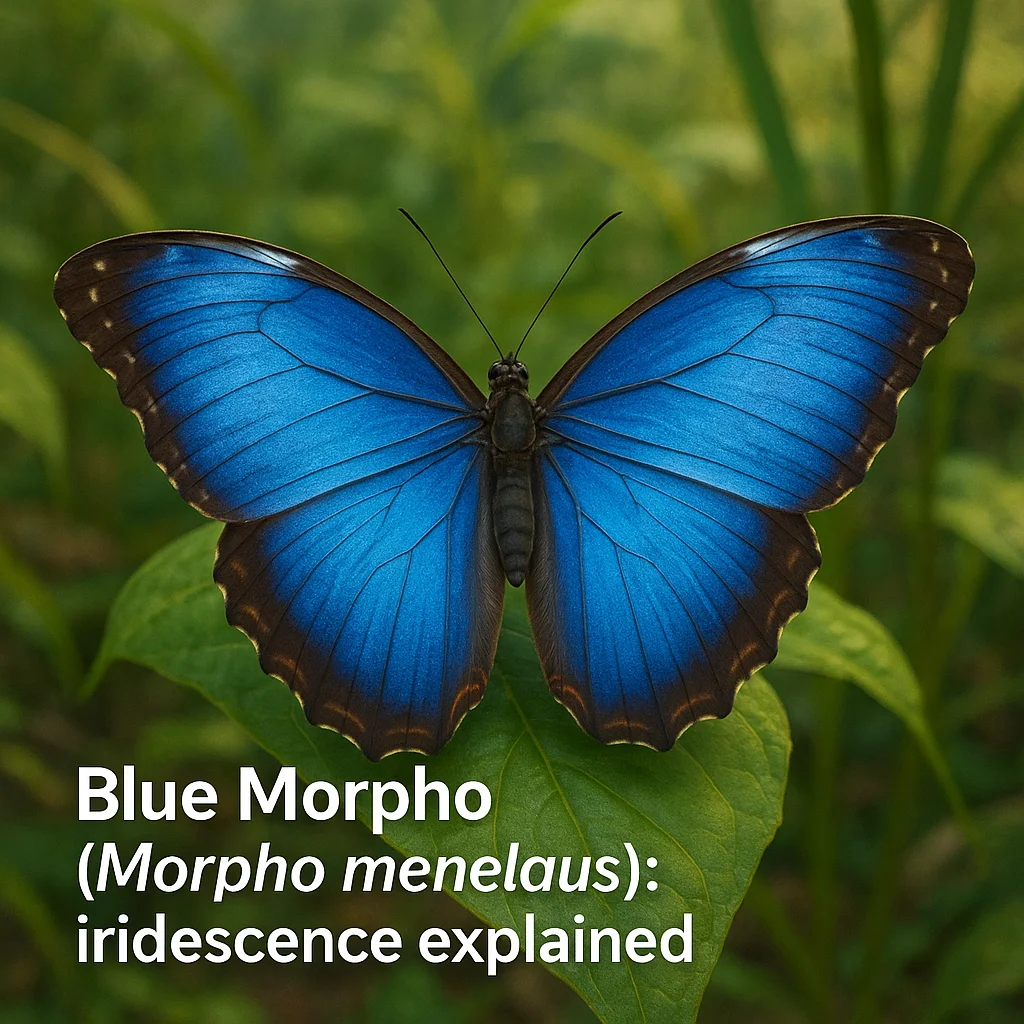
The Blue Morpho, scientifically known as Morpho menelaus, is one of the most spectacular butterflies in the world, renowned for its vibrant blue wings and fascinating optical phenomenon known as iridescence.
- Common names: Blue Morpho
- Scientific name: Morpho menelaus
- Insect or not: Yes, it is an insect and an invertebrate
- Order / family: Lepidoptera / Nymphalidae
- Typical size range: Wingspan of 12–15 cm (4.7–5.9 inches)
- Key colors/patterns: Shimmering bright blue wings with brown undersides marked with eye spots
- Activity: Diurnal (daytime active)
- Typical habitats: Tropical forests, primarily rainforests
- Where in the world it occurs: Central and South America, including Brazil, Costa Rica, and Venezuela
- Seasonality: Visible year-round in tropical regions
🔍 Identification
The Blue Morpho butterfly is easily recognizable by its stunning blue wings. The vibrant blue color is not due to pigments but structural coloration caused by microscopic scales on the wings that reflect light. When viewed from below, the brown patterned undersides make them appear less conspicuous to predators when wings are closed.
The body of the butterfly is relatively small compared to its wide wings. Its antennae are long and clubbed, typical of butterflies. The legs are adapted for gripping and walking along surfaces.
The Blue Morpho's flight is slow and gliding, often seen flitting through dappled forest light, which adds to its almost magical appearance. While their coloring is unique, they can be confused with other Morpho species, although their specific patterns and habitats provide clues for proper identification.
- Bright iridescent blue wings when viewed from above
- Brown undersides with distinctive eye spots
- Bold and large wingspan relative to body size
- Slow, gliding flight pattern
- Long, clubbed antennae
- Commonly found in rainforest habitats
- Lower wings contrast when exposed in flight
🧠 Basic Body Structure
Like all butterflies, the Blue Morpho has a tripartite body plan: the head, thorax, and abdomen. The head houses sensory organs including large compound eyes and long antennae. The thorax connects to the six legs and is the attachment point for the wings, allowing for flight.
The exoskeleton is a hard outer layer that provides protection and structure, crucial for an invertebrate like the butterfly. The Blue Morpho undergoes complete metamorphosis, transitioning through distinct life phases with molting occurring during development.
🌍 Habitat & Distribution
Blue Morphos thrive in tropical rainforests with abundant foliage and high humidity, which are ideal for their life cycle and reproductive needs. Such environments are found across Central and South America, making these regions perfect for spotting Morphos.
They are generally found near water bodies like rivers and streams, which support a rich variety of plant life necessary for their life cycle. Forest margins and edges are also prime spots where sunlight causes their wings to shimmer strikingly.
Changes in forest conditions, such as deforestation, have impacted their distribution, affecting how frequently they can be encountered.
📅 Seasonal Appearance & Activity
The Blue Morpho is most frequently observed during the warmer and wetter months, coinciding with increased plant growth and availability of food resources. Being diurnal, they are active during the day when sunlight enhances their wing coloration and helps them absorb warmth necessary for flight.
So long as regions maintain their tropical climate, these butterflies can generally be seen year-round. Rain may decrease activity levels temporarily, but they are highly adapted to the wet environments they call home.
- Typically seen during sunny days
- Increases in visibility in the wet season
- Warmer months see peak activity
- Active in the dappled sunlight of forest paths
- Can be sighted year-round in consistent climates
🥚 Reproduction & Egg-Laying
The mating behavior of Blue Morphos involves males using their striking blue appearance for display during courtship flights. Once paired, females lay eggs on a host plant known for sustaining caterpillar development.
Eggs are typically laid singly on the undersides of leaves, where emerging larvae have immediate access to food. The exact number of eggs laid can vary, with females depositing many to increase chances of offspring survival amidst high predation rates.
🌀 Metamorphosis & Life Cycle
The Blue Morpho undergoes complete metamorphosis, starting its life as an egg. The eggs hatch into hungry larvae (caterpillars), which feed on the leaves of host plants and grow rapidly through molting.
Once mature, the caterpillar forms a chrysalis and enters the pupal stage. Within, it transforms dramatically, emerging as a fully developed adult butterfly. Each stage varies in duration, influenced by environmental conditions, typically lasting weeks to months.
🍽️ Diet & Feeding Behavior
The dietary habits of the Blue Morpho butterfly vary across life stages. Caterpillars primarily consume leaves of host plants, requiring considerable food for growth. As adults, they shift to feeding on the juices of fermenting fruit, using their proboscis to suck up nutrients.
Although predominantly herbivorous, their role in ecosystems extends to occasional mutualistic relationships with plants they pollinate while feeding.
🦉 Predators & Defense
Blue Morphos face numerous threats from birds, reptiles, amphibians, and even predation from fellow invertebrates like spiders. To defend against these threats, they utilize a range of strategies.
The stunning iridescence provides a form of camouflage, blending them into the dappled forest light. When disturbed, they use rapid wing beats to startle predators with their sudden flash of blue. Their undersides with eye spots resemble larger animals, deterring would-be attackers.
- Camouflage through light refraction
- Startle display by flashing bright wings
- Mimicry through eye spots on wing undersides
- Rapid flight to avoid capture
- Feeding in concealed locations
👥 Social Behavior & Swarms
Blue Morphos are typically solitary butterflies, although they may congregate in areas rich with resources or at breeding times. While migrations are not standardized like in some butterflies, they may move through forests in search of new feeding grounds or optimal laying sites.
Territorial interactions are observed more frequently during mating periods, when males may become particularly active in pursuit of potential mates.
🧭 Senses & Communication
Like many butterflies, the Blue Morpho uses its senses to navigate and communicate in its environment. Vision is its primary sense, enhanced by compound eyes that detect light and motion. The bright wing coloration can serve as a visual signal in mating rituals.
Communicationally, pheromones play a significant role in mating and species recognition. The butterflies may also rely on subtle vibrational cues through substrate interaction and antennae touch for environmental information gathering.
🌱 Role in the Ecosystem
The Blue Morpho butterfly is an ecological participant, contributing to the ecosystems through roles such as pollination. By visiting flowers, they inadvertently aid in plant reproduction. Furthermore, their larvae help to manage vegetation growth through leaf feeding.
As prey for numerous animals, they are integral to the local food web, supporting predator populations and fostering biodiversity. Their presence in rainforests underscores the health and vibrancy of these environments.
📉 Population & Conservation Notes
The population status of Blue Morphos is variable, with some regions reporting them as common where habitat conditions remain favorable. Threats such as deforestation, habitat fragmentation, and climate change pose ongoing concerns for their wellbeing.
Conservation efforts focus on protecting rainforests and restoring natural habitats to ensure their survival. By maintaining these ecosystems, Blue Morphos and countless other species stand a better chance for a stable future.
- Plant native flora to support local ecosystems
- Support rainforest conservation projects
- Minimize pesticide use to protect insect populations
- Encourage sustainable agriculture practices
⚠️ Human Interaction & Safety
Typically, Blue Morphos are harmless to humans and do not bite or sting. Their presence is appreciated for the natural beauty they bring to tropical regions.
When observing these butterflies, it is crucial to respect their habitat and avoid disrupting their natural behavior. Collecting wild specimens is discouraged as part of responsible wildlife observation.
📌 Summary
- Recognizable by their stunning blue wings
- Inhabit tropical rainforests across Central and South America
- Active predominantly during daylight hours
- Experience complete metamorphosis from egg to adult
- Diet shifts from plant leaves in larvae to fruit juice as adults
- Defend with camouflage and startle displays
- Contribute to ecosystems through pollination and as prey
- Conservation efforts are crucial due to habitat threats