🕷️ Common Peacock (Aglais io): eyespots and defense
🧾 Quick Facts
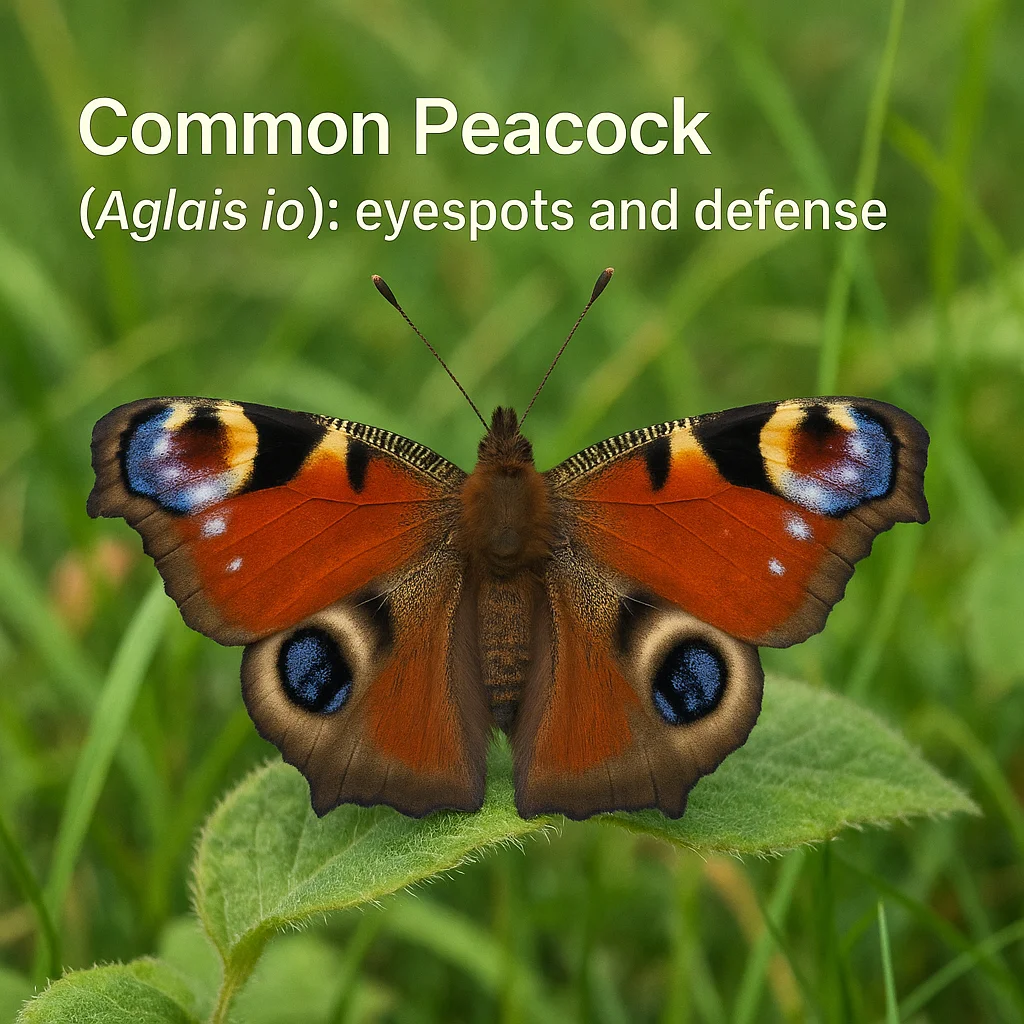
The Common Peacock, scientifically known as Aglais io, is a widely recognized butterfly found across various regions, notable for its vibrant eyespots which serve as a defense mechanism against predators.
- Common Names: Peacock Butterfly
- Scientific Name: Aglais io
- Insect: Yes, invertebrate with six legs
- Order & Family: Lepidoptera, Nymphalidae
- Typical Size Range: 50 to 55 mm wingspan
- Key Colors/Patterns: Vibrant eyespots on red-brown wings
- Activity: Diurnal (active during the day)
- Typical Habitats: Meadows, gardens, woodlands
- Geographic Occurrence: Europe and parts of Asia
- Seasonality: Most visible in spring and summer
🔍 Identification
The Common Peacock can be easily identified by its striking appearance. It has a robust, slightly elongated body, characteristic of butterflies. Its antennae are clubbed at the ends, a trait seen in most butterflies. The wings are broad with slightly wavy edges.
The most distinctive feature is the presence of eye-like patterns or eyespots on each wing. These eyespots can deter predators by mimicking the eyes of larger animals. Leg characteristics are typical to butterflies, facilitating an effortless movement as it flutters from flower to flower.
Common look-alikes include the Red Admiral and the Painted Lady; however, the peacock’s eyespots are unique distinguishing features.
- Top ID Tips:
- Noticeable eyespots on wings
- Red-brown wing with purple-blue tones
- Clubbed antennae
- Broad wings with smooth edges
- Compact body size, about 50-55 mm wingspan
- Active during daylight
- Flight pattern: rapid and fluttering
- Found near flowering plants
🧠 Basic Body Structure
As an insect, the Common Peacock has a tripartite body structure consisting of the head, thorax, and abdomen. This butterfly has six legs attached to the thorax. It possesses an exoskeleton, providing protection and support, which it molts during its life stages to accommodate growth. It also has two pairs of wings, characteristic of butterflies.
This species is an invertebrate, meaning it lacks a vertebral column. Instead, it relies on its exoskeleton for structural integrity.
🌍 Habitat & Distribution
The Common Peacock thrives in a variety of environments, preferring temperate regions that offer a mix of sunlight and shade. Typical habitats include meadows, gardens, and woodlands with ample flowering plants.
Microhabitats such as sheltered corners of gardens, forest glades, and roadside hedges provide ideal resting places. Geographically, the butterfly is found across Europe and parts of Asia, inhabiting temperate climates. Changes in land use and climate can significantly impact its populations, often shifting it towards urban areas where suitable conditions remain.
📅 Seasonal Appearance & Activity
The Common Peacock is most active from spring through late summer when temperatures are warm, and flowers are abundant. As a diurnal creature, it is most visible during sunny days, avoiding rainy or overly humid conditions.
- Best Time to Spot It:
- Spring and summer months
- Sunny and warm days
- Mid-morning to early afternoon
- Flower-rich environments
- Reduced activity on overcast or rainy days
🥚 Reproduction & Egg-Laying
Mating typically occurs in the warmer months, often initiated by males who exhibit territorial behavior to attract females. Once courtship is successful, the female lays eggs on host plants, specifically nettles.
Egg-laying varies with climate and food availability. A female can lay several hundred eggs over her lifetime, ensuring the next generation's survival despite predation threats.
🌀 Metamorphosis & Life Cycle
The Common Peacock undergoes complete metamorphosis, transitioning through a series of developmental stages: egg, larva (caterpillar), pupa (chrysalis), and adult.
Eggs hatch within one to two weeks, revealing caterpillars that feed voraciously on host plants like nettles. This larval stage lasts about four weeks, followed by pupation where transformative changes occur over two to three weeks. The adult butterfly emerges, equipped for reproduction and seeking nectar-rich flowers.
🍽️ Diet & Feeding Behavior
At the adult stage, the Common Peacock primarily feeds on nectar, using its long proboscis to access flowers. As caterpillars, their diet is more specialized, focusing on leaves of nettle plants.
These butterflies serve as pollinators, playing a vital ecological role by transferring pollen between plants. In larval stages, they are herbivores with chewing mouthparts adapted for leaf consumption.
🦉 Predators & Defense
Natural predators of the Common Peacock include birds, small mammals, and predatory insects like wasps and spiders. To deter these threats, the butterfly employs various defenses: camouflage on the undersides of wings, sudden revealing of eyespots to startle predators, and agile flight for escape.
- Defense Highlights:
- Eyespots mimic predator eyes
- Camouflaged wing undersides
- Swift, erratic flight patterns
- Bold coloration warns of unpalatability
👥 Social Behavior & Swarms
The Common Peacock is primarily solitary, with limited interactions outside mating. Rarely forming swarms, they may gather in favorable habitats when resources are plentiful. Mating encounters are brief but essential for species propagation.
🧭 Senses & Communication
This butterfly relies heavily on vision and smell to locate food and mates. Their compound eyes provide a wide field of view, while antennae are sensitive to pheromones emitted by potential mates. Communication is primarily pheromonal; however, visual cues like wing displays play a role in courtship.
🌱 Role in the Ecosystem
Ecologically, the Common Peacock is a vital pollinator, facilitating the reproduction of flowering plants. Its larvae serve as food for various predators, linking it within food webs. Relationships with nettles benefit both the plant and butterfly, showcasing ecological mutualism.
While generally beneficial, large populations can sometimes defoliate host plants significantly, impacting garden aesthetics or wild plant growth.
📉 Population & Conservation Notes
The Common Peacock is often described as common in suitable habitats, yet its populations are sensitive to environmental changes like habitat loss and pesticide use. Conservation efforts focus on maintaining biodiversity, with urban gardens acting as refuges.
- How to Help (Low-Impact):
- Plant native flowering plants
- Avoid using pesticides in gardens
- Leave leaf litter undisturbed
- Create butterfly-friendly areas in urban spaces
⚠️ Human Interaction & Safety
The Common Peacock is harmless to humans, neither capable of biting nor stinging. It is essential to respect wildlife by observing these butterflies without capturing them. Encourage natural behaviors by maintaining a distance and protecting their habitats.
📌 Summary
- Identified by eyespots and red-brown wings
- Found in temperate areas of Europe and Asia
- Visible from spring to late summer
- Complete lifecycle: egg, caterpillar, pupa, butterfly
- Feeds on nectar, pollinates plants
- Predated by birds and insects; uses eyespots for defense
- Essential pollinator within ecosystems
- Population varies due to habitat changes
- Observe respectfully without capture