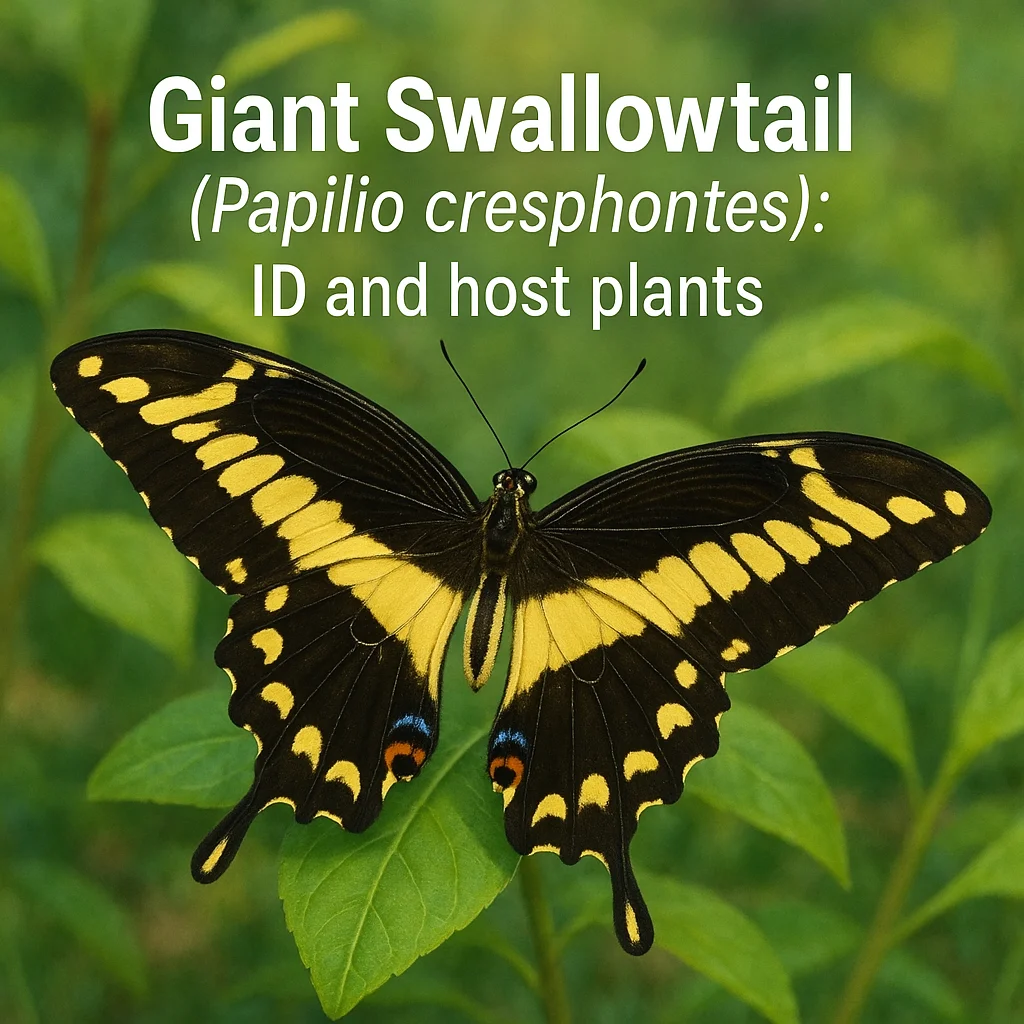
🕷️ Giant Swallowtail (Papilio cresphontes): ID and host plants
🧾 Quick Facts
The Giant Swallowtail (Papilio cresphontes) is a magnificent butterfly that graces gardens and natural landscapes with its grand presence. Known for its large size and striking appearance, it is a favorite among butterfly enthusiasts and nature observers.
- Common names: Giant Swallowtail
- Scientific name: Papilio cresphontes
- Insect status: Yes, it is an invertebrate
- Order / Family: Lepidoptera / Papilionidae
- Typical size range: 10–16 cm (wingspan)
- Key colors/patterns: Black wings with yellow bands
- Activity: Diurnal
- Typical habitats: Gardens, woodlands, groves
- Geographic range: North and Central America
- Seasonality: Spring to late fall
🔍 Identification
The Giant Swallowtail is recognized in the field by its impressive size and unique color patterns. Its wings exhibit a striking contrast between black and yellow, creating a visually arresting appearance.
- Body shape and silhouette: Graceful and elongated with a noticeable tail-like extension on each hind wing
- Antennae type: Clubbed, typical of butterflies
- Wing features: Two bright yellow bands cross the upper and lower wings
- Leg traits and movement style: Thin legs, primarily used for perching and tasting foliage
- Distinguishing look-alikes: Resembles other swallowtails like the Eastern Tiger Swallowtail but can be differentiated by its larger size and different color patterns
- Look for the yellow and black color scheme
- Identify the elongated tails on the hind wings
- Observe the butterfly's grand wingspan
- Check for the characteristic two yellow bands
- Spot its slow, sailing flight pattern
- Use the clubbed antennae as an identifying feature
🧠 Basic Body Structure
Like all insects, the Giant Swallowtail has a body divided into three main parts: the head, thorax, and abdomen. Equipped with six legs, they fall under the class of invertebrates, meaning they lack an internal skeleton and rely on an exoskeleton for defense and structure. This protective exterior is periodically shed in a process called molting.
🌍 Habitat & Distribution
The Giant Swallowtail thrives in varied environments such as woodlands, groves, and urban gardens. It often prefers areas where host plants like citrus trees are abundant. Its range extends across North America and parts of Central America, adapting somewhat to available climates, from temperate to subtropical regions.
Habitat alteration due to urbanization can affect their distribution, though they often adapt to backyard gardens and urban greenery where host plants are cultivated.
📅 Seasonal Appearance & Activity
The Giant Swallowtail is most active during the warmer seasons from spring through late fall. Being a diurnal insect, it is typically visible during daylight hours, particularly in sunny weather. Temperature and humidity levels influence their daily activity.
- Spring to fall, peaking in midsummer
- Best observed during the day
- Preferably seen in dry, warm weather
- Spotting is optimal in sunny gardens and parks
🥚 Reproduction & Egg-Laying
Mating involves a series of complex courtship flights and pheromone signaling. Females lay eggs singularly on the upper surfaces of leaves of host plants, such as citrus trees. The quantity of eggs laid can vary greatly depending on environmental factors and available resources.
🌀 Metamorphosis & Life Cycle
The Giant Swallowtail undergoes complete metamorphosis, transitioning through distinct stages. Beginning as an egg, it hatches into a larva (caterpillar) that is predominantly herbivorous, feeding on the leaves of host plants. This stage can last from 3-4 weeks.
After reaching the requisite size, the caterpillar forms a chrysalis, inside which it undergoes pupation. This stage lasts approximately 2-3 weeks before emerging as an adult butterfly. The adult feeds primarily on nectar and can live from a few weeks to several months.
🍽️ Diet & Feeding Behavior
In its larval stage, the Giant Swallowtail caterpillar feeds on the leaves of various Rutaceae plant family members, including citrus. As an adult, it acts as a pollinator, feeding on the nectar of flowers using its specialized proboscis, which functions like a straw.
🦉 Predators & Defense
Natural predators include birds, spiders, and certain mammals. The caterpillar employs cryptic coloration to evade detection, mimicking bird droppings on leaves. In the adult stage, its rapid flight and erratic flying patterns serve as defense mechanisms against predators.
- Camouflage as caterpillars
- Erratic flight to evade capture
- Mimicry to deter predators
- Cryptic pupal stage for concealment
👥 Social Behavior & Swarms
The Giant Swallowtail is generally solitary, except during mating or when congregating at abundant nectar sources. It does not participate in the swarming behavior observed in some other butterfly species.
🧭 Senses & Communication
Equipped with compound eyes, the Giant Swallowtail is highly reliant on sight for detecting movement and patterns. It uses chemical cues to communicate, particularly during mating interactions, by releasing pheromones. Although lacking auditory organs, it senses vibrations as a means of environmental awareness.
🌱 Role in the Ecosystem
The Giant Swallowtail plays a vital ecological role as a pollinator, aiding in the cross-pollination of various plant species, thereby maintaining the health of ecosystems. As prey, it supports the biodiversity of higher trophic levels in its natural habitat.
📉 Population & Conservation Notes
The population status of the Giant Swallowtail is generally stable. However, localized declines due to habitat destruction, pesticide use, and climate change have been noted. Conservation efforts focusing on habitat protection and reducing pesticide application are essential for maintaining their populations.
- Plant native host plants
- Create butterfly gardens
- Avoid using pesticides and herbicides
- Protect natural habitats and green spaces
⚠️ Human Interaction & Safety
The Giant Swallowtail poses no harm to humans. It is neither poisonous nor aggressive. In areas where its caterpillar feeds on citrus leaves, it may be considered a minor pest; however, its impact is generally not significant. Observing these butterflies should involve respect for their habitat without disturbing their natural behaviors.
📌 Summary
- Large, black and yellow butterfly
- Found in North and Central America
- Prefers gardens and citrus groves
- Active from spring through fall, mainly by day
- Undergoes complete metamorphosis
- Role includes pollination and serving as prey
- Stable population, but sensitive to habitat changes
- Safe for humans, inspiring natural appreciation