🕷️ Great Eggfly (Hypolimnas bolina): sexual dimorphism
🧾 Quick Facts
The Great Eggfly, also known as the Blue Moon Butterfly, is a captivating species admired for its significant sexual dimorphism. Found primarily in tropical regions, this butterfly showcases distinct differences between the male and female forms, making it a fascinating subject for both amateur naturalists and experienced entomologists. Below are some essential facts about this remarkable butterfly:
- Common Names: Great Eggfly, Blue Moon Butterfly, Common Eggfly
- Scientific Name: Hypolimnas bolina
- Insect or Not: Insect; a member of the butterfly family
- Order / Family: Lepidoptera / Nymphalidae
- Typical Size Range (Adult): Wingspan of 70 to 85 mm
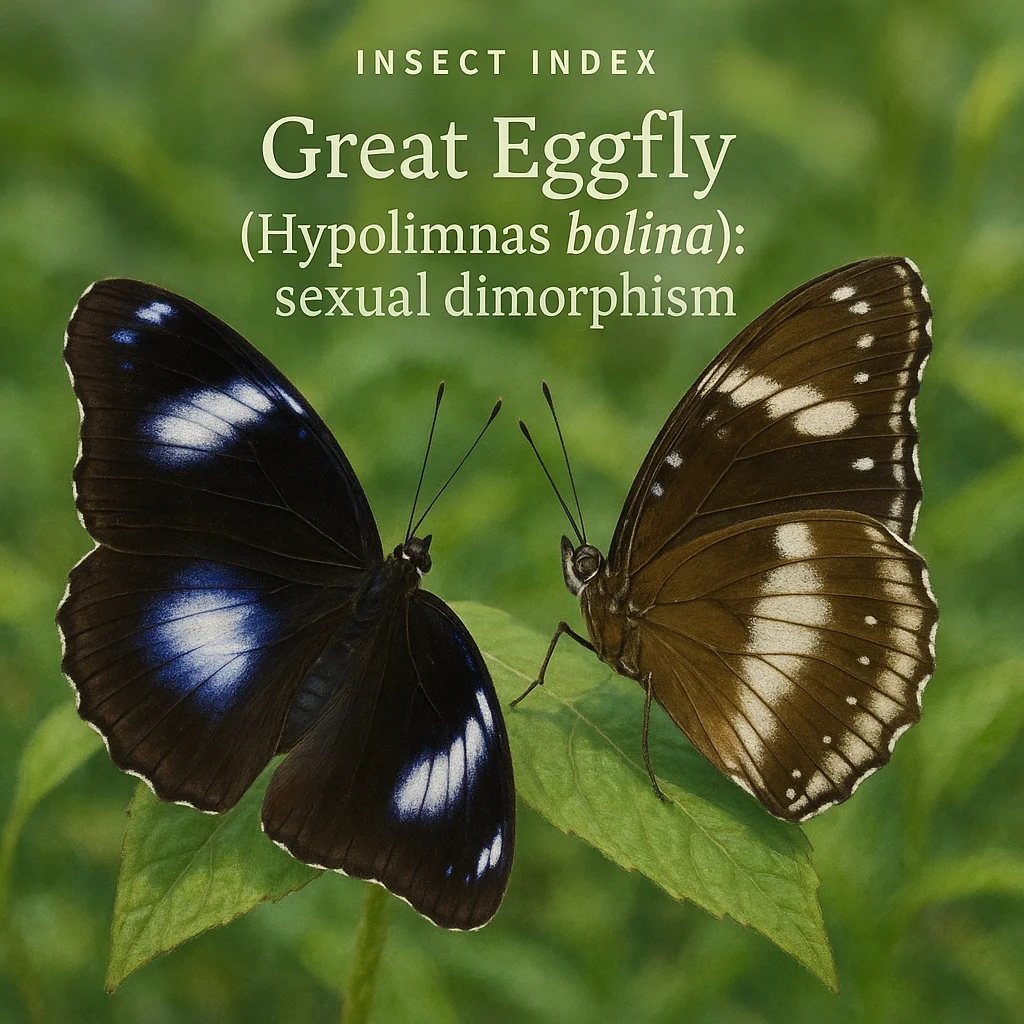
- Key Colors/Patterns: Males exhibit dark velvety wings with striking blue and purple iridescent spots, while females are lighter with various shades of brown and white markings
- Activity: Diurnal (active during the day)
- Typical Habitats: Tropical and subtropical forests, gardens, and farmlands
- Where in the World: South and Southeast Asia, Australia, and the Pacific Islands
- Seasonality: Adults are visible throughout the year in tropical regions, most abundant during the wet season
🔍 Identification
The Great Eggfly can be identified by its distinctive wing patterns and colors, which vary between the sexes. The males are strikingly different from the females, a phenomenon known as sexual dimorphism.
The male's body is robust, with a dark velvety appearance, highlighted by bold iridescent blue and purple spots on the upper side of the wings. The female, however, presents a subtler beauty, with light brown wings adorned with white and orange patches.
The antennae of both sexes are slender and slightly clubbed, typically characteristic of butterflies. The Great Eggfly exhibits smooth, often gliding flight patterns, which contrast with the rapid flapping of other species.
- Top ID Tips:
- Look for the characteristic blue and purple spots on males
- Observe the subdued coloration and patterns on females
- Note the wing shape: slightly rounded with smooth edges
- Butterfly-like long and slender antennae
- Distinctive smooth flight
- Check for sex-specific colorations to determine gender
🧠 Basic Body Structure
Like all insects, the Great Eggfly's body is divided into three primary parts: head, thorax, and abdomen. The head carries the compound eyes, mouthparts adapted for sipping nectar, and sensory antennae. The thorax houses the muscles that power the wings and legs, while the abdomen contains the digestive and reproductive organs.
This butterfly, like all insects, possesses six legs attached in pairs to the thorax. It is an invertebrate, meaning it lacks a backbone, relying on an external exoskeleton for support and protection. The Great Eggfly undergoes periodic molting to facilitate growth, a common trait among insects with exoskeletons.
🌍 Habitat & Distribution
The Great Eggfly thrives in a variety of lush environments, from tropical and subtropical forests to urban gardens and farmlands. It is commonly found in areas with plentiful vegetation, which provides adequate resources for feeding and laying eggs.
Geographically, this species spans from Southern Asia through Southeast Asia, Australia, and the Pacific Islands. Its adaptability to a range of climates makes it particularly resilient to habitat change, although deforestation and urban development can impact local populations.
📅 Seasonal Appearance & Activity
The Great Eggfly is most visible during the warmer months, when temperatures are high and floral resources are abundant. Tropical regions witness their activity year-round, while in subtropical zones, they might be less evident during colder periods.
As a diurnal species, the Great Eggfly is active during daylight, taking advantage of warm, sunny days, while often retreating during heavy rainfall and extreme humidity.
- Best Time to Spot It:
- Warm, sunny days
- High temperature periods
- During the wet season in tropical areas
- Mid-morning to late afternoon
🥚 Reproduction & Egg-Laying
Reproductive behaviors in the Great Eggfly involve elaborate courtship displays, with males often showcasing their eye-catching wings to attract females. Mating typically occurs in a secluded area.
Females lay their eggs on host plants that provide food for emerging larvae. The Great Eggfly is not known for laying enormous numbers of eggs; instead, it ensures successful hatching by selecting nutritious host plants. Egg quantity and location may vary across different regions and environmental conditions.
🌀 Metamorphosis & Life Cycle
The Great Eggfly undergoes complete metamorphosis, consisting of four distinct life stages: egg, larva (caterpillar), pupa (chrysalis), and adult.
Eggs are laid on specific host plants where newborn larvae can begin feeding immediately. Caterpillars consume vast quantities of leaves to fuel their growth. Once they reach sufficient size, the caterpillars enter the pupal stage, forming a chrysalis where remarkable transformation processes occur internally. After several weeks, a fully formed adult emerges, ready to search for nectar and continue the reproduction cycle.
🍽️ Diet & Feeding Behavior
In the larval stage, Great Eggfly caterpillars predominantly feed on the leaves of selected host plants, often from the Acanthus and Portulaca families. As adults, they shift to a liquid diet, using their long proboscis to extract nectar from flowers.
The species is primarily a herbivore and is known to play a vital role as a pollinator due to its interactions with floral species.
🦉 Predators & Defense
The Great Eggfly faces predation from various birds, reptiles, and larger insects. It deploys several defense strategies, including bright, eye-catching coloration that can startle potential predators, as well as flight to escape threats.
- Defense Highlights:
- Bright, contrasting coloration to ward off threats
- Agile flight for evasion
- Pupal mimicry when camouflaged against vegetation
- Infrequent exposure during vulnerable stages
👥 Social Behavior & Swarms
The Great Eggfly is largely solitary, with few social interactions beyond mating. Although it does not form swarms, certain conditions, such as optimal nectar availability, might cause temporary congregations of individuals at feeding sites.
🧭 Senses & Communication
This species relies heavily on its keen sense of vision to navigate and interact with its environment. Visual cues play a significant role in mating behaviors, as does the use of pheromones for communication between individuals.
🌱 Role in the Ecosystem
The Great Eggfly serves an important ecological role as a pollinator, facilitating plant reproduction. Its presence contributes to healthy ecosystems by cycling nutrients and supporting the food web as both consumer and prey.
Butterflies, including the Great Eggfly, are indicators of environmental health, with their presence often signaling biodiversity and ecosystem stability.
📉 Population & Conservation Notes
The Great Eggfly is commonly found in regions with suitable habitats, although localized threats such as habitat destruction, pesticide use, and climate change could impact specific populations. Habitat preservation and awareness are vital to maintaining healthy numbers.
- How to Help (Low-Impact):
- Plant native flowering species
- Avoid harmful pesticides
- Maintain garden diversity
- Create butterfly-friendly environments
⚠️ Human Interaction & Safety
The Great Eggfly does not pose any significant threat to humans. It does not bite or sting and is generally harmless. Observers should avoid handling butterflies to prevent damage to their delicate wings. Appreciating and respecting natural habitats without interference contributes to conservation efforts.
📌 Summary
- Identifiable by vivid sexual dimorphism: males have blue and purple iridescence, females are brown and white
- Habitats include tropical/subtropical forests and urban gardens
- Visible throughout the year in tropical areas, most abundantly during warm months
- Undergoes complete metamorphosis with four life stages
- Feeds on leaves as a larva and nectar as an adult
- Faces predation by birds and reptiles, employs bright coloration as defense
- Plays key ecological roles in pollination and food webs
- Preservation of habitat and avoidance of pesticides can support populations
- Harmless to humans, should be observed respectfully in natural settings