🕷️ Painted Lady (Vanessa cardui): the global traveler
🧾 Quick Facts
The Painted Lady, scientifically known as Vanessa cardui, is a globally recognized butterfly, celebrated for its extraordinary migratory patterns and widespread presence. A member of the Nymphalidae family, it thrives in diverse climates and environments across the continents, contributing significantly to pollination.
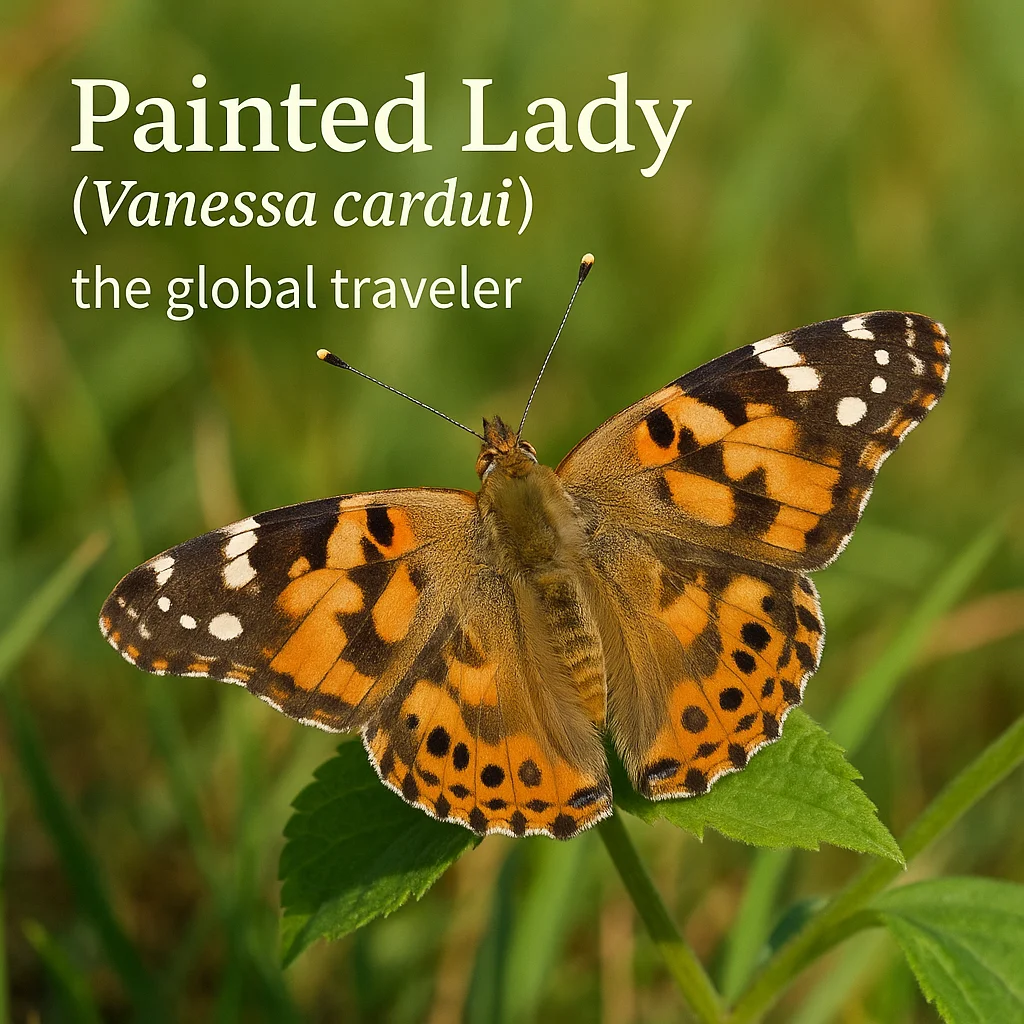
- Common Names: Painted Lady, Thistle Butterfly
- Scientific Name: Vanessa cardui
- Insect: Yes, it's an invertebrate
- Order / Family: Lepidoptera / Nymphalidae
- Typical Size: Wingspan of 5 to 9 cm (2 to 3.5 inches)
- Key Colors/Patterns: Vibrant orange and black with white spots
- Activity: Primarily diurnal (active during the day)
- Typical Habitats: Meadows, gardens, roadsides, coastal dunes
- Global Presence: Found on all continents except Antarctica
- Seasonality: Varies by region, often seen in summer and fall
🔍 Identification
Recognizing the Painted Lady in the field is enhanced by its distinctive orange wings intricately edged and mottled with black patterns and characteristic white spots. Its forewings reveal a tipped silhouette and club-shaped antennae that aid in species identification. Their legs are slender, supporting a quick, fluttering flight style. Although sometimes confused with the smaller American Lady, noted differences in wing patterns assist in accurate identification.
- Top ID Tips:
- Look for vibrant orange and black wings with white spots.
- Note the wing edges with black margins and eyespots on hindwings.
- The forewings have a distinguished triangular apex.
- Clubbed antennae typical of many butterflies.
- Medium-sized body with a swift flight pattern.
- Easily mistaken for the American Lady but with different spot placements.
- Whole specimen easily seen when feeding on flowers.
- Full upper and under wing pattern visible when resting.
🧠 Basic Body Structure
The Painted Lady is an example of typical insect morphology, consisting of a head, thorax, and abdomen. They possess six jointed legs that classify them as insects, in addition to their substantial, scaled wings. The exoskeleton provides support and protection, undergoing molting as they grow.
This butterfly is a vertebrate or invertebrate, meaning it lacks a backbone, an essential evolutionary feature that distinguishes it physiologically and behaviorally from vertebrate species.
🌍 Habitat & Distribution
The Painted Lady is truly adaptable, making its home in a variety of settings ranging from open fields and flowery gardens to mountain clearings and deserts. These butterflies favor habitats rich in nectar-providing flora. Often found in urban parks as well as rural meadows, they are a visitor in countless natural landscapes. Their distribution spans from North America to Europe, Asia, and Africa, enjoying climates that range from temperate to tropical. Changes in habitat due to urban development and climate shifts can affect local butterfly populations, altering their migratory patterns and sightings.
📅 Seasonal Appearance & Activity
Painted Ladies are typically visible during warmer months. Their most active periods correspond with the blooming of numerous flowering plants from spring through early autumn. Famed for their migratory nature, their presence intensifies during seasonal shifts, attracting attention across vast geographical expanses.
- Best Time to Spot It:
- Late spring to late summer
- Daytime, during warmer sunny spells
- During dry weather, avoiding heavy rain
- Where flowers are in abundance
- Migration seasons in spring and fall
- Near blooms such as thistles and asters
🥚 Reproduction & Egg-Laying
The courtship of the Painted Lady involves aerial displays and pheromone declarations to attract mates. Egg-laying is methodical, with females depositing singularly or in small clusters on suitable host plants like thistles and mallow. These promising nurseries provide essential nutrients for the burgeoning caterpillars.
Typical clutches vary regionally and seasonally, reflecting environmental conditions and host plant availability.
🌀 Metamorphosis & Life Cycle
The Painted Lady undergoes a complete metamorphosis. This lifecycle begins with eggs hatching in around 3 to 5 days, revealing larvae or caterpillars that are ravenous leaf-eaters. The larval stage persists for about 10 to 14 days, followed by the pupal stage, typically lasting 7 to 10 days, where transformation into adults occurs.
Post-emergence, adults lead a nectar-rich existence, surviving up to 2 to 4 weeks. They function not only in reproduction but also as vital pollinators for a myriad of plants.
🍽️ Diet & Feeding Behavior
During their caterpillar stage, Painted Ladies eagerly consume host plant leaves. As adults, they shift to a nectar-based diet facilitated by their long, coiled proboscis adapted for sucking. Their preference for a diverse assemblage of flowers underscores their ecological role as pollinators and critical contributors to plant reproduction, aiding in the sustainability of ecosystems.
🦉 Predators & Defense
Painted Ladies are preyed upon by birds, spiders, and some small mammals. Defensive strategies include cryptic coloration and erratic flight to escape predators. Their flashy wing patterns can startle and confuse, while some individuals consume toxins as caterpillars, making them distasteful.
- Defense Highlights:
- Camo patterns to blend with environments
- Swift, erratic flight to elude capture
- Warning coloration as a deterrent
- Unpalatability due to accumulated toxins
👥 Social Behavior & Swarms
Typically solitary, Painted Ladies occasionally form swarms triggered by environmental cues. These migrations are not only awe-inspiring spectacles but are crucial for ensuring gene flow across distant populations. Such organized movements are integral to colonizing fresh habitats or escaping deteriorating ones.
🧭 Senses & Communication
Painted Ladies have evolved acute vision, particularly adept at perceiving ultraviolet patterns on flowers. Their antennae are critical in detecting pheromones, while vibrations play a lesser role. Communication often hinges on chemical cues, enabling individuals to locate mates and suitable environments, enhancing survival chances.
🌱 Role in the Ecosystem
As a key pollinator, the Painted Lady supports the reproduction of various wildflowers, fostering the establishment and health of ecosystems. It serves as both prey and decomposer, enriching the food web's complexity. Interactions with plants range from mutualistic symbioses to herbivory during its caterpillar phase.
📉 Population & Conservation Notes
While typically abundant, the Painted Lady's populations are subject to fluctuations due to environmental pressures such as habitat destruction and climate variability. Despite being common inhabitants in many habitats, knowledge gaps remain about their exact numbers.
- How to Help (Low-Impact):
- Plant native wildflowers to provide nectar
- Avoid insecticides in garden areas
- Promote conservation of meadows and grasslands
- Raise awareness about pollinator-friendly practices
⚠️ Human Interaction & Safety
Painted Ladies pose no harm to humans as they neither bite nor sting. For any allergic reactions to butterflies, it is advisable to seek medical attention. Observing these butterflies is best approached with respect for their environment, avoiding disturbances or collection for private keeping.
📌 Summary
- Notable for their bright orange and black wing patterns with white spots.
- Adapted to diverse habitats, contributing as pollinators worldwide.
- Life cycle embodies complete metamorphosis with distinct stages.
- Feeding primarily on nectar as adults and on host plant leaves as caterpillars.
- Predators include birds and spiders; employ camouflage and warning signals.
- Participates actively in ecosystem balance through pollination and as prey.
- Interactions with humans are non-intrusive; observe respectfully.