🕷️ Red Admiral (Vanessa atalanta): habitat and seasons
🧾 Quick Facts
The Red Admiral butterfly, scientifically known as Vanessa atalanta, is a captivating member of the Nymphalidae family. This butterfly is renowned for its striking appearance and worldwide distribution. Below are some quick facts about this fascinating species:
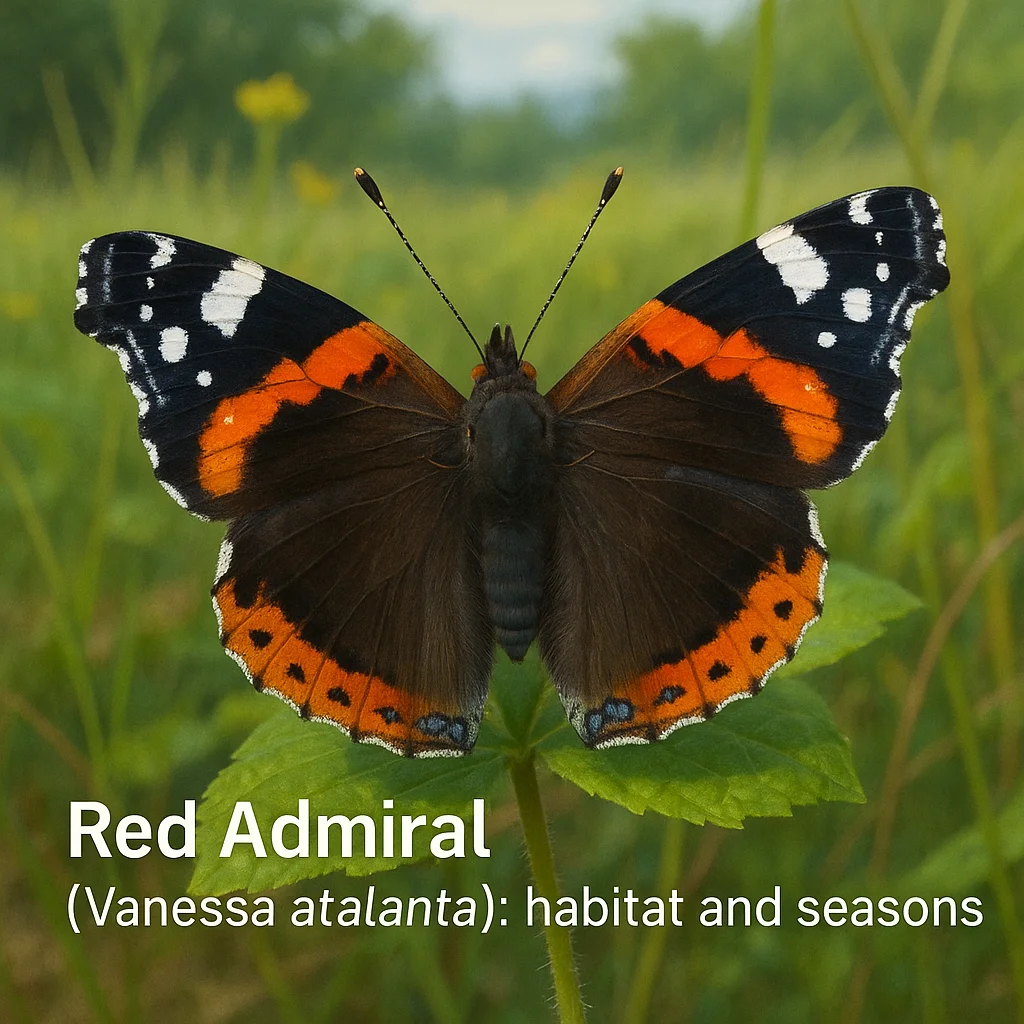
- Common Names: Red Admiral
- Scientific Name: Vanessa atalanta
- Insect or Not: Insect (invertebrate)
- Order / Family: Lepidoptera / Nymphalidae
- Typical Size Range: 45-50 mm wingspan
- Key Colors/Patterns: Reddish-orange bands, black wings with white spots
- Activity: Diurnal (active during the day)
- Typical Habitats: Gardens, parks, woodlands, coastal areas
- Where in the World It Occurs: North America, Europe, Asia, North Africa
- Seasonality: Most visible in spring and summer, often migrating in fall
🔍 Identification
The Red Admiral is easy to recognize due to its vivid color patterns. It displays a unique silhouette with broad wings and a distinctive body structure.
The antennae of the Red Admiral are club-shaped, as is typical for butterflies. The wings are adorned with black, white, and red patterns which are striking in appearance. Legs are slender, adapted for perching rather than digging, with the insect typically seen flitting from flower to flower.
Red Admirals can be mistaken for other Nymphalidae family members, but their bold reddish-orange bands are distinctive.
- Top ID Tips:
- Look for bright orange-red bands across the forewings.
- Notice the size: moderately large with a significant wingspan.
- Club-shaped antennae typical of butterflies.
- Perching style on flowers during sunny days.
- Black forewings with white spotting near the tips.
- Beneath, the wings are mottled brown—good for camouflage.
- Usually solitary but sometimes found with others during migration.
🧠 Basic Body Structure
As an insect, the Red Admiral has three primary body segments: head, thorax, and abdomen. It possesses six legs, which is characteristic of all insects.
The Red Admiral is an invertebrate, meaning it lacks a backbone. Its body is protected by an exoskeleton, which provides structural support and must be shed periodically in a process known as molting. This species also features two sets of wings that allow for its characteristic nimble flight.
🌍 Habitat & Distribution
The Red Admiral is highly adaptable, flourishing in a variety of habitats including urban gardens, woodlands, grasslands, and coastal areas. Its wide distribution spans continents including North America, Europe, parts of Asia, and North Africa.
These butterflies are typically associated with temperate climates where they exhibit migratory behavior in response to changing seasons. Within these habitats, the Red Admiral can often be found in microhabitats such as under the canopy of trees or among the flowers where they feed on nectar.
Habitat changes, such as urbanization and deforestation, can impact sightings by reducing available resources and suitable living conditions.
📅 Seasonal Appearance & Activity
The Red Admiral is primarily active during warmer months, making its presence most noticeable in spring and summer. It is diurnal, meaning it is active during daylight hours and relies heavily on warm temperatures and sunny conditions for activity.
Although tolerant of a range of climatic conditions, sudden weather changes such as cold snaps or heavy rains can reduce butterfly activity.
- Best Time to Spot It:
- Early spring through late summer.
- Sunny days are optimal for sightings.
- Peak activity usually from mid-morning to late afternoon.
- Often seen before rain when feeding intensely.
🥚 Reproduction & Egg-Laying
The mating behavior of the Red Admiral often includes a courtship dance where males display aerial prowess. Females select mates based on these displays, a common characteristic among butterflies.
Eggs are typically laid on host plants, particularly nettles in Europe and North America. A single female can lay hundreds of eggs during her lifetime, ensuring that even if conditions are less than ideal, some offspring have a chance to survive.
🌀 Metamorphosis & Life Cycle
The Red Admiral undergoes complete metamorphosis consisting of four stages: egg, larva (caterpillar), pupa (chrysalis), and adult.
Eggs hatch into larvae that feed on the leaves of the host plant. The larval stage lasts several weeks, depending on temperature and food availability.
Once fully grown, the larva forms a chrysalis—a protective shell—where it undergoes transformation into an adult. This pupal stage can last from two weeks to over a month.
Upon emerging as adults, Red Admiral butterflies feed primarily on nectar, living from two weeks to several months, depending on environmental conditions.
🍽️ Diet & Feeding Behavior
As caterpillars, Red Admirals are herbivorous, consuming the leaves of host plants such as nettles.
In adulthood, they primarily feed on nectar using a specialized proboscis to access this source of energy. They can also sip on tree sap, fermenting fruit, and, occasionally, bird droppings for minerals.
By feeding on nectar, Red Admirals play a vital role in pollination, transferring pollen from flower to flower.
🦉 Predators & Defense
Red Admirals face predation threats from birds, spiders, and other insects. To defend against these predators, they rely on a combination of camouflage and rapid, erratic flight.
The mottled undersides of their wings allow them to blend into bark and leaf litter, while their vibrant colors can startle predators, providing a moment of escape.
- Defense Highlights:
- Cryptic coloration on the underside for blending in.
- Flash of color to startle predators.
- Quick, unpredictable flight patterns.
- Occasional reliance on defensive mimicry.
👥 Social Behavior & Swarms
The Red Admiral is largely solitary but may temporarily congregate during migration or on abundant food sources. Territorial behavior can be observed as males patrol and defend areas rich in resources.
Migrations are influenced by regional climate conditions where they travel long distances to find suitable breeding grounds as temperatures change.
🧭 Senses & Communication
Red Admirals possess well-developed vision, which helps them distinguish colors necessary for finding flowers and potential mates.
They also utilize pheromones for communication, particularly during mating. Touch and vibration might play roles in their interactions, especially during courtship displays.
🌱 Role in the Ecosystem
Red Admirals contribute significantly to pollinating a variety of flowering plants, thus supporting biodiversity. Their larvae act as herbivores that help control plant populations, particularly certain nettles, maintaining ecological balance.
They also serve as prey for various predators, forming a critical component of the food web.
📉 Population & Conservation Notes
The Red Admiral is generally considered common, although local populations can fluctuate based on habitat availability and environmental conditions.
Factors such as pesticide use, habitat fragmentation, and climate change pose threats to their populations, affecting their migratory patterns and reproduction.
- How to Help (Low-Impact):
- Plant native flora to provide nectar sources.
- Minimize pesticide use in gardens and lawns.
- Encourage the growth of host plants like nettles.
- Create butterfly-friendly environments with varied plant species.
⚠️ Human Interaction & Safety
Red Admirals do not bite or sting and are considered harmless to humans. Observing them can be a delightful experience as they flit from flower to flower.
When observing, it is important to approach gently and avoid touching the butterflies to prevent damage to their delicate wings. Encourage others to engage with nature respectfully and not collect or harm these creatures.
📌 Summary
- The Red Admiral is a striking butterfly easily identified by its reddish-orange bands and black wings with white spots.
- Habitats include gardens, woodlands, and coastal areas across much of the temperate world.
- Most visible in warmer months, active during the day, and can undertake long migrations.
- Complete metamorphosis with nectar-feeding adult stage.
- Role as pollinator is significant, contributing to plant reproduction and ecosystem health.
- Threats include habitat loss and climate change; conservation involves native plant gardening.
- Non-threatening to humans, supporting enjoyable nature observation.