🕷️ Ulysses Swallowtail Papilio Ulysses Electric Blue In The Tropics
🧾 Quick Facts
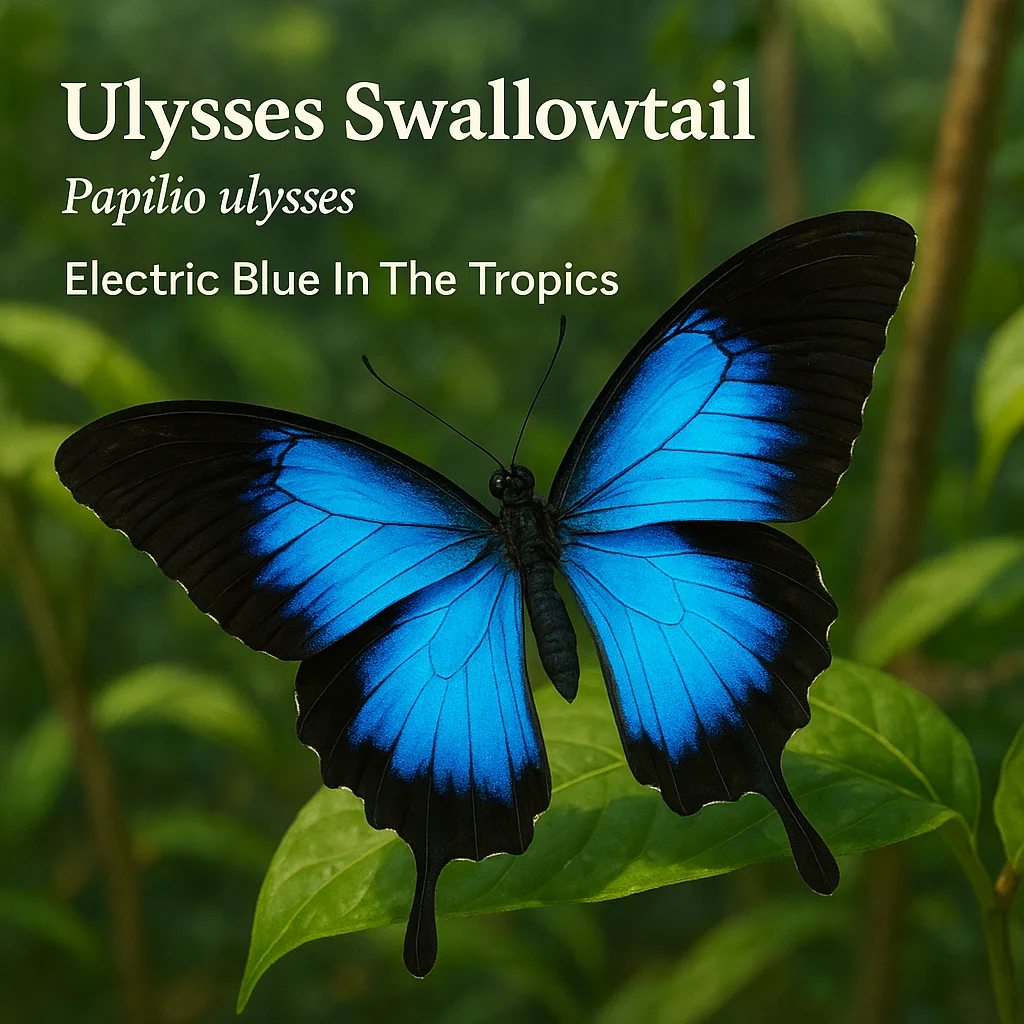
The Ulysses Swallowtail, also known as the Blue Mountain Swallowtail, is a striking butterfly native to tropical regions. Known for its vibrant electric blue wings, this species is a marvel of nature.
- Common Names: Ulysses Swallowtail, Blue Mountain Swallowtail
- Scientific Name: Papilio ulysses
- Insect/Invertebrate: Yes, it is an insect.
- Order/Family: Lepidoptera/Papilionidae
- Typical Size Range: Wingspan of approximately 10 to 14 cm
- Key Colors/Patterns: Bright electric blue on the upper side of the wings with black borders; underside is brown
- Activity: Diurnal (active during the day)
- Typical Habitats: Rainforests and tropical woodlands
- Where in the World it Occurs: Northern Australia, New Guinea, and surrounding islands
- Seasonality: Can be seen year-round, with peaks in warmer months
🔍 Identification
Recognizing the Ulysses Swallowtail in the field is a delight for many nature enthusiasts and butterfly observers.
- Body Shape and Silhouette: Characteristic swallowtail shape with tails extending from the hind wings
- Antennae: Clubbed antennae typical of butterflies
- Wing Features: Bright blue upper wings with black edges, tails have minimal coloration
- Leg Traits and Movement Style: Thin legs; uses front legs to taste various surfaces
- Distinguishing Look-alikes: Could be confused with other blue swallowtails; look for the distinct pattern and size
- Top ID Tips:
- Look for bright blue with black margins
- Check the wing underside for brown coloration
- Notice swallowtail extensions on hind wings
- Daytime flight is a good indicator
- Less visible blue when at rest
- Prefers tropical environments
🧠 Basic Body Structure
The Ulysses Swallowtail, like all insects, has a three-part body: head, thorax, and abdomen. It possesses six legs, which are segmented and facilitate walking and feeding. As an invertebrate, this butterfly lacks a spine and relies on an exoskeleton for structural support.
The exoskeleton is vital for protection and anchoring muscles. This butterfly goes through molting as it grows, shedding its old exoskeleton. It has two pairs of wings, which are crucial for flight and display.
🌍 Habitat & Distribution
The Ulysses Swallowtail thrives in rainforests and tropical woodlands. These environments provide a wealth of nectar sources and suitable plants for egg-laying.
Geographically, it is found in Northern Australia, New Guinea, and adjacent islands. The butterfly prefers humid tropical climates but can occasionally be spotted in surrounding areas where conditions are favorable.
📅 Seasonal Appearance & Activity
This butterfly can be seen throughout the year, with peak visibility during warmer months. Diurnal by nature, the Ulysses Swallowtail is active during daylight, particularly when the weather is warm and sunny.
- Warm months are best for sightings
- Most active on sunny days
- Least active during rainfall
- Mornings and early afternoons are optimal
🥚 Reproduction & Egg-Laying
Mating involves aerial displays and pheromone signaling by males to attract females. After mating, females lay eggs on host plants, typically citrus species, where caterpillars can feed upon hatching.
Egg counts of each female vary and are often determined by the availability and condition of the host plants. Egg-laying is strategic, ensuring that larvae have immediate access to food sources.
🌀 Metamorphosis & Life Cycle
The Ulysses Swallowtail undergoes complete metamorphosis: from egg to larva (caterpillar), to pupa (chrysalis), then to adult. Eggs hatch into caterpillars, which feed voraciously on host plants. This stage lasts a few weeks, depending on environmental factors.
After reaching a sufficient size, caterpillars transform into pupae. The pupal stage can last several weeks to months. The adult emerges from the chrysalis, ready to embark on its role as a pollinator.
🍽️ Diet & Feeding Behavior
In their larval stage, Ulysses Swallowtails are caterpillars that chew on leaves of host plants. As adults, they feed on nectar from a variety of flowering plants, using their proboscis to sip the sweet liquid.
This feeding behavior positions them as crucial pollinators in their ecosystems, promoting plant reproduction and biodiversity.
🦉 Predators & Defense
The Ulysses Swallowtail faces predation from birds, small reptiles, and spiders. Defense mechanisms include rapid flight and the use of camouflage when resting with wings closed, displaying the brown undersides.
- Camouflage with wings closed
- Rapid flight to escape predators
- Startle effect from bright blue flashing
- Mimicry to resemble less palatable species
👥 Social Behavior & Swarms
The Ulysses Swallowtail is usually solitary; males are territorial and will defend their areas from rivals. In some cases, congregations can occur at optimal nectar sites, especially after rains or in favorable weather.
Migration or swarming is not characteristic of this species; rather, local movements relate to searching for food or mates.
🧭 Senses & Communication
This butterfly has well-developed vision to detect colors and movement, essential for finding flowers and mates. Scent and pheromones play a role in mating and territory marking.
Communication is subtle, mainly through visual signals and pheromones, ensuring efficiency in reproduction and territorial disputes.
🌱 Role in the Ecosystem
The Ulysses Swallowtail is an important pollinator. By feeding on nectar, it facilitates the transfer of pollen between flowers, aiding plant reproduction.
It is a crucial part of the food web, providing nourishment for predators and influencing ecological balance in tropical forests.
📉 Population & Conservation Notes
The Ulysses Swallowtail is generally considered a common species within its range, but its population can be affected by habitat loss due to deforestation and urbanization. Climate change also poses threats by altering suitable habitat conditions.
- Plant native flora to support their life cycle
- Avoid pesticide use around gardens
- Participate in local conservation programs
- Support sustainable land management practices
⚠️ Human Interaction & Safety
The Ulysses Swallowtail is harmless and does not pose any safety concerns to humans. As with all wildlife, respectful observation is encouraged to ensure its preservation and the continued enjoyment of its beauty in natural habitats. Refrain from capturing or harming these butterflies.
📌 Summary
- Identified by electric blue wings with black margins
- Inhabits tropical rainforests and woodlands
- Seasonal visibility peaks in warmer months
- Undergoes complete metamorphosis
- Feeds on nectar, crucial for pollination
- Faces predation from birds and reptiles
- Vital role in ecosystem as a pollinator
- Populations stable but vulnerable to habitat loss
- Encouragement of respectful observation