🕷️ Damselfly Myths and Facts
🧾 Quick Facts
Damselflies are delicate, enchanting insects often confused with dragonflies. They belong to the order Odonata and are characterized by their slender bodies and vibrant colors. Here are some quick facts about damselflies:
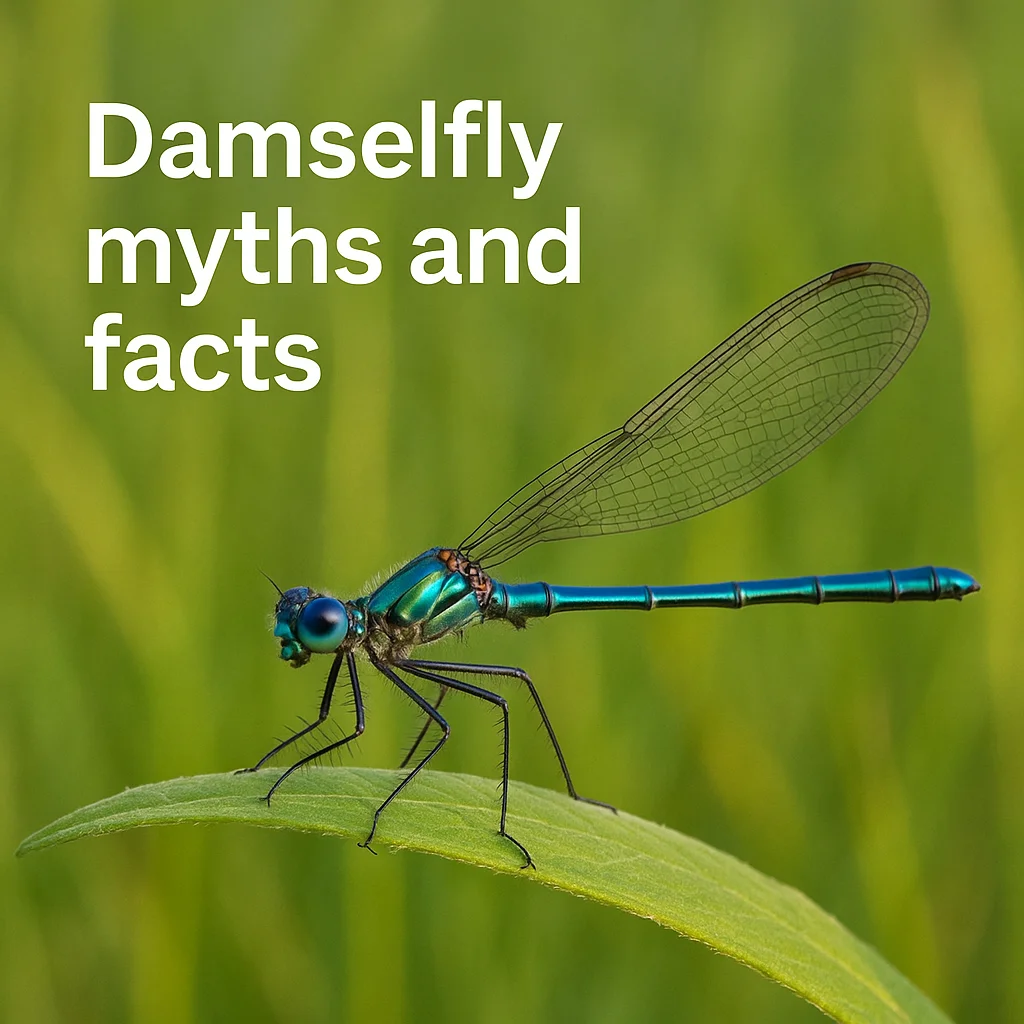
- Common names: Damselfly
- Scientific name: Varies by species
- Insect or not: Insect (invertebrate)
- Order/Family: Odonata/Zygoptera
- Typical size range: 1 to 5 cm (adult)
- Key colors/patterns: Often blue, green, or red with metallic sheen
- Activity: Diurnal (active during the day)
- Typical habitats: Wetlands, ponds, streams, marshes
- Where in the world it occurs: Global; more common in temperate and tropical regions
- Seasonality: Spring to early autumn (varies by region)
🔍 Identification
Identifying a damselfly in the field can be thrilling for enthusiasts and nature lovers. Here's how to recognize these fascinating insects:
- Body shape and silhouette: Slender, elongated body with wings held together above the body when at rest.
- Antennae type: Short and non-obtrusive, not used for primary identification.
- Wing features: Transparent wings that are narrow and similar in shape; each pair can move independently.
- Leg traits and movement style: Long and thin legs adapted for perching, not for walking.
- Distinguishing look-alikes: Often confused with dragonflies, but dragonflies rest with wings spread flat.
- Top ID Tip: Look for their wings held together above the body.
- Top ID Tip: Observe the slender, tube-like abdomen.
- Top ID Tip: Note the vibrant metallic or pastel coloration.
- Top ID Tip: Notice their hovering flight pattern.
- Top ID Tip: Damselflies have eyes that are set apart compared to dragonflies.
- Top ID Tip: Often found near still or slow-moving water.
🧠 Basic Body Structure
Understanding the basic body structure of a damselfly provides insight into its adaptations and behaviors:
Damselflies have a segmented body consisting of the head, thorax, and abdomen. Like all insects, they possess six legs and an exoskeleton that provides a hard outer covering. Damselflies are invertebrates, meaning they lack a backbone.
Their complex life cycle involves molting as they grow, and they possess two pairs of wings that allow agile flight.
🌍 Habitat & Distribution
Damselflies can be found in a variety of wetland environments that provide abundant opportunities for feeding and breeding:
- Preferred environments include marshes, ponds, streams, and lakes.
- Microhabitats are often where vegetation meets the water, such as reeds and aquatic plants.
- Geographic range includes most temperate and tropical regions worldwide.
- Sightings can be affected by changes in habitat due to human interference or climate change.
📅 Seasonal Appearance & Activity
The seasonal appearance of damselflies is closely tied to environmental conditions that support their life cycle:
- Most visible during warmer months, from spring through early autumn.
- Diurnally active, making them easiest to spot on sunny, calm days.
- Weather influences: Temperature plays a significant role, with preferring moderate warmth and avoiding high winds or heavy rain.
- Best Time to Spot It: Late spring mornings.
- Best Time to Spot It: Sunny days near water bodies.
- Best Time to Spot It: Warm afternoons in summer.
- Best Time to Spot It: Early autumn around garden ponds.
🥚 Reproduction & Egg-Laying
Damselfly reproduction is a fascinating contribution to their life story:
Mating often involves elaborate courtship rituals, with males and females engaging in a tandem flight. In some species, males may guard females while they lay eggs to ensure their offspring's success.
Eggs are typically laid on aquatic plants or in the water itself, where they can remain safe from predators. The number of eggs can vary by species and conditions.
🌀 Metamorphosis & Life Cycle
Damselflies undergo incomplete metamorphosis, with the stages of egg, nymph, and adult:
The eggs hatch into aquatic nymphs, which have a long, slender body like adults and feed on tiny aquatic organisms. This stage can last several months to a couple of years, depending on environmental conditions.
Nymphs undergo multiple molts before emerging as adults, leaving behind their exoskeleton. The adult stage is considerably shorter, spanning weeks to months, during which they focus on reproduction and dispersal.
🍽️ Diet & Feeding Behavior
Damselflies play an essential role as predators:
- At the nymph stage, they employ chewing mouthparts to capture and consume aquatic invertebrates.
- Adult damselflies are airborne hunters, catching other small insects mid-flight with their agile maneuverability.
Their feeding behavior helps control the populations of mosquitoes and other small pests.
🦉 Predators & Defense
Despite their adept flying abilities, damselflies face many natural threats:
Common predators include birds, fish, amphibians, and larger insects. They utilize camouflage within vegetation, swift evasive flights, and the reflective quality of their wings as defense strategies.
- Defense Highlights: Use of rapid flight to escape predators.
- Defense Highlights: Camouflaged coloration matching their habitat.
- Defense Highlights: Silent flight to evade detection.
- Defense Highlights: Carefully choosing habitats with cover.
👥 Social Behavior & Swarms
Damselflies are typically solitary creatures, although they may gather in large numbers in favorable habitats:
Encounters primarily occur during mating flights. Unlike some insects, damselflies do not form communal or colony-based social structures.
🧭 Senses & Communication
Damselflies rely heavily on their acute senses to navigate and interact with their environment:
- Vision: Compound eyes provide a wide field of view, critical for hunting and avoiding predators.
- Smell/Pheromones: Less developed in damselflies compared to other insects.
- Communication: Visual cues are primarily used during courtship behaviors.
🌱 Role in the Ecosystem
Damselflies are valuable members of their ecosystems, contributing to:
- Pollination: While not significant pollinators, they occasionally contribute to plant reproduction.
- Pest Control: Their appetite for mosquitoes and other insects helps manage pest populations.
- Food-Web Role: As both predator and prey, they are integral in maintaining ecological balance.
📉 Population & Conservation Notes
While some damselfly species are common, others face threats due to habitat loss and environmental changes:
- Local abundance varies depending on habitat quality and availability.
- Conservation efforts include preserving wetlands and reducing pesticide use.
- Light pollution and climate change can disrupt their lifecycles.
- How to Help (Low-Impact): Create garden ponds.
- How to Help (Low-Impact): Plant native aquatic vegetation.
- How to Help (Low-Impact): Reduce lawn pesticide use.
- How to Help (Low-Impact): Preserve natural pond edges.
⚠️ Human Interaction & Safety
Damselflies are harmless to humans and do not sting or bite. Respectful observation and minimal disturbance are recommended while watching these fascinating insects. Avoid collecting wild specimens to protect biodiversity and ecosystems.
📌 Summary
- ID: Slender body, wings held together when at rest.
- Habitat: Wetlands, streams, and ponds.
- Seasonality: Most active in warmer months.
- Life Cycle: Incomplete metamorphosis.
- Diet: Predatory, feeds on small insects.
- Predators: Birds, fish, amphibians.
- Ecology: Important for pest control and ecological balance.
- Human Notes: Not harmful, safe to observe respectfully.