🕷️ How To Spot Damselfly Eggs On Plants Simple Guide
🧾 Quick Facts
Damselflies are a group of insects known for their delicate, slender bodies and vibrant colors. They are closely related to dragonflies, but can be distinguished by their thinner bodies and wing structure.
- Common names: Damselfly
- Scientific name: Varies by species
- Insect or not: Yes, they are insects with segmented bodies and six legs.
- Order / Family: Odonata / Zygoptera
- Typical size range: 1.5–5 cm in length
- Key colors/patterns: Blue, green, red, black; often iridescent
- Activity: Diurnal (active during the day)
- Typical habitats: Near water bodies like ponds and streams
- Where in the world: Found globally, excluding Antarctica
- Seasonality: Most visible during spring and summer
🔍 Identification
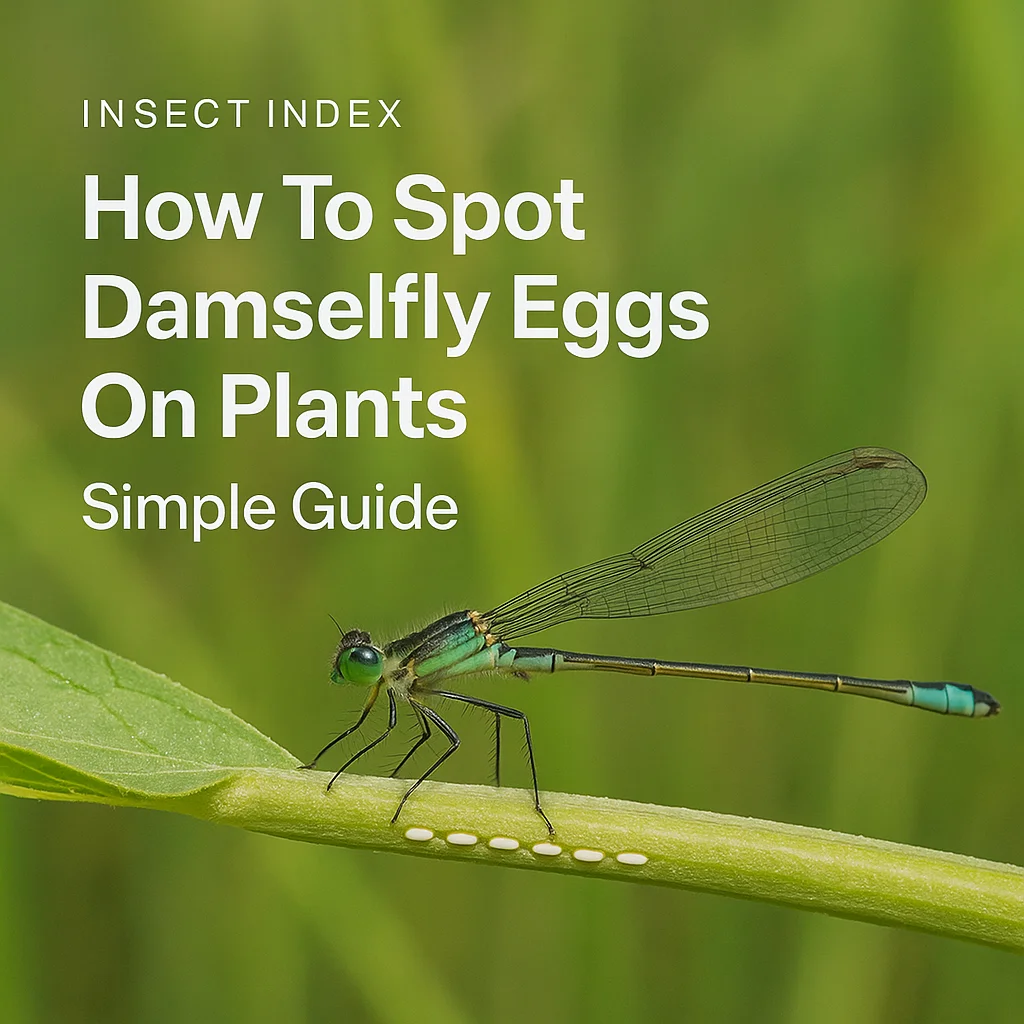
Damselflies have slender bodies that taper towards the end, large eyes, and two pairs of delicate wings. They hold their wings upright and together when at rest, unlike dragonflies whose wings lay flat. The antennae are short and bristle-like. Damselflies often fly with a fluttering movement, landing frequently.
- Body shape: Slender and elongated
- Antennae: Short and fine, not significant for ID
- Wing features: Two pairs held together when at rest
- Legs: Thin, suited for capturing prey
- Look-alikes: May be confused with dragonflies but are smaller and slimmer
- Top ID Tips:
- Look for slender bodies and vibrant colors.
- Observe the upright resting wing position.
- Note their fluttering flight pattern.
- Check near water bodies where they breed.
- Smaller size compared to dragonflies.
- Presence during daylight hours.
🧠 Basic Body Structure
Damselflies, like all insects, have a head, thorax, and abdomen. They possess six legs, attached to the thorax, which allow for grabbing prey. They grow through metamorphosis, starting as eggs, then aquatic nymphs, and finally adults with exoskeletons providing structural support. Being invertebrates, they lack a backbone.
🌍 Habitat & Distribution
Damselflies prefer aquatic environments such as ponds, lakes, and streams with abundant vegetation. These habitats provide places for egg-laying and nymph development. While damselflies can be found on every continent except Antarctica, they are most diverse in tropical and temperate regions. Changes in water quality and habitat destruction can alter local populations.
📅 Seasonal Appearance & Activity
Damselflies are most often observed during the warmer months of spring and summer. Their activity peaks during sunny days when temperatures are higher, as they are cold-blooded and rely on warmth to become more active. Most species are diurnal, being active from morning to afternoon.
- Best Time to Spot It:
- Spring and summer months.
- Sunny days for higher activity.
- Daytime, especially around noon.
- Calm and warm conditions.
🥚 Reproduction & Egg-Laying
Damselflies engage in elaborate aerial courtship displays. Mating often takes place near water, where males establish territories. After mating, females lay eggs on submerged plant stems or floating vegetation. Depending on the species, hundreds of eggs may be laid, and this strategy ensures that some will survive predation and environmental conditions.
🌀 Metamorphosis & Life Cycle
Damselflies undergo incomplete metamorphosis, consisting of three life stages: egg, nymph, and adult. Eggs hatch into aquatic nymphs, which are carnivorous and live in water, hunting other small aquatic organisms. The nymph stage can last several months to a few years, depending on the species and environmental conditions. After the final molt, nymphs emerge as adults, ready to dry their wings and begin a terrestrial life focused on reproduction and feeding.
🍽️ Diet & Feeding Behavior
As nymphs, damselflies are predatory, using extendable jaws to capture prey like mosquito larvae, tadpoles, and other small aquatic organisms. Adult damselflies, with their prominent eyes and swift flight, capture flying insects, providing natural pest control. Both nymphs and adults have chewing mouthparts adapted for gripping and consuming prey.
🦉 Predators & Defense
Damselflies face predation from birds, amphibians, and spiders. They employ several defensive strategies: their slim bodies and rapid flight enable quick evasion; some species exhibit camouflage, blending into their surroundings; others rely on mimicry, resembling more dangerous insects to avoid predators.
- Defense Highlights:
- Camouflage abilities help in evading predators.
- Speedy flight and agile maneuvers as primary defense.
- Mimicry of other dangerous insects for protection.
- Nymphs can dwell under aquatic vegetation to conceal themselves.
👥 Social Behavior & Swarms
Damselflies are primarily solitary insects. They do not form swarms or colonies, but can be seen in large numbers near suitable habitats due to favorable conditions. Territorial behavior is often observed among males, especially during mating seasons when they compete for the best breeding sites.
🧭 Senses & Communication
Damselflies rely heavily on their acute vision to detect movement and potential prey. Their large, multifaceted eyes provide a wide field of view. They do not communicate through sound but may use visual cues and chemical signals for courtship and territorial displays.
🌱 Role in the Ecosystem
Damselflies are vital components of their ecosystems, acting as both predators and prey. Their predation on mosquitoes and other insects helps control pest populations. They also serve as food for birds, amphibians, and other wildlife, integral to maintaining ecological balance. This dual role underscores their importance in both aquatic and terrestrial food webs.
📉 Population & Conservation Notes
Damselflies are commonly found in suitable habitats but face threats from habitat loss, pollution, and climate change. Conservation efforts focus on preserving aquatic habitats and promoting biodiversity. Local abundance varies, with some species being more vulnerable than others.
- How to Help (Low-Impact):
- Plant native vegetation to provide habitat.
- Avoid using chemical pesticides near water bodies.
- Preserve local wetlands and support conservation projects.
- Participate in citizen science projects to monitor populations.
⚠️ Human Interaction & Safety
Damselflies are harmless to humans and do not bite or sting. Their presence is beneficial, aiding in the control of pest insects. Observers should respect their habitats, avoiding the collection or disturbance of these creatures to ensure ongoing contributions to ecosystem health.
📌 Summary
- Damselflies are identified by their slender bodies and upright wing posture.
- They are common in aquatic habitats across most continents.
- Most active during the day in spring and summer.
- Undergo incomplete metamorphosis with aquatic nymph stages.
- Carnivorous, feeding on small insects and contributing to pest control.
- Main predators include birds, amphibians, and larger insects.
- Important for ecosystem balance as both predator and prey.
- Population health varies; conservation focuses on habitat preservation.
- Non-aggressive, they are safe for human interaction.