🕷️ Spreadwings: wings partially open at rest
🧾 Quick Facts
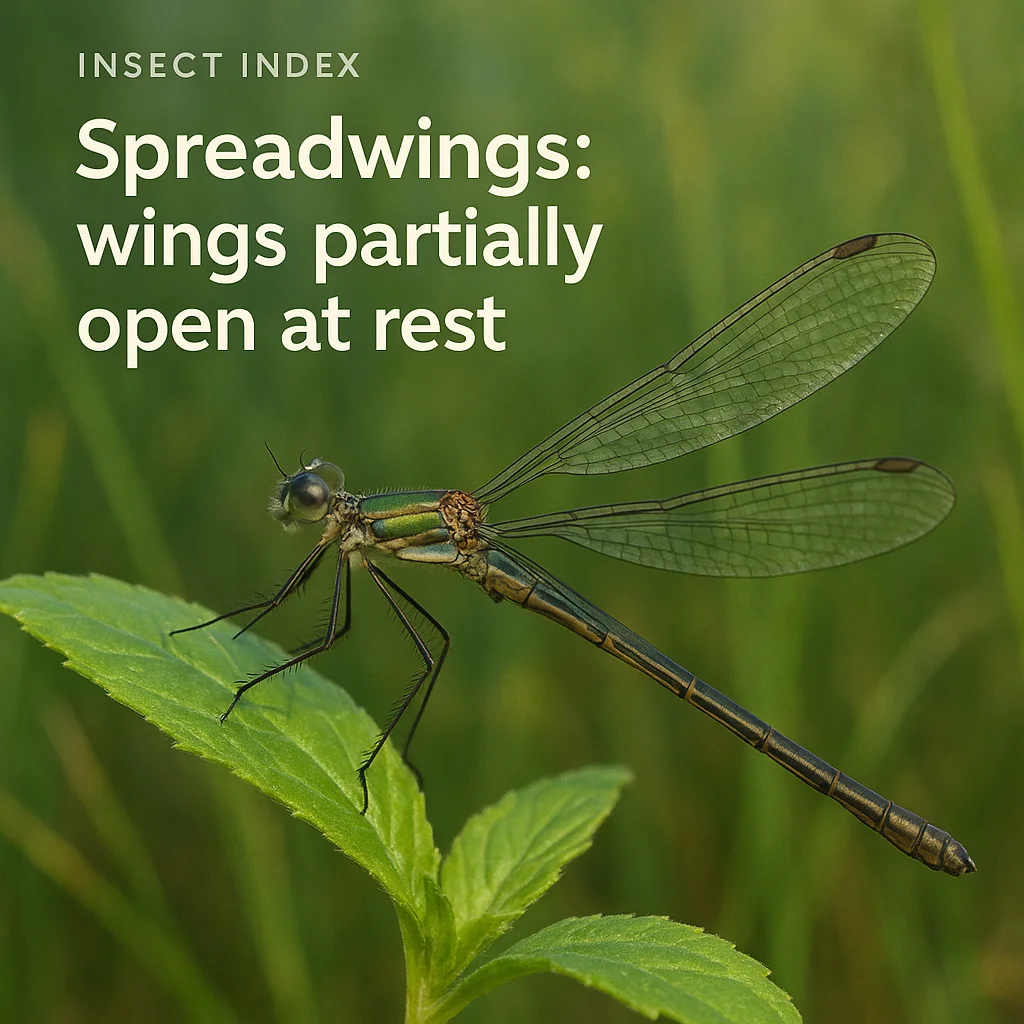
Spreadwings are an intriguing group of damselflies that exhibit a unique resting behavior by keeping their wings partially open. Unlike the typical damselfly, which rests with wings closed, spreadwings offer a distinctive silhouette that aids in identification. They belong to the family Lestidae and are distributed widely across various regions, with specific species adapted to different habitats.
- Common names: Spreadwing damselflies
- Scientific name: Varies by species
- Insect or not: Yes, they are insects, which are invertebrates
- Order / family: Odonata / Lestidae
- Typical size range (adult): 3 to 6 cm in length
- Key colors/patterns: Metallic green or blue bodies with clear wings
- Activity: Primarily diurnal
- Typical habitats: Wetlands, ponds, marshes
- Where in the world it occurs: North America, Europe, Asia
- Seasonality: Most visible in spring and summer
🔍 Identification
The spreadwings can be recognized by their slender bodies and wings that rest partially open. The elongated abdomen is usually metallic green or blue, with some species exhibiting intricate patterns or spots. Their wings are transparent and can reflect sunlight, adding to their visual allure. The antennae are short and often not very noticeable. The legs are delicate and are not adapted for long-distance travel on land. Their movement is characterized by elegant, fluttering flights close to water sources.
- Top ID Tips:
- Slim, elongated body
- Wings partially open when at rest
- Metallic or iridescent body colors
- Short antennae
- Found near water bodies
- Flight is fluttery and near the ground
- Clear, delicate wings
🧠 Basic Body Structure
As insects, spreadwings have a fundamental body structure consisting of three main parts: the head, thorax, and abdomen. They possess six legs, characteristic of all insects, and an exoskeleton that provides structural support and protection. Periodically, they undergo molting to grow. Spreadwings are invertebrates, meaning they lack a backbone and have a hard exterior shell.
🌍 Habitat & Distribution
Spreadwings favor habitats like wetlands, marshes, and ponds, where they can find abundant food sources and suitable breeding sites. They are notably found in the undergrowth of forests bordering water bodies and perch on reeds or twigs. Geographically, they are present across North America, Europe, and Asia, thriving in temperate regions. Environmental changes such as habitat destruction and water pollution can significantly impact their local populations and sightings.
📅 Seasonal Appearance & Activity
Spreadwings are most commonly visible during the warmer months of spring and summer when they are actively involved in breeding and foraging. Their activity is predominantly diurnal, with peak hours around midday when temperatures are optimal. They are less visible or inactive during adverse weather conditions, such as heavy rain or strong winds.
- Best Time to Spot It:
- Late spring to early summer
- Midday hours
- Warm, sunny days
- Around still or slow-moving water
🥚 Reproduction & Egg-Laying
Spreadwings engage in a fascinating courtship display where the males often showcase vivid colors to attract females. The mating process usually involves the male grasping the female behind the head with claspers, forming a heart-shaped tandem flight. Eggs are typically laid in submerged vegetation or floating debris, which provides protection until hatching. Egg counts can vary based on species and environmental conditions.
🌀 Metamorphosis & Life Cycle
Spreadwings undergo incomplete metamorphosis, developing through egg, nymph, and adult stages. The eggs hatch into aquatic nymphs that prey on small organisms. This stage can last from several months to a year, depending on temperature and food availability. Once fully developed, nymphs transform into winged adults after a final molt. Adults typically live for a few weeks to months, during which they reproduce and complete their life cycle.
🍽️ Diet & Feeding Behavior
These damselflies are predatory at all life stages. Nymphs feed on aquatic invertebrates such as mosquito larvae, contributing to the control of pest populations. Adults are aerial hunters, capturing small flying insects like gnats and flies using their legs. They possess chewing mouthparts adapted for consuming their prey efficiently.
🦉 Predators & Defense
Natural threats to spreadwings include birds, larger insects, and amphibians. Their primary defense mechanisms include camouflage and swift flight to evade capture. Some species exhibit startle displays by suddenly flashing their wings. Despite their non-toxic nature, their metallic colors can deter predators uncertain of their palatability.
- Defense Highlights:
- Camouflage among vegetation
- Startling wing displays
- Quick, agile flight
- Metallic body coloration
👥 Social Behavior & Swarms
Spreadwings are primarily solitary creatures, with social interactions primarily restricted to mating. While they do not form swarms like some other insects, numerous individuals may be found in suitable habitats due to the abundance of resources. Encounters with conspecifics are generally brief and related to reproductive or territorial disputes.
🧭 Senses & Communication
Spreadwings rely heavily on vision to locate prey and partners, with large compound eyes granting them keen perception. They also utilize chemical cues for mating purposes, though specific pheromone usage in spreadwings is less documented compared to other insects. Communication is minimal, mostly involving visual signals during mating displays.
🌱 Role in the Ecosystem
Spreadwings play a crucial role as both predators and prey within their ecosystems. As predators, they help control populations of small insects, reducing pest numbers. They also form part of the diet of various birds and amphibians, integrating into the broader food web. Though they are not significant pollinators, their presence indicates healthy aquatic environments, indirectly benefiting plant and animal life.
📉 Population & Conservation Notes
While many spreadwing species are commonly observed, some face challenges due to habitat destruction and water body pollution. Conservation efforts focusing on preserving wetland habitats can benefit their populations. Additionally, maintaining clean waterways supports their breeding and feeding needs.
- How to Help (Low-Impact):
- Preserve local wetlands
- Avoid using pesticides near water bodies
- Promote clean water initiatives
- Encourage native plant growth near water sources
⚠️ Human Interaction & Safety
Spreadwings are harmless to humans and do not bite or sting. These docile insects are fascinating to observe and contribute positively to ecological balance. For personal safety, it is advised to appreciate them from a distance and to avoid capturing or handling them to prevent stress to the insect.
📌 Summary
- Distinctive wings partially open at rest
- Found predominantly in wetlands and near water bodies
- Active during warm months, primarily diurnal
- Undergo incomplete metamorphosis
- Predators of small insects throughout life stages
- Camouflage and agility are key defenses
- Important role in pest control and as part of the food web
- Conservation efforts focus on habitat preservation