🕷️ Darners: fast flyers and migration
🧾 Quick Facts
The Darners are a group of dragonflies known for their impressive flying abilities and long migrations. These agile insects belong to the family Aeshnidae and are often spotted soaring swiftly over ponds and wetlands.
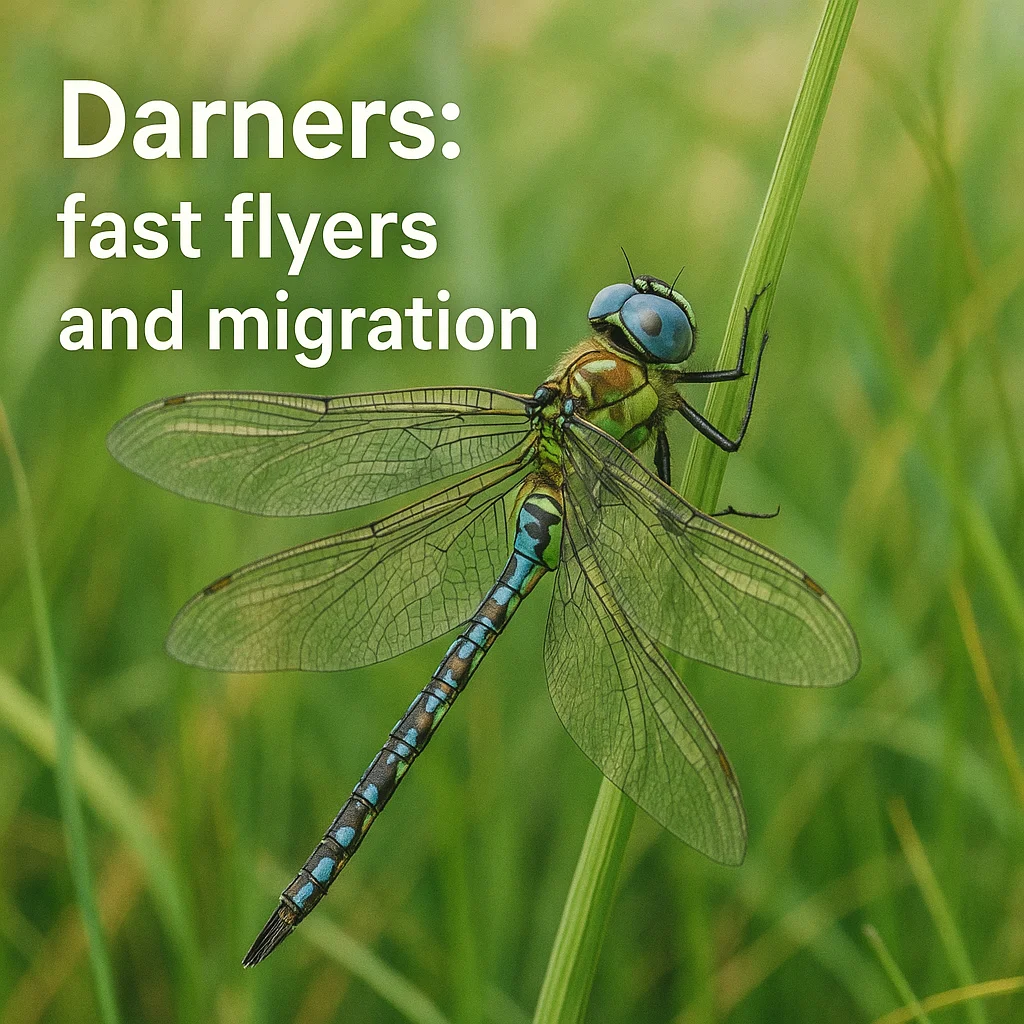
- Common names: Darners
- Scientific name: Aeshnidae (varies by species)
- Insect or not: Yes, they are insects (invertebrates)
- Order / Family: Odonata / Aeshnidae
- Typical size range: 6.5 to 9 cm in length
- Key colors/patterns: Blue, green, black patterns
- Activity: Diurnal (active during the day)
- Typical habitats: Wetlands, ponds, lakes, slow streams
- Where in the world it occurs: Found on all continents except Antarctica
- Seasonality: Most visible in spring and summer
🔍 Identification
Darners are easily recognized by their elongated bodies and striking colors. Their body shapes are bullet-like, aiding their swift flight. They have short, setaceous antennae and two pairs of similarly-sized, transparent wings that appear netted. Their legs are adapted for perching rather than walking.
- Top ID Tips:
- Long, slender bodies with vivid coloration
- Large, multifaceted compound eyes
- Transparent wings with strong venation pattern
- Typically found around water bodies
- Fast, agile flyers
- Look for horizontal resting posture on branches
- Listen for rustling sounds made as they fly among foliage
- More noticeable during sunny, warm days
- Females often seen near aquatic vegetation for egg-laying
🧠 Basic Body Structure
Darners, like all insects, are characterized by their division into three main body sections: the head, thorax, and abdomen. They sport six legs, a common trait among insects, and possess an exoskeleton that protects their internal organs. Darners have transparent wings that they use for agile flying, and being invertebrates, they lack a backbone.
🌍 Habitat & Distribution
Darners prefer habitats that are in close proximity to fresh water, such as ponds, lakes, marshes, and slow-moving rivers. They are frequently found in or near wetlands and other aquatic environments where they hunt for prey and reproduce. Geographically, darners are widespread and can be found in various climates across all continents, except Antarctica. Changes in habitat, such as water pollution or habitat destruction, can significantly affect their populations and distribution.
📅 Seasonal Appearance & Activity
The likelihood of encountering darners is highest during the warmer months of the year, predominantly in spring and summer when the temperatures rise. They are mostly active in the daylight, with increased activity during sunny and humid conditions.
- Best Time to Spot It:
- Spring through early autumn
- Midday on warm, windless days
- Sunny weather with minimal cloud cover
- Near aquatic habitats in the early afternoon
- Warm regions tend to have a longer activity season
🥚 Reproduction & Egg-Laying
Darners exhibit notable mating behaviors which often involve aerial acrobatics. The males typically establish territories near water bodies and rival against other males to gain access to receptive females. After mating, females lay their eggs in or near water, choosing substrates such as aquatic plants, mud, or submerged wood. The number of eggs laid swings significantly based on species and environmental conditions, but generally, they are laid in batches, guaranteeing greater survival chances.
🌀 Metamorphosis & Life Cycle
Darners undergo incomplete metamorphosis, consisting of three stages: egg, nymph, and adult. The eggs, once laid, hatch into aquatic nymphs, which are voracious predators, feeding on small aquatic organisms. Nymphs live underwater for several months to a few years, growing and molting multiple times as they develop. Eventually, they emerge from the water, transforming into winged adults in a final molt on a plant stem. Adult darners are primarily predators, capturing insects in mid-flight. Lifespan of adults ranges from a few weeks to several months.
🍽️ Diet & Feeding Behavior
Darners are predatory both as nymphs and adults. As nymphs, they utilize their specialized mouthparts to ambush and consume small aquatic prey such as mosquito larvae, tadpoles, and even small fish. Adults hunt using their exceptional flying capabilities, employing their strong jaws to catch and consume flying insects like mosquitoes, flies, and butterflies. Their predatory nature helps control pest populations significantly.
🦉 Predators & Defense
Darners face various natural enemies, including birds, frogs, spiders, and larger dragonflies. They employ several defense strategies such as rapid flight and evasive maneuvers to escape predation. Their coloration provides some camouflage among vegetation, and their agility in flight makes it challenging for predators to capture them.
- Defense Highlights:
- Camouflaging coloration blending with foliage
- Agile flight to escape predators
- Strong, quick wingbeats
- Early detection and fast evasion
👥 Social Behavior & Swarms
Darners are generally solitary creatures, predominantly meeting others when reproducing or sharing favorable hunting grounds. However, certain species can form collective migrations, often triggered by seasonal changes and breeding requirements. Such migrations are thought to be influenced by environmental factors including temperature and resource availability, resembling mini swarms that migrate in search of suitable breeding environments.
🧭 Senses & Communication
Darners rely heavily on their acute vision to locate prey, potential mates, and avoid threats. They have large compound eyes that provide nearly 360-degree vision, crucial for in-flight navigation and hunting. Although their reliance on other senses like smell or sound is not predominant, subtle vibrations and touch cues can play a role in interactions with other insects.
🌱 Role in the Ecosystem
Darners play a vital role in their ecosystems as regulators of insect populations. By preying on various other insects, including pest species, they help maintain ecological balance. They also serve as food sources for higher predators, becoming integral components of local food webs. Conservation of their wetland habitats benefits numerous associated species, preserving biodiversity.
📉 Population & Conservation Notes
While many darner species are commonly found in favorable habitats, threats such as habitat destruction, climate change, pollution, and the use of pesticides can negatively affect their populations. In some regions, conservation efforts focus on habitat restoration and pollution control to promote their survival and the broader health of aquatic ecosystems.
- How to Help (Low-Impact):
- Support or engage in wetland conservation
- Plant native vegetation around water bodies
- Avoid using chemical pesticides near aquatic areas
- Minimize pollution by supporting eco-friendly practices
- Create or maintain bird and insect-friendly gardens
⚠️ Human Interaction & Safety
Darners do not pose any significant threat to humans and are non-aggressive. They do not sting or bite unless roughly handled. Encouraging their presence by creating favorable environments can enhance biodiversity and help in natural pest control. Respectful observation is encouraged, while collecting or disturbing wild specimens is discouraged to prevent disruption of local populations.
📌 Summary
- Recognizable by their long bodies and vibrant colors
- Inhabit wetlands and near water bodies globally
- Most active during spring and summer, on warm days
- Undergo incomplete metamorphosis: egg, nymph, adult
- Predatory diet, helping control insect populations
- Natural predators include birds, larger insects
- Crucial roles in ecosystem functioning and pest management
- Threatened by habitat destruction and pollution
- Observe respectfully, contribute to conservation efforts