🕷️ Common fly myths (debunked)
🧾 Quick Facts
Flies are often misunderstood insects, surrounded by myths and misconceptions. Contrary to some beliefs, they play crucial roles in our ecosystems, ranging from pollination to decomposition. Below are some key facts about flies:
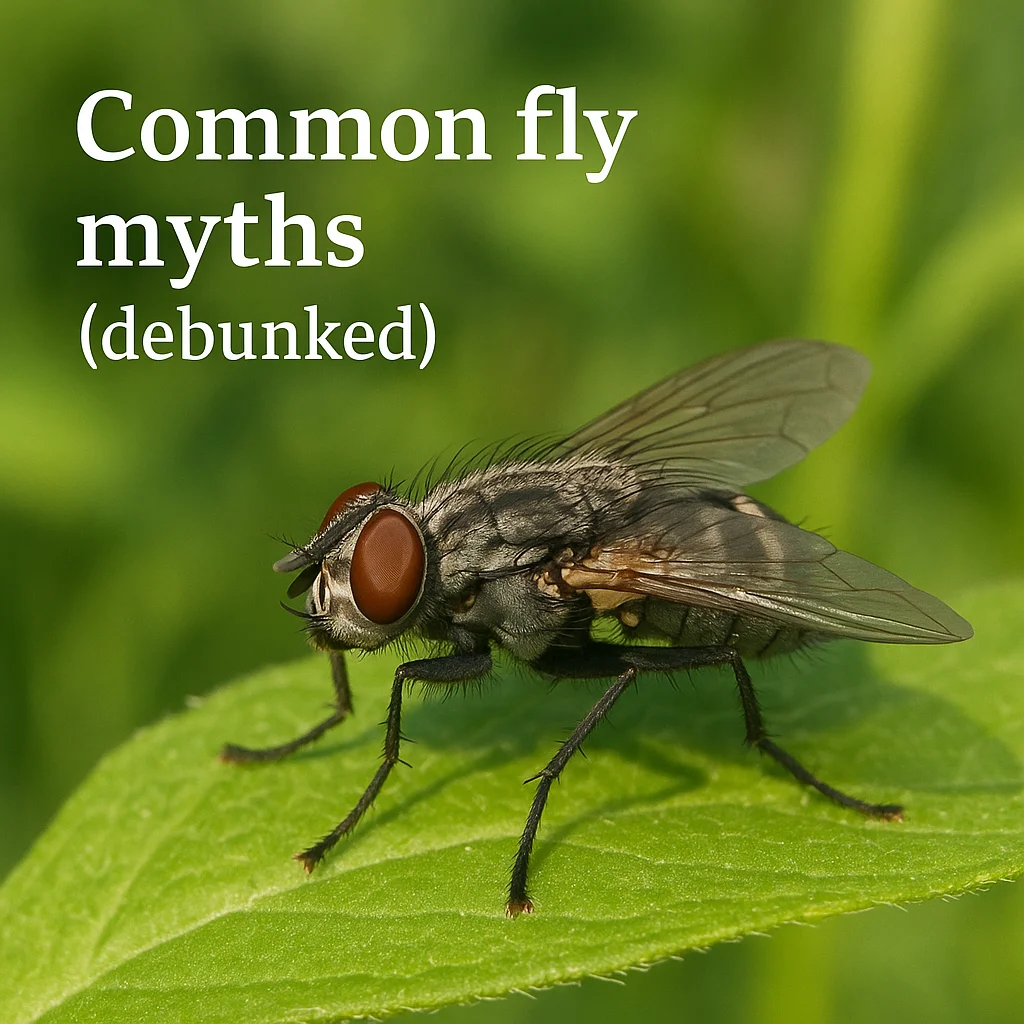
- Common names: Housefly, Bluebottle, Horsefly
- Scientific name: Varies
- Insect or not: Yes, flies are insects as they have a segmented body and six legs.
- Order / family: Diptera
- Typical size range: 3 mm to 25 mm (adult)
- Key colors/patterns: Black, grey, metallic blue, stripes
- Activity: Diurnal (active mostly during the day)
- Typical habitats: Urban areas, agricultural fields, wetlands
- Where in the world it occurs: Found globally, except in extremely cold regions
- Seasonality: Most visible in spring and summer
🔍 Identification
Flies can be identified by their unique body structure and behavior. They generally possess a compact body with two wings, which distinguishes them from other insects that possess four. The following characteristics will help you to recognize a fly:
- Body shape and silhouette: Compact, with a rounded thorax and distinct head
- Antennae type: Short and bristle-like
- Wing features: Two transparent wings, often with visible veins
- Leg traits and movement style: Six slender legs adapted for walking and clinging to surfaces
- Distinguishing look-alikes and common confusion: Often confused with bees and beetles, but those have four wings or harder bodies
- Top ID Tips:
- Check for two wings, not four.
- Look for bristle-like antennae.
- Observe the quick, erratic flight patterns.
- Note the elongated, soft body structure.
- Spot the bulbous eyes that may cover most of the head.
- Listen for the distinctive buzzing sound.
🧠 Basic Body Structure
Flies are invertebrates, as they lack a vertebral column. Their bodies are divided into three main parts: head, thorax, and abdomen. Like all insects, they have an exoskeleton that provides structural support and protection, which they outgrow and shed through a process known as molting. Their one pair of functional wings is attached to the thorax, while the reduced second pair of wings (halteres) aids in flight stability.
🌍 Habitat & Distribution
Flies are adaptable insects that inhabit diverse environments. They are common in urban settings, agricultural lands, forests, and wetlands. They often seek out decaying organic matter, which serves as a food source and breeding ground. While globally distributed, the abundance of flies can be influenced by local climate conditions, such as temperature and humidity. Changes in these conditions can affect their visibility in various habitats.
📅 Seasonal Appearance & Activity
Flies are generally more active in warmer months, with peak activity typically seen during spring and summer. They are diurnal insects, most active during daylight hours. Favorable weather conditions that are warm and moderately humid can enhance their activity levels, while cold or rainy conditions can deter them.
- Best Time to Spot It:
- Sunny days in spring and summer
- During mid-morning and afternoon
- Warm and slightly humid weather
- Open areas with abundant food sources
🥚 Reproduction & Egg-Laying
Fly mating involves various courtship behaviors depending on the species, which can include specific flight patterns and pheromone signaling. Female flies lay eggs on or near a suitable food source, such as decaying matter or feces. The number of eggs laid can vary significantly, but a single female can lay hundreds of eggs in her lifetime, ensuring a higher chance of offspring survival.
🌀 Metamorphosis & Life Cycle
Flies undergo complete metamorphosis, progressing through distinct stages: egg, larva, pupa, and adult. The lifecycle starts with the egg, which hatches into a larva (commonly known as maggot). Maggots feed voraciously on the material they were laid in and undergo several molts. After a period of growth, the larva enters the pupal stage, where it undergoes transformation. Lastly, the adult fly emerges, ready to breed and continue the cycle. The duration of each stage can vary and is influenced by environmental conditions.
🍽️ Diet & Feeding Behavior
Flies have varied diets that can change throughout their lifecycle. Adult flies primarily feed on liquids, employing sponging mouthparts to ingest food, while larvae generally consume solid matter like decomposing organic materials. Flies can act as scavengers, helping to break down and recycle nutrients, and as pollinators, contributing to the fertilization of plants.
🦉 Predators & Defense
Flies are preyed upon by a variety of creatures, including birds, amphibians, reptiles, spiders, and mammals. To defend against predators, flies rely on rapid, agile flight, which enables them to escape quickly. Some species utilize mimicry or camouflage to avoid detection.
- Defense Highlights:
- Quick, evasive flight
- Mimicry of stinging insects to avoid predators
- Ability to hide in small crevices
- High reproduction rate to offset predation
👥 Social Behavior & Swarms
Most fly species are solitary, focusing their interactions on mating and competition for resources. However, some flies can be seen swarming, which typically occurs for mating purposes or in response to favorable environmental factors, such as abundant food or optimal breeding conditions.
🧭 Senses & Communication
Flies have well-developed senses that they use to communicate and navigate their environment. They have compound eyes that give them a wide field of vision, allowing for quick detection of movement. Antennae play a pivotal role in smell, helping flies locate food sources and identify mates. In some species, vibrations and wing movements are used for communication, particularly during courtship.
🌱 Role in the Ecosystem
Flies are significant contributors to their ecosystems. As pollinators, they assist in the reproduction of various plant species. They act as decomposers, breaking down dead material and recycling nutrients back into the ecosystem. While some flies can transmit diseases to humans, their overall ecological contributions are valuable, helping maintain ecological balance.
📉 Population & Conservation Notes
Flies are generally abundant and common worldwide, thriving in numerous environments. However, local populations may be affected by habitat destruction, pesticide use, and climate change. Conservation efforts focus on maintaining natural habitats and minimizing chemical use to support the biodiversity they contribute to.
- How to Help (Low-Impact):
- Plant native flowers to support pollinators
- Reduce pesticide usage in gardens
- Promote organic waste recycling
- Leave areas of leaf litter undisturbed
⚠️ Human Interaction & Safety
Some flies are known to bite, such as horseflies, primarily to feed on blood, whereas most common flies do not. In the event of a bite, washing the area to prevent infection is advisable. If severe reactions occur, professional advice should be sought. It is essential to observe flies respectfully in their natural environment without collecting or harming them.
📌 Summary
- Flies are identifiable by their two-wing structure and erratic flight.
- Found globally, they thrive in varied habitats such as urban areas and wetlands.
- Most active during warm, sunny months, particularly during the day.
- Undergo complete metamorphosis from egg to adult.
- Serve vital ecological roles as pollinators and decomposers.
- Predators include birds, reptiles, and amphibians. Defense includes quick flight and mimicry.
- Though solitary, some species swarm under favorable conditions.
- Communication relies on visual and olfactory cues.
- Local populations may be impacted by environmental changes.
- Exercise respectful observation practices without harming or collecting.