🕷️ Fungus Gnats Tiny Plant-pot Fliers And Soil Tips
🧾 Quick Facts
Fungus gnats, although often considered nuisances in indoor gardening, are fascinating creatures that have adapted well to the environments where we cultivate plants. Here is a snapshot of their characteristics:
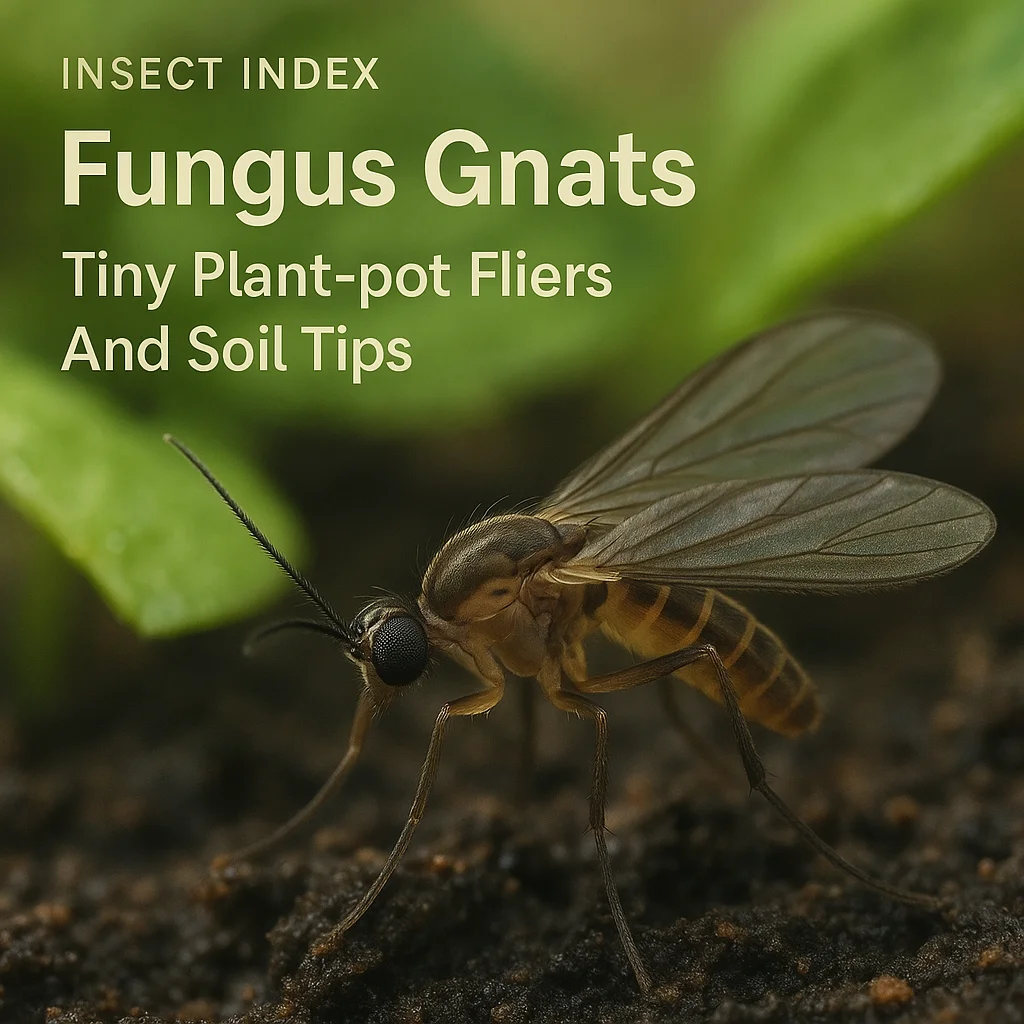
- Common names: Fungus gnat, darkwinged fungus gnat
- Scientific name: Varies (families include Sciaridae, Mycetophilidae)
- Insect or not: Yes, fungus gnats are insects, characterized by three-part bodies and six legs
- Order / family: Order Diptera; Families Sciaridae, Mycetophilidae
- Typical size range (adult): 1.5 to 4 mm in length
- Key colors/patterns: Generally black or dark brown with long legs
- Activity: Mainly active during the day
- Typical habitats: Potted plants, damp soil, greenhouses, gardens
- Where in the world it occurs: Globally common where indoor plants are grown
- Seasonality: Can be seen year-round in indoor settings
🔍 Identification
Fungus gnats are small, delicate flies that, due to their size and appearance, can be easily mistaken for other tiny insects. Identification involves several visual cues:
Their bodies appear long with a distinct slender shape, complemented by characteristic long legs which make them seem almost spidery. The antennae are distinct, typically long and thread-like, making them distinguishable from common fruit flies.
Their wings are clear with a simplistic venation pattern, appearing slightly smoky or dark when held against light. Fungus gnats have a slow, erratic flying style that resembles hovering.
These gnats are commonly mistaken for small mosquitoes; however, their non-biting mouthparts and plant association differentiate them significantly.
- Top ID Tips:
- Slender, dark body
- Long, thin legs and antennae
- Clear wings with minimal venation
- Erratic, weak flight pattern
- Presence around potted plants
- Non-biting mouthparts
- Often seen resting on plant pots
🧠 Basic Body Structure
Fungus gnats, like other insects, have a body divided into three main sections: the head, thorax, and abdomen. Their six legs help support navigational stability during flight and stillness.
Their hard outer shell, or exoskeleton, provides protection and support. Like most insects, they possess both compound eyes and simple eyes, aiding in their ability to respond to light changes.
As invertebrates, fungus gnats lack a spinal column, relying entirely on their external skeleton for body support.
🌍 Habitat & Distribution
Fungus gnats thrive in environments with abundant moisture and organic material, making indoor settings with potted plants a perfect habitat. They favor the top 1 to 2 inches of potting mix where conditions are ideal for their larvae.
They are native to a variety of environments, from forests and wetlands to urban gardens around the world, including North America, Europe, and parts of Asia.
Due to their adaptability, they are present wherever humans maintain warm, humid environments with sufficient organic decomposition.
📅 Seasonal Appearance & Activity
Fungus gnats do not adhere to a strict seasonal appearance due to their preference for indoor habitats and environments under controlled conditions. They are usually seen:
- Best Time to Spot It:
- Year-round in controlled environments like greenhouses
- During plant overwatering periods
- In moderate to high humidity areas
- In regions with temperate climates, although less frequently outdoors
🥚 Reproduction & Egg-Laying
Fungus gnats engage in direct mating without extensive courtship rituals. Females lay their eggs on the surface of moist soil or decaying organic matter, where their offspring will find adequate nutrition upon hatching.
Eggs are usually laid in clusters, with a single female capable of laying hundreds over her short lifetime, although variations can occur with environmental changes.
🌀 Metamorphosis & Life Cycle
Fungus gnats undergo complete metamorphosis, which includes stages of egg, larva, pupa, and adult.
• Egg Stage: Eggs are laid in moist soil. They hatch within three to six days, depending on temperature and humidity.
• Larval Stage: The larvae, which are white and translucent, feed on organic matter in the soil. This stage lasts about two weeks.
• Pupal Stage: The larvae pupate in the soil, where metamorphosis continues over three to four days.
• Adult Stage: Adults emerge to mate and lay eggs, living for about one week.
🍽️ Diet & Feeding Behavior
In their larval stage, fungus gnats feed on organic matter within the soil, including decomposing plant material and fungi. They may sometimes consume root hairs, causing damage to seedlings and young plants under high populations.
Adults primarily consume nectar and do not harm plants, making them harmless aside from being an annoyance.
🦉 Predators & Defense
Fungus gnats are prey to several natural enemies, including arachnids, predatory beetles, and nematodes. Their primary defense strategy is their size and speed, allowing them to evade predators with quick, erratic flight movements.
- Defense Highlights:
- Small size and elusive flight
- High reproductive rate
- Thriving in moist soil environments
- Production of eggs in secure, hidden spots
👥 Social Behavior & Swarms
Fungus gnats are not social insects. They do not form organized colonies or social structures; rather, they live solitary lives except during mating encounters. Occasional swarms may appear around light sources at dusk as they congregate transiently.
🧭 Senses & Communication
Fungus gnats rely predominantly on vision and pheromones for mating and locating suitable environments. They are sensitive to light and are often attracted to bright lights during dark hours.
Communication is mainly through chemical signaling between larvae and adults, guiding them toward nutrient-rich environments.
🌱 Role in the Ecosystem
Fungus gnats contribute to decomposition by breaking down organic materials in the soil, which benefits plant nutrient cycling. Their larvae, by consuming fungi and decaying matter, help maintain soil health.
They also play a minor role in pollination, although this is not their primary ecological contribution.
📉 Population & Conservation Notes
Fungus gnats are frequently reported as common in suitable habitats, especially within human-controlled environments. Local abundance can vary depending on available organic material and moisture levels.
Conservation is not a critical issue for fungus gnats due to their wide distribution and adaptability.
- How to Help (Low-Impact):
- Maintain balanced watering practices
- Encourage biodiversity in gardens
- Reduce pesticide use to allow natural predators
- Utilize natural fertilizers
⚠️ Human Interaction & Safety
Fungus gnats do not bite or sting and are considered harmless to humans and pets. They are primarily a nuisance due to their presence in high numbers around plants.
If any irritation occurs when dealing with them, such as skin contact with the soil, washing the area with soap and water is advisable.
Observation of fungus gnats should focus on respecting these creatures, appreciating their role in natural decomposition, and promoting methods that balance their populations without collection or harm.
📌 Summary
- Identify fungus gnats by their dark, slender bodies and erratic flight
- Found year-round in moist, organic-rich environments
- Undergo complete metamorphosis, with larvae feeding on soil matter
- Harmless to humans, although can damage young plants in high numbers
- Serve important roles in decomposition and nutrient recycling
- Natural predators include spiders and soil-dwelling beetles
- Populations thrive in indoor environments with organic plant material
- Best managed by natural water regulation and predator encouragement