🕷️ Horse Flies And Deer Flies Painful Bites And Habitat Clues
🧾 Quick Facts
Horse flies and deer flies are notorious for their painful bites and are part of a group of biting flies in the family Tabanidae. They are known to inhabit many parts of the world and exhibit noticeable differences in appearance and behavior between species.
- Common names: Horse flies, deer flies
- Scientific name: Varies (Family: Tabanidae)
- Insect: Yes, they are invertebrates
- Order: Diptera
- Typical size range (adult): 5mm to 25mm
- Key colors/patterns: Black, brown, gray, often with banded wings
- Activity: Primarily diurnal (active during the day)
- Typical habitats: Wetlands, forests, grasslands
- Where in the world it occurs: Found worldwide, particularly temperate and tropical regions
- Seasonality: Most visible in warmer months
🔍 Identification
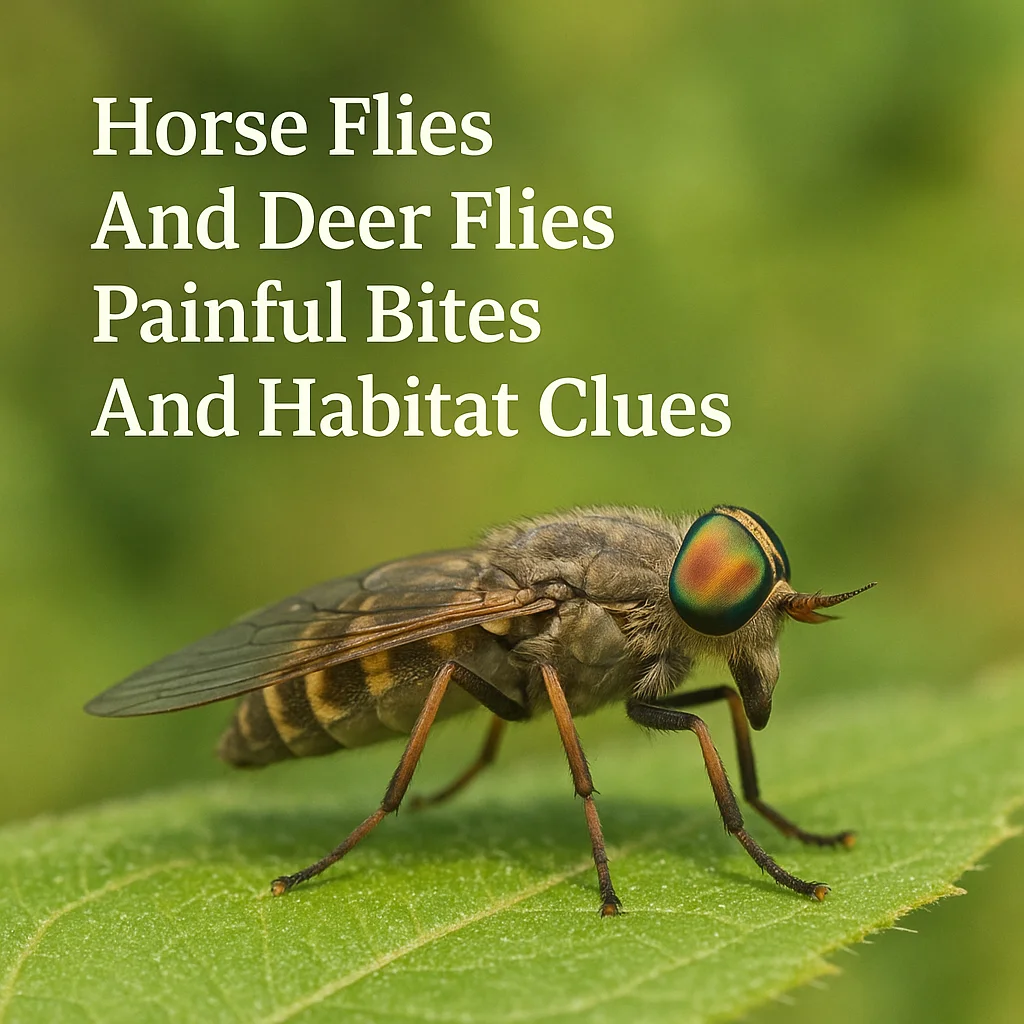
Identifying horse flies and deer flies involves understanding their body structure and distinctive features. Both are robust flies with a noticeable size and can be distinguished by their wing patterns and head shapes.
- Horse flies generally have a stocky body and prominent compound eyes.
- Deer flies are smaller, often with patterned wings.
- Both have short antennae and strong wing venation.
- Legs are typically long, aiding in swift flight.
- Comprehensive full-body images are crucial, showing head to abdomen.
- Common look-alikes include bees and wasps, but flies lack long stingers.
- Top ID Tips:
- Check for banded or clear wings for deer flies.
- Observe eye colors; green or iridescent hues are common.
- Listen for their distinctive buzz during warm days.
- Examine leg position and movement when perched or flying.
- Identify by bite symptoms; horse fly bites cause welts.
- Take note of flight patterns; short, direct flights are typical.
🧠 Basic Body Structure
Being true insects, horse flies and deer flies possess the fundamental structures of the class Insecta. This includes a clearly defined head, thorax, and abdomen. Each of these sections plays distinct roles in their biology and behavior.
With their six legs, these flies are adept at rapid movement. They have a hard exoskeleton that offers both protection and support. As invertebrates, they lack internal spines, and their rigidity comes from an exoskeleton, which they shed through molting.
🌍 Habitat & Distribution
Horse flies and deer flies are highly adaptable and frequent a variety of habitats. Their preference usually leans towards moist environments where their larvae can thrive. Wetlands, bogs, meadows, and forests are typical environments where they are found, though some species have adapted to drier habitats.
Geographically, they are distributed globally, being particularly abundant in temperate and tropical climates. Variations in habitat availability can affect local abundance and distribution, as can changes in land use that alter their preferred environments.
📅 Seasonal Appearance & Activity
These flies are most often observed during warmer seasons when environmental conditions favor their lifecycle. Their activity peaks in the heat of the day, diminishing as temperatures drop.
- Best Time to Spot It:
- Spring through late summer
- Warm, sunny days
- Away from storms and high winds
- Near still or slow-moving water bodies
🥚 Reproduction & Egg-Laying
Mating behaviors among horse flies and deer flies include flight displays and territorial battles, primarily initiated by males to attract females. Eggs are typically laid in masses on plants, rocks, or soil near water sources.
The number of eggs per laying event varies by species but can often reach hundreds. These eggs hatch into larvae that develop in moist environments, such as mud or decaying organic matter.
🌀 Metamorphosis & Life Cycle
Horse flies and deer flies undergo complete metamorphosis, passing through the stages of egg, larva, pupa, and adult. Each stage has distinct ecological roles and adaptations.
Larvae are primarily aquatic or semi-aquatic, living in moist conditions and feeding on detritus or small organisms. Pupal stages usually occur in protected soil niches, lasting a few weeks to several months, depending on environmental conditions. Adult flies emerge ready to feed and reproduce.
🍽️ Diet & Feeding Behavior
The different life stages of horse flies and deer flies lead to diverse feeding habits. Larvae feed on organic material and small invertebrates. Adult flies are known for their blood-feeding habits; females require blood meals for egg development.
Possessing piercing-sucking mouthparts, these flies can penetrate animal skin to access blood, often targeting livestock and humans. Males, by contrast, often feed on flower nectar and plant juices.
🦉 Predators & Defense
Several natural predators of horse flies and deer flies include birds, amphibians, reptiles, and predatory arthropods. These flies adopt numerous defense mechanisms, such as rapid flight and erratic movements, which make it difficult for predators to capture them.
- Defense Highlights:
- Camouflage in natural habitats
- Rapid, unpredictable flying
- Thick exoskeleton to withstand minor impacts
- Combining flight with short sprints for escape
👥 Social Behavior & Swarms
Horse flies and deer flies are largely solitary, with swarming behavior primarily restricted to mating contexts. They do not form colonies or engage in cooperative activities commonly observed in social insects like bees and ants.
During mating periods, however, small groups may gather around suitable breeding sites, driven by reproductive pheromones and environmental indicators.
🧭 Senses & Communication
These flies have highly developed senses that aid in their survival and reproduction. Vision plays a crucial role; their compound eyes provide extensive visual fields, critical for spotting mates and avoiding predators.
Communication mostly occurs through visual and chemical cues, especially during mating seasons. Pheromones guide individuals to breeding sites, while visual signals play roles during courtship displays.
🌱 Role in the Ecosystem
As ecological participants, horse flies and deer flies contribute to food webs both as pollinators and prey. While their larvae aid in nutrient cycling through detritus consumption, adults serve as pollinators for some wildflowers, though this role is secondary to their blood-feeding habits.
Their presence impacts human agriculture as well by causing stress to livestock, sometimes reducing grazing efficiency and productivity.
📉 Population & Conservation Notes
Horse flies and deer flies are not generally considered endangered, with local abundance varying by habitat quality and availability. Urbanization and wetlands degradation pose more significant threats in certain areas.
- How to Help (Low-Impact):
- Preserve natural wetland habitats
- Encourage native flora growth
- Avoid using harmful pesticides
- Support conservation of natural water systems
⚠️ Human Interaction & Safety
Horse flies and deer flies can be aggressive when seeking blood meals, causing painful bites. These bites can cause welts and itching but are generally not medically dangerous.
If bitten, washing the area with soap and water and avoiding scratching are recommended. Seek professional advice if you experience severe reactions. It's crucial to observe these insects respectfully to avoid bites and promote conservation education.
📌 Summary
- Identified by stocky bodies and banded wings
- Common in wetlands and forests worldwide
- Most active during warm, sunny days
- Undergo complete metamorphosis
- Larvae feed on detritus; adults may consume nectar and blood
- Predators include birds and amphibians
- Important food-web participants, sometimes pollinators
- Human interaction generally involves painful bites