🕷️ Houseflies Why They Land On Everything And How To Reduce Them
🧾 Quick Facts
Houseflies are one of the most common insect intruders found in human households globally. Despite their nuisance, they play complex roles in ecosystems. The housefly is not a single species but represents various types that display similar behaviors and characteristics. Understanding their biology and habits can help in managing their presence indoors.
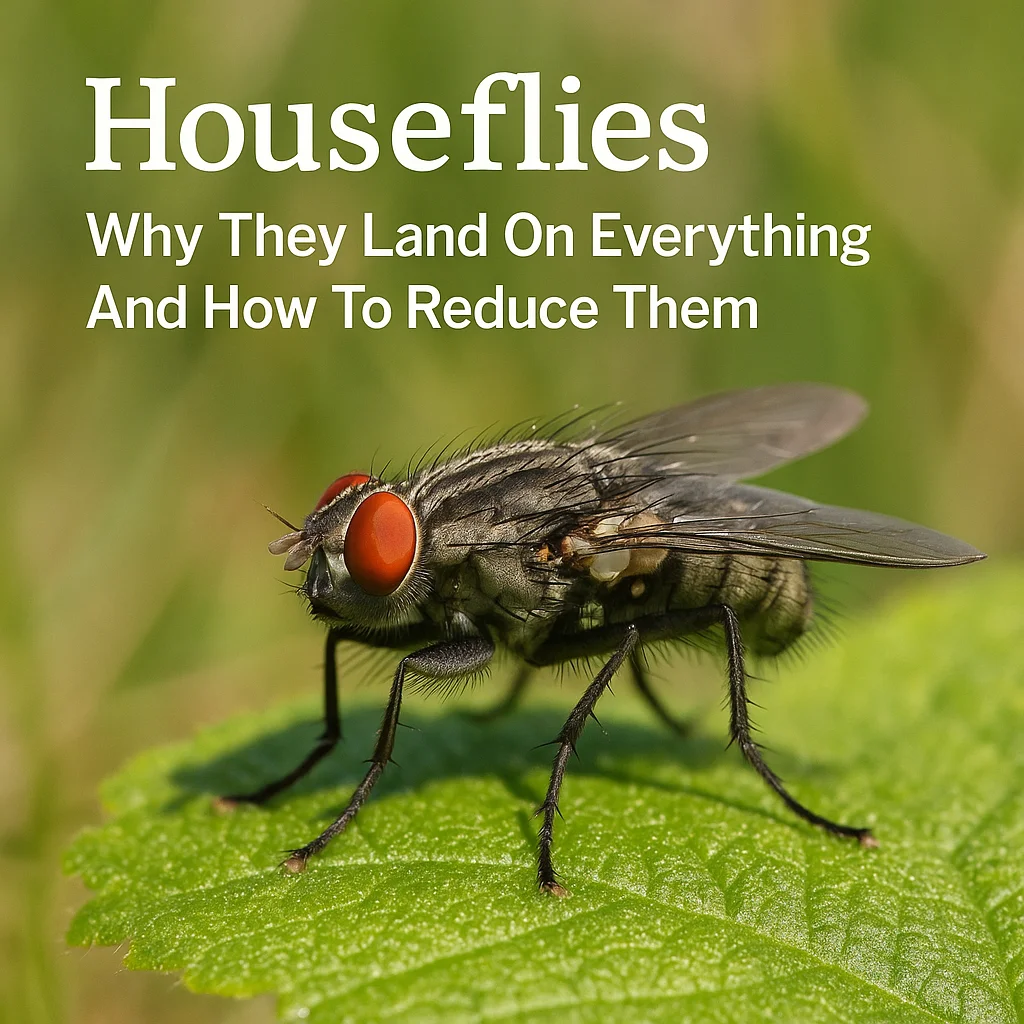
- Common names: Housefly, Common fly
- Scientific name: Varies (Musca domestica is the most recognized)
- Insect or not: Yes, invertebrate
- Order / family: Diptera / Muscidae
- Typical size range: 5 to 8 mm (adult)
- Key colors/patterns: Gray thorax with four dark stripes
- Activity: Diurnal
- Typical habitats: Urban areas, farms, garbage dumps
- Where in the world it occurs: Worldwide
- Seasonality: Most common in warmer months
🔍 Identification
Recognizing a housefly in the field requires attention to certain physical characteristics. Houseflies have a compact body shape, clearly segmented into the head, thorax, and abdomen. Their antennae are short and barely noticeable. They possess a single pair of wings with distinctive veins and small halteres (balancing organs) behind each wing. Their legs are relatively long compared to their body size, aiding in nimble movement.
Houseflies can often be confused with other small flies but are distinguished by their robust build and specific wing markings. Look-alikes include blowflies and other domestic flies.
- Top ID Tips:
- Check for the gray thorax with four black stripes.
- Observe the single pair of wings.
- Look for the small halteres for balance behind the wings.
- Notice the quick, erratic flight pattern.
- Examine the short, inconspicuous antennae.
- Identify the predominately dull green or gray abdomen.
🧠 Basic Body Structure
Houseflies are a classic example of an insect, having three main body parts: the head, thorax, and abdomen. They possess six legs, essential for mobility and manipulation of food. Their exoskeleton provides protection and structural support, requiring them to molt to grow. Houseflies have a notable invertebrate status, meaning they lack a backbone, unlike vertebrate organisms. Their flight is powered by one pair of functional wings, with the reduced second pair forming halteres for balance and stability during flight.
🌍 Habitat & Distribution
The housefly thrives in environments rich in organic matter, commonly found in urban landscapes, agriculture areas, and near human settlements. They exploit microhabitats such as garbage bins, compost heaps, and animal farms where decaying materials and waste provide necessary resources. Geographically, they are present on every continent except Antarctica, preferring temperate and tropical climates. Changes in human waste management and urbanization can significantly impact their population distribution and density.
📅 Seasonal Appearance & Activity
Houseflies are most commonly observed during warmer months, when temperatures facilitate their breeding and feeding activities. They are diurnal, primarily active during daylight hours. Weather fluctuations such as increased humidity may enhance their activity, while cold temperatures typically reduce their numbers. Their presence indoors may extend into cooler months due to artificial heating.
- Best Time to Spot It:
- Late spring to early autumn
- During sunny, warm weather
- Daytime, especially afternoon
- After periods of rain, in humid conditions
🥚 Reproduction & Egg-Laying
Houseflies exhibit rapid reproductive cycles, with females laying batches of eggs multiple times over their lifespan. Courtship involves specific wing movements and pheromone release, generally occurring in areas rich with organic matter. Eggs are laid in groups on decaying materials like food waste and animal excrement, where ample food is available for emerging larvae. The typical egg count varies, with females laying hundreds of eggs in their lifetime, depending on environmental factors like temperature and resource availability.
🌀 Metamorphosis & Life Cycle
Houseflies undergo complete metamorphosis, transitioning through four distinct stages: egg, larva, pupa, and adult. Eggs hatch within a day, leading to the larval stage, where maggots feed voraciously on decomposing organic matter. This stage lasts about three to five days under favorable conditions. Following this, larvae enter the pupal phase, encased in a protective shell, where transformation into adults takes place over several days.
Adult houseflies lead a largely aerial life, feeding on a wide range of substances using sponging mouthparts. Their entire lifecycle from egg to adult can complete in as little as ten days, allowing populations to increase swiftly under optimal conditions.
🍽️ Diet & Feeding Behavior
Houseflies are opportunistic feeders at both larval and adult stages. Larvae consume decomposing organic matter, efficiently breaking down waste materials. Adults have sponging mouthparts suited for liquid consumption, feeding on sugary substances, decaying materials, and any moist organic matter they encounter. This feeding behavior aids in nutrient recycling but also leads to the spread of pathogens and contaminants.
🦉 Predators & Defense
Houseflies face predation from various animals, including birds, reptiles, amphibians, spiders, and certain parasitic wasps. Their primary defense strategies include quick flight and the ability to locate themselves in high-density human habitations, making individual capture challenging. They lack physical defenses like stingers or robust exoskeleton but rely on speed and numbers for survival.
- Defense Highlights:
- Rapid, erratic flight to evade capture
- High reproductive rate to offset predation
- Flocking to locations rich in food resources
- Utilizing human structures for shelter
👥 Social Behavior & Swarms
Houseflies do not form structured colonies but can be observed in swarms in environments favorable for feeding and reproduction. These gatherings are typically triggered by the abundance of resources rather than social interactions. While solitary in terms of lifecycle initiatives, their swarms represent opportunistic congregation rather than familial cooperation.
🧭 Senses & Communication
Houseflies rely heavily on their keen sense of smell and sight. Compound eyes grant them wide, multifaceted vision, crucial for detecting movement and potential threats. Olfactory receptors are tuned to detect volatile compounds, guiding them to food sources. Although houseflies do not communicate through complex linguistic means, they respond to environmental stimuli and pheromones.
🌱 Role in the Ecosystem
Houseflies contribute significantly to ecosystems as decomposers, breaking down organic matter and recycling nutrients. Their larvae play a critical role in waste degradation. In some regions, adult houseflies serve as minor pollinators for certain plant species. However, their proximity to human activity can result in the transmission of diseases, painting them as both beneficial decomposers and vectors for pathogens.
📉 Population & Conservation Notes
Houseflies are often reported as common in suitable habitats, with local abundance influenced by temperature, sanitation, and human activity. While not threatened, their populations can become problematic in poorly managed areas, leading to increased interest in control measures. Promoting good hygiene practices and proper waste disposal are crucial in managing their numbers effectively.
- How to Help (Low-Impact):
- Maintain clean living areas by disposing of waste properly
- Encourage the use of natural predators where feasible
- Implement proper composting techniques to manage waste
- Avoid unnecessary pesticide use to maintain ecological balance
⚠️ Human Interaction & Safety
Houseflies do not bite or sting; however, their feeding habits can lead to the spread of contaminants. Practicing proper sanitation and hygiene is essential in preventing potential health issues associated with their presence. It's important to wash surfaces and avoid contact with open wounds if flies are known to be present. Collecting or killing them in large numbers is not necessary; instead, focus on reducing attractants indoors respectfully.
📌 Summary
- Identification: Gray bodies with dark stripes; quick flyers
- Habitat: Prefers urban and semi-urban settings rich in organic waste
- Seasonality: Most visible during warmer months; diurnal
- Life Cycle: Complete metamorphosis; fast reproduction
- Diet: Opportunistic feeders; decomposers and scavengers
- Predators: Birds, reptiles, spiders, parasites
- Ecology: Vital decomposers; minor pollinators
- Human Notes: Hygiene critical; manage presence with proper sanitation