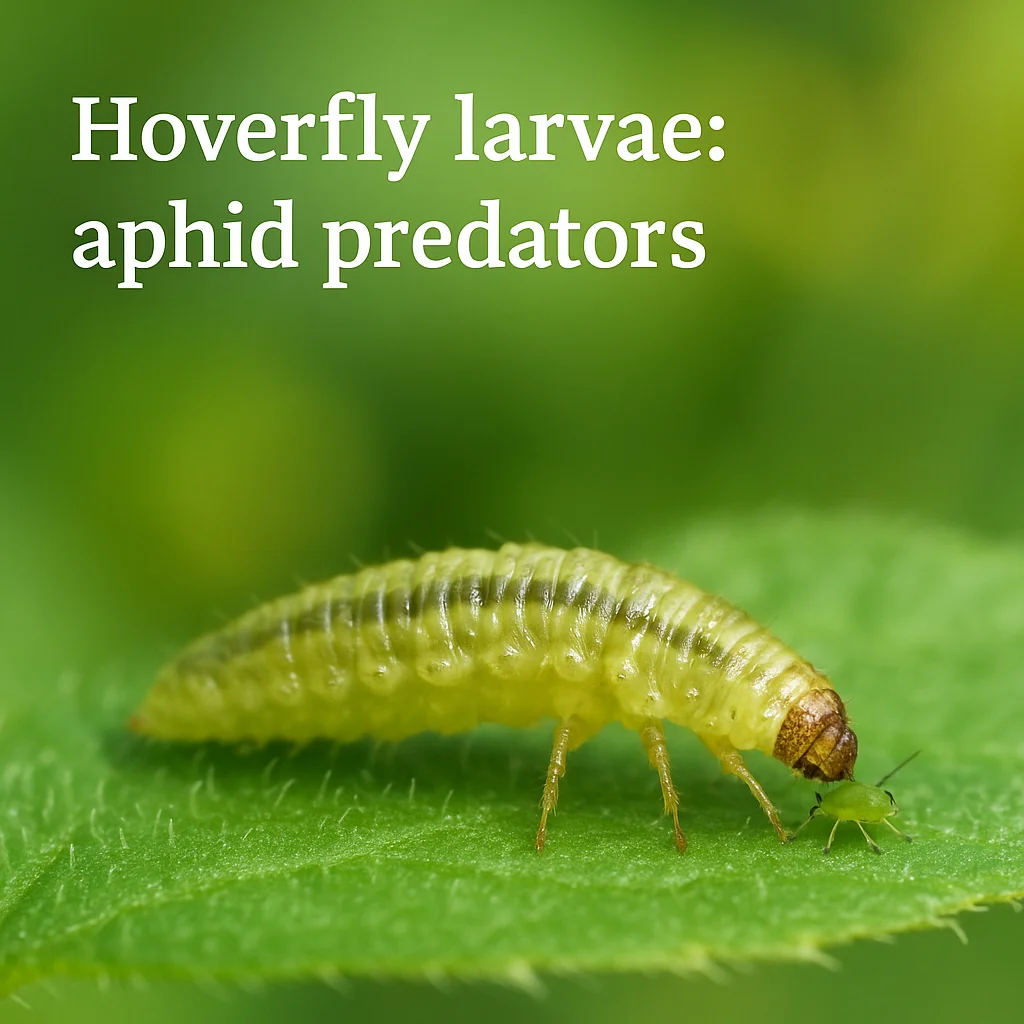
🕷️ Hoverfly larvae: aphid predators
🧾 Quick Facts
Hoverfly larvae are a group of insects well-known for their role in controlling aphid populations. These larvae belong to the Syrphidae family and are often found in various gardens and fields around the world.
- Common Names: Hoverflies, Syrphid flies, Flower flies
- Scientific Name: Varies by species (e.g., Syrphus ribesii)
- Insect or Not: Invertebrate, classified as insects
- Order / Family: Diptera / Syrphidae
- Typical Size Range: 5 to 20 mm
- Key Colors/Patterns: Often yellow and black, resembling bees or wasps
- Activity: Primarily diurnal (active during the day)
- Typical Habitats: Gardens, fields, meadows, forests
- Where in the World: Found on all continents except Antarctica
- Seasonality: Adults most visible in spring and summer
🔍 Identification
Hoverfly larvae can be recognized by their elongated, cylindrical bodies and lack of legs. Unlike adults, larvae do not have wings. They move by wriggling their bodies.
- Body shape and silhouette: Cylindrical, legless larvae
- Antennae type: Simple and short on adults
- Wing features: Wings are found only on adults
- Leg traits and movement style: Larvae lack legs and move by wriggling
- Distinguishing look-alikes: Resemble some caterpillars but are legless
- Top ID Tips:
- Cylindrical, legless body
- Often found under leaves or near aphid colonies
- Color varies from green to brown
- Distinct wriggling movement
- Small, inconspicuous eyes on larvae
- Secretive and often hidden under foliage
🧠 Basic Body Structure
Hoverfly larvae have a simple body structure comprising of a head, thorax, and abdomen. As insects, they typically have a hard exoskeleton, which they shed during molting. Adult hoverflies have six legs and two wings.
Hoverfly larvae are invertebrates, meaning they do not have a backbone. Instead, their bodies are supported by an external skeleton (exoskeleton).
🌍 Habitat & Distribution
Hoverfly larvae are found in a variety of habitats, including gardens, parks, meadows, and forests. They prefer environments where aphids are abundant, as these are their main food source.
This group of insects is geographically widespread, occurring on every continent except Antarctica. They thrive in temperate climates but can also be found in tropical and subtropical regions.
Changes in habitat, such as increased urbanization and changes in land use, can impact their distribution and sightings.
📅 Seasonal Appearance & Activity
Hoverfly larvae are most commonly observed in the spring and summer months, when aphid populations peak. They are diurnal, meaning they are active during the day and typically rest at night.
Weather conditions such as temperature and humidity can affect their activity levels. Warmer weather generally leads to increased larval activity.
- Best Time to Spot It:
- During spring and summer
- On warm, sunny days
- Near aphid-infested plants
- In daytime, when larvae are more active
🥚 Reproduction & Egg-Laying
Hoverflies have fascinating mating behaviors often involving aerial displays and complex courtship rituals. The females lay their eggs strategically near aphid colonies to provide immediate food for the hatching larvae.
The typical egg count varies between species, but a female can lay hundreds of eggs during her lifetime. These eggs are often laid on the underside of leaves, concealed from predators.
🌀 Metamorphosis & Life Cycle
Hoverflies undergo complete metamorphosis, consisting of four stages: egg, larva, pupa, and adult.
In the larval stage, they feed voraciously on aphids, their primary food source. This stage can last several days to weeks, depending on the species and environmental conditions.
After the larval stage, they pupate, forming a protective casing where they undergo transformation into adult hoverflies. This pupal stage is usually brief, lasting a few days.
Adult hoverflies emerge to feed on nectar and pollen. They are active pollinators and play a significant role in the ecosystem.
🍽️ Diet & Feeding Behavior
Hoverfly larvae are predominantly predatory, feeding primarily on aphids. Their mouthparts are adapted for piercing and digesting soft-bodied insects.
As larvae, they help control aphid populations in gardens and fields. Adults switch to plant-based diets, feeding on nectar and pollen, and are important pollinators.
🦉 Predators & Defense
Hoverfly larvae have several natural predators, including birds, spiders, and parasitoid wasps. Their primary defense strategy is camouflage, as they often blend into their surroundings.
Some species might have chemical defenses or mimic toxic species to deter predators.
- Defense Highlights:
- Camouflage with plant material
- Some mimicry of stinging insects
- Quick movement to evade capture
- Shedding skin to escape predator grip
👥 Social Behavior & Swarms
Hoverfly larvae are solitary and do not exhibit social behaviors. They are focused on feeding and do not establish territories or social structures.
Adult hoverflies do not form swarms, but can sometimes be seen in large numbers when food resources are abundant.
🧭 Senses & Communication
Hoverflies rely heavily on vision and smell. Their compound eyes provide a wide field of view, and they use their sense of smell to locate flowers and potential mates.
Communication in hoverflies is minimal, often restricted to visual and chemical cues related to mating and resource location.
🌱 Role in the Ecosystem
Hoverfly larvae play a crucial role in natural aphid control, providing a natural pest management service to gardens and agricultural settings. This predation helps maintain plant health and reduces the need for chemical insecticides.
As adults, hoverflies are significant pollinators, aiding in the reproduction of many flowering plants. Their presence contributes to healthier ecosystems and greater biodiversity.
📉 Population & Conservation Notes
Hoverflies are generally common in many suitable habitats, but their populations can be impacted by habitat loss, pesticide use, and climate change.
- How to Help (Low-Impact):
- Plant native flowers to provide nectar sources
- Limit pesticide use to protect larvae
- Leave areas of leaf litter for habitat
- Create insect-friendly garden spaces
⚠️ Human Interaction & Safety
Hoverfly larvae pose no direct threat to humans. They do not bite or sting. Observing them can be an enlightening experience for nature enthusiasts, but it's important to do so respectfully and avoid collecting or disturbing them.
If handling any insects, general advice includes washing your hands afterward and avoiding any contact with sensitive areas like the eyes or mouth.
📌 Summary
- Hoverfly larvae are key aphid predators.
- They thrive in gardens, fields, and meadows.
- Best seen during spring and summer, on warm, sunny days.
- Undergo complete metamorphosis: egg, larva, pupa, adult.
- Larvae feed on aphids; adults on nectar and pollen.
- Natural enemies include birds and parasitoids.
- Play vital roles in aphid control and pollination.
- Population affected by habitat loss and pesticides.