🕷️ Sand Flies What They Are And Where They Bite
🧾 Quick Facts
Sand flies are small, blood-feeding insects known for their role as pests and vectors of diseases. They are found in various regions around the world and are predominantly active during warmer months. Here's a quick overview:
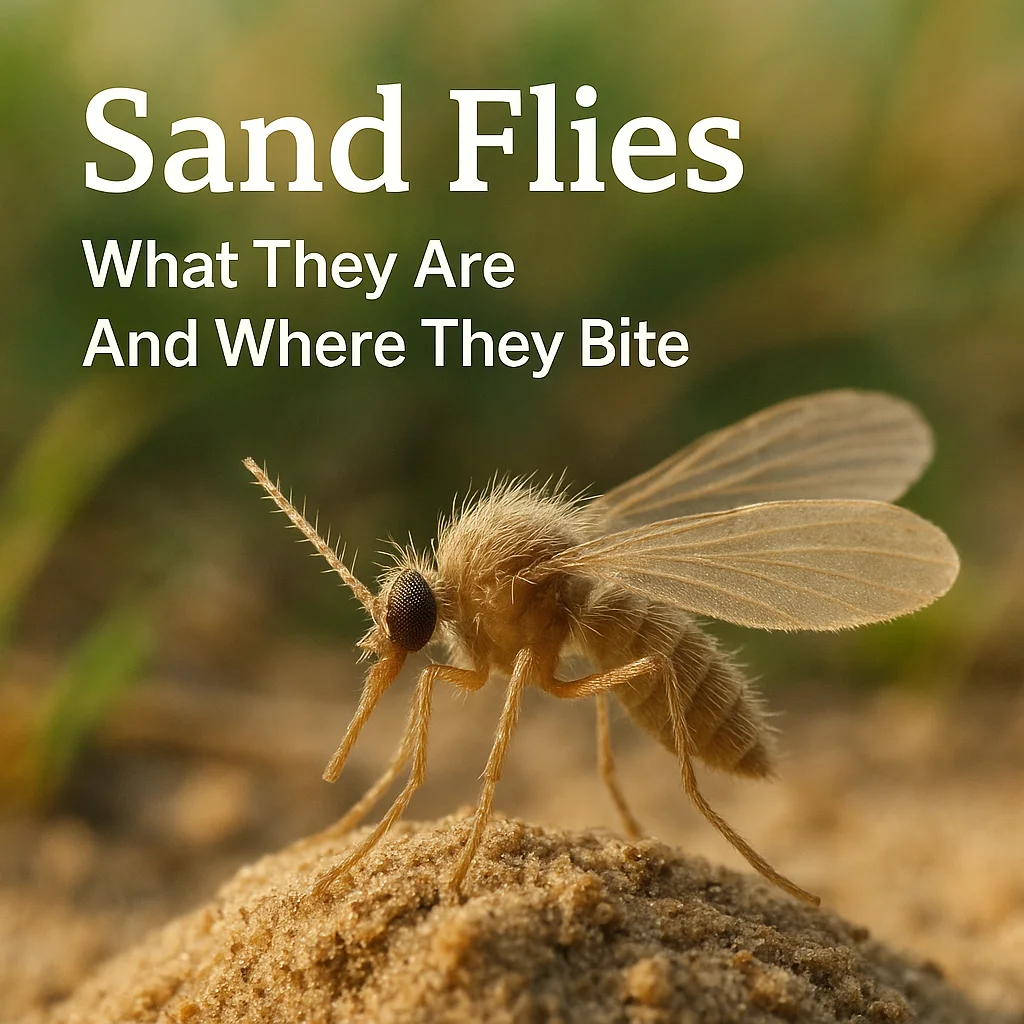
- Common names: Sand flies, sandflies, sand gnats
- Scientific name: Varies (several genera, including Phlebotomus and Lutzomyia)
- Insect: Yes, they are invertebrates belonging to the insect class
- Order/family: Diptera/Psychodidae
- Typical size range: About 1.5–3.5 mm in length (adults)
- Key colors/patterns: Typically tan to gray with fuzzy appearances and hairy bodies
- Activity: Mostly nocturnal
- Typical habitats: Coastal areas, forests, wetlands, and human habitation near such areas
- Where in the world it occurs: Found in tropical, subtropical, and temperate regions globally
- Seasonality: Most visible during warmer months, varies by region
🔍 Identification
Sand flies can be recognized by their small, delicate bodies and unique flying pattern.
- Body shape and silhouette: Small, with a humpbacked appearance
- Antennae type: Long segmented antennae, often held forward
- Wing features: Narrow, hairy wings held in a V-shape at rest
- Leg traits and movement style: Long legs, slow erratic flying movement
- Distinguishing look-alikes: Resemble other gnats but are recognized by their distinctive flight and hairy bodies
- Top ID Tips:
- Small size and erratic flying pattern
- Long antennae and hairy wings
- Typically have a hunched appearance
- Most active during evening and night
- Fuzzy, tan-colored bodies
- Found near water sources or moist areas
🧠 Basic Body Structure
As insects, sand flies have distinct body segmentation comprising of three main parts: the head, thorax, and abdomen.
They possess six legs, like all insects, and an external skeleton known as an exoskeleton, which they periodically shed or molt to grow. Their wings are delicate and covered with hairs, providing a fuzzy appearance. Sand flies are invertebrates, meaning they do not have a vertebral column (backbone).
🌍 Habitat & Distribution
Sand flies prefer moist and warm environments. Coastal areas, forests, wetlands, and the rural outskirts of urban zones are common habitats. They thrive in places with abundant organic material and moisture, such as animal burrows, tree holes, and leaf litter.
Geographically, sand flies are present in tropical, subtropical, and temperate regions worldwide. Changes in habitat from urbanization and deforestation have impacted where sand flies are commonly found, often bringing them closer to human dwellings.
📅 Seasonal Appearance & Activity
Sand flies are predominantly active in warmer months, though this may vary depending on the region. Their activity typically peaks during the evening and nighttime when temperatures are cooler.
- Best Time to Spot It:
- Warm, humid nights
- Evening hours to early morning
- During rainy seasons when humidity is high
- In coastal or wetland areas
🥚 Reproduction & Egg-Laying
Mating behaviors in sand flies typically include wing vibrations and pheromone production. The females usually lay eggs in moist environments rich in organic matter to provide nourishment for the larvae.
Sand flies can lay hundreds of eggs over their lifespan, although the exact count varies with environmental conditions. They usually deposit eggs in soils rich in organic nutrients or decaying vegetation.
🌀 Metamorphosis & Life Cycle
Sand flies undergo complete metamorphosis, which consists of four stages: egg, larva, pupa, and adult.
During the egg stage, tiny eggs are laid in nutrient-rich moist environments. The larvae hatch and feed on organic matter, often in humid soil, for several days or weeks, growing and molting through various instars.
The pupal stage follows, where transformation into adults occurs. This stage is relatively brief but crucial for development. As adults, sand flies emerge to mate, with females seeking blood meals to nourish their eggs.
🍽️ Diet & Feeding Behavior
In their larval stages, sand flies typically feed on decaying organic material found in their surroundings. Adult sand flies, however, exhibit a different feeding behavior: females require blood meals to reproduce.
Possessing piercing-sucking mouthparts, female sand flies are known to bite a variety of hosts, including humans, domesticated animals, and wildlife. Males primarily feed on nectar and plant juices.
🦉 Predators & Defense
Sand flies are preyed upon by various birds, reptiles, amphibians, and spiders. They employ several defense strategies to survive.
- Defense Highlights:
- Small size provides camouflage
- Nocturnal habits help avoid diurnal predators
- Erratic flight patterns make capture difficult
- Inhabit microhabitats that offer protection
👥 Social Behavior & Swarms
Sand flies are primarily solitary creatures. They do not exhibit social behaviors like cooperation or communal living. Encounters between sand flies are often brief and limited to courtship and mating interactions. They may form swarms, especially when emerging as adults, driven by environmental conditions suitable for reproduction.
🧭 Senses & Communication
Sand flies rely heavily on their sense of smell, especially when locating hosts for blood meals. They can detect carbon dioxide and body odors, which guide their feeding activities. Vision is less critical for them, especially given their nocturnal lifestyle.
Communication in sand flies generally involves pheromones, used in mating behaviors to attract partners. Vibrations and wing movements may also play a role during courtship.
🌱 Role in the Ecosystem
Sand flies have several ecological roles. While adult females are best known for their blood-feeding habits, the larvae contribute to decomposition processes by feeding on organic material, thereby recycling nutrients back into the soil.
They are a part of the food web, serving as prey for various predators and influencing the dynamics of local ecosystems. When it comes to relationships, sand flies can be primary vectors for diseases like leishmaniasis, impacting both human and animal health. However, not all species are significant disease vectors.
📉 Population & Conservation Notes
The population status of sand flies can vary greatly depending on their habitat. Many species are common and thrive in suitable environments, but changes like habitat destruction and pesticide use can negatively affect their numbers.
- How to Help (Low-Impact):
- Promote native vegetation in landscapes
- Avoid excessive use of pesticides
- Maintain natural wetlands and reduce habitat destruction
- Encourage biodiversity in gardens
⚠️ Human Interaction & Safety
Sand flies are known to bite, which can be an annoyance. Their bites may cause irritation and itchiness and, in some cases, transmit diseases like leishmaniasis. For any severe reaction or if discomfort persists, it is advisable to seek professional advice.
It is essential to observe sand flies respectfully, appreciating their role in the ecosystem. Avoid collecting wild specimens and focus on non-intrusive observation techniques.
📌 Summary
- Sand flies are small, nocturnal insects with distinct hairy bodies found in tropical to temperate regions.
- They prefer moist environments and are most active during the warmer months.
- Undergo complete metamorphosis, with stages including egg, larva, pupa, and adult.
- Their diet varies by life stage, with adult females requiring blood for reproduction.
- Predators include birds, reptiles, and spiders, with defense strategies including camouflage and erratic flight.
- No social structure; solitary except during mating and environmental swarming.
- Roles in the ecosystem include decomposition and serving as prey for other wildlife.
- Population is often stable but impacted by habitat changes and pesticide use.
- Bites can cause irritation; seek professional advice if there are severe reactions.