🕷️ Stable Flies The ‘biting Housefly' Explained
🧾 Quick Facts
Stable flies, often referred to as the ‘biting housefly,’ are notable for their painful bite and their close resemblance to the common housefly. While they may seem ubiquitous, these flies have specific characteristics that differentiate them from their non-biting cousins.
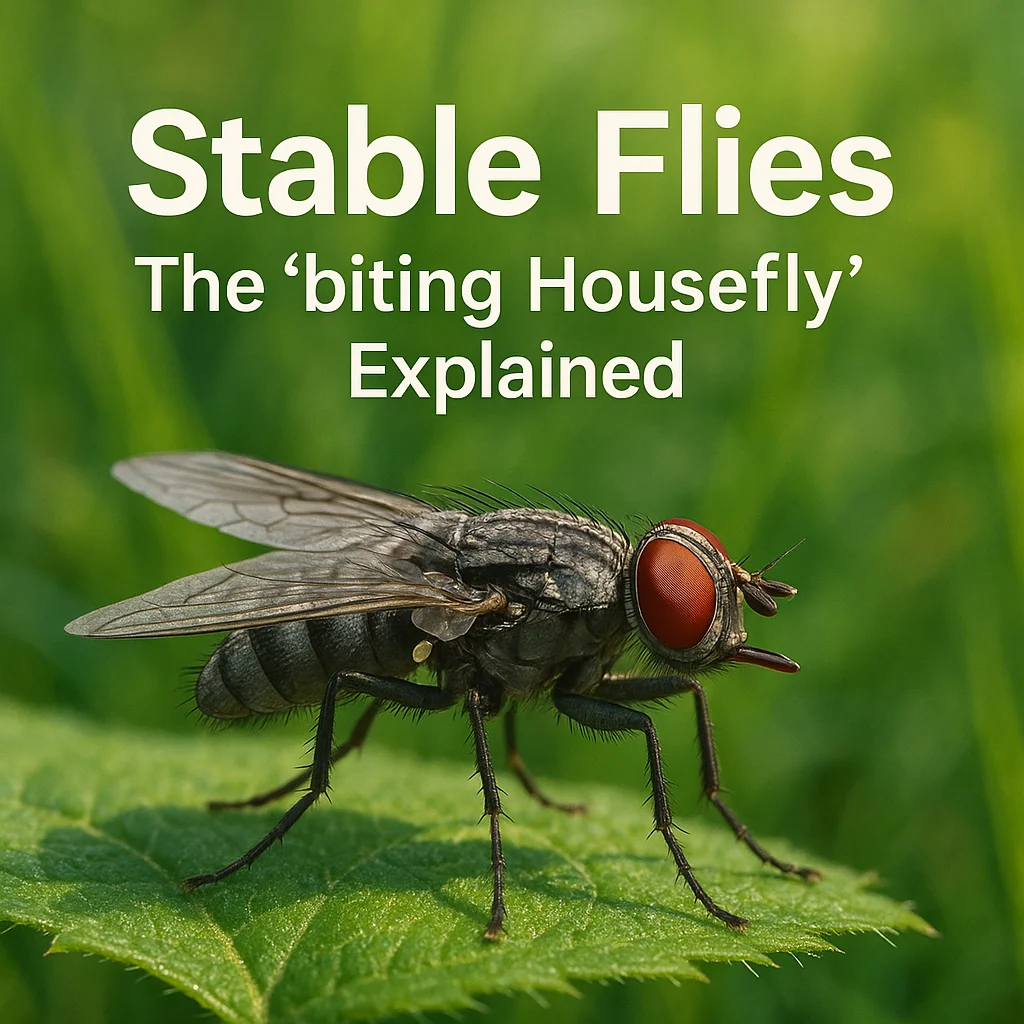
- Common Names: Stable fly, biting housefly
- Scientific Name: Stomoxys calcitrans
- Insect or Not: Yes, they are insects, a type of invertebrate.
- Order / Family: Diptera / Muscidae
- Typical Size Range: 5 to 7 mm in length
- Key Colors/Patterns: Gray with darker spots on the abdomen
- Activity: Primarily diurnal
- Typical Habitats: Farms, stables, and areas with high livestock presence
- Where in the World Occurs: Found worldwide, particularly in temperate and tropical regions.
- Seasonality: Most commonly seen in warmer months
🔍 Identification
The stable fly can be recognized in the field by its striking resemblance to the common housefly, but with distinctive features that set it apart. The body is compact and robust with thorny legs adapted to biting. The antennae are short and inconspicuous, but the fly's proboscis is pointed forward, utilized for piercing and feeding on blood.
- Body Shape and Silhouette: Compact, housefly-like with a stout body
- Antennae Type: Short and inconspicuous, typical of muscid flies
- Wing Features: Clear wings with characteristic prominent veins
- Leg Traits and Movement Style: Strong, spiny legs adapted to stable surfaces
- Distinguishing Look-alikes and Common Confusion: Resembles houseflies but differs due to its forward-projecting proboscis
- Look for the forward-projecting proboscis.
- Check for the distinct wing vein patterns.
- Note the characteristic biting behavior.
- Observe body size and gray coloration.
- Typically found around livestock.
- Examine for more aggressive behavior than regular houseflies.
🧠 Basic Body Structure
Stable flies, like all insects, have three main body parts: the head, thorax, and abdomen. They have a rigid exoskeleton providing support and protection. They possess six legs, a common trait among insects. These flies undergo molting, shedding their exoskeleton to grow. Their wings are clear and used for quick flight. Being invertebrates, they have no internal skeleton or backbone.
🌍 Habitat & Distribution
Stable flies are versatile in terms of habitat preference, generally found in environments conducive to livestock—a factor that garners their common name. This includes farms, stables, and areas with animal husbandry. However, they've adapted to more urban locales if conditions are favorable. The preferred microhabitats consist of straw bedding, decomposing organic matter, and manure where they can breed.
Geographically, stable flies are widely distributed across temperate and tropical regions, being prevalent on every continent, exhibiting a higher presence in areas with agriculture and warm climates. Habitat changes, such as urban development and farming adjustments, can significantly affect local population sightings.
📅 Seasonal Appearance & Activity
Stable flies are most active during the warmer months, aligning their life cycle with that of many agricultural practices. They are diurnal creatures, preferring to utilize daylight for their activities. Their activity is influenced by weather conditions, with warm temperatures and dry weather augmenting their visibility.
- Most active during spring and summer.
- Peak activity on warm sunny days.
- Reduced activity in cold or wet conditions.
- Generally not active during winter months.
🥚 Reproduction & Egg-Laying
Mating behavior in stable flies often involves swarming, with males actively seeking out females. Egg-laying typically occurs in organic matter rich in decaying vegetation or manure, which provides a nurturing environment for the larvae. Female stable flies can lay multiple batches of eggs throughout their lifespan, each containing about 50 to 100 eggs, though counts can vary by region and environmental conditions.
🌀 Metamorphosis & Life Cycle
Stable flies experience complete metamorphosis, consisting of four stages: egg, larva, pupa, and adult. Eggs are laid in moist, decaying organic matter, where larvae hatch and feed on bacteria and decomposing substances. The larval stage is critical as they develop into pupae, which are immobile and resemble grain-sized structures.
Larvae mature into adults within two to three weeks, a duration that fluctuates based on temperature and humidity. The adults, equipped with proboscises, seek out blood from livestock, which is vital for their reproductive processes.
🍽️ Diet & Feeding Behavior
Stable flies require blood meals as adults to support reproductive capabilities. They utilize piercing-sucking mouthparts to pierce the skin of livestock and humans. Larvae, on the other hand, are scavengers in their early stages, consuming bacteria and detritus from organic matter. As adults, they are considered pests due to their blood-feeding, which can disrupt livestock and humans alike.
🦉 Predators & Defense
Stable flies face numerous predators, including birds, amphibians, and certain reptiles, as well as parasitoid wasps that specifically target their larvae. Their primary defense mechanisms include camouflage within their environment, swift flight to evade capture, and a hardy exoskeleton.
- Utilizes mimicry by resembling houseflies.
- Quickness and agility in take-off.
- Hard exoskeleton providing a physical defense.
- Can rest in concealed locations among straw and debris.
👥 Social Behavior & Swarms
Stable flies are not typically social, and do not form colonies or swarms like bees or ants. However, they may be encountered in large numbers, especially when environmental conditions drive them to congregate around livestock. These gatherings are opportunistic rather than cooperative. Mating encounters are relatively brief and lead to dispersion following copulation.
🧭 Senses & Communication
The senses of stable flies are highly developed for their ecological roles. Their compound eyes offer excellent vision for detecting movement, while olfactory receptors in their antennae help in finding hosts and mates through scent. They communicate primarily through pheromones, which are chemical signals employed during mating.
🌱 Role in the Ecosystem
Stable flies play various roles within their ecosystems—both beneficial and detrimental. They contribute to the decomposition process during their larval stages, breaking down organic matter and recycling nutrients. However, as adults, they are considered pests due to their blood-sucking behavior, impacting livestock health by causing irritation and weight loss.
In addition, they can act as vectors for diseases, transferring pathogens between animals albeit indirectly. Their presence in the food web serves as prey for numerous predators, thus maintaining ecological balance.
📉 Population & Conservation Notes
Stable fly populations are commonly robust in suitable habitats, flourishing in areas with livestock and favorable breeding conditions. However, vulnerabilities arise from habitat degradation due to agricultural expansion, pesticide use, and urban encroachment, which can impact local abundances.
- Plant native vegetation around farms to disrupt fly breeding.
- Use composting practices that prevent fly access to organic waste.
- Reduce pesticide usage to protect natural predators.
- Maintain veterinary hygiene to limit fly exposure.
⚠️ Human Interaction & Safety
Stable flies are notable for their bites, which can be irritating and occasionally painful for both humans and animals. While they can transmit diseases, they do not directly inject pathogens through their bites. For discomfort from bites, it is advised to wash the area with soap and water, avoid scratching, and seek professional advice if severe reactions occur. Observe these flies with respect in their natural settings and avoid collecting them.
📌 Summary
- Similar in appearance to houseflies but distinct due to biting behavior.
- Widely distributed, favoring areas with livestock.
- Most active during warmer months and daylight hours.
- Undergo complete metamorphosis with four life stages.
- Adults feed on blood, while larvae scavenge decomposing material.
- Subject to predation by birds, spiders, and reptiles.
- Impact ecosystems by aiding in decomposition and serving as prey.
- Common in suitable environments but sensitive to habitat alterations.
- Irritating but generally non-dangerous bites to humans and animals.