🕷️ Booklice Tiny Indoor ‘paper' Insects Explained
🧾 Quick Facts
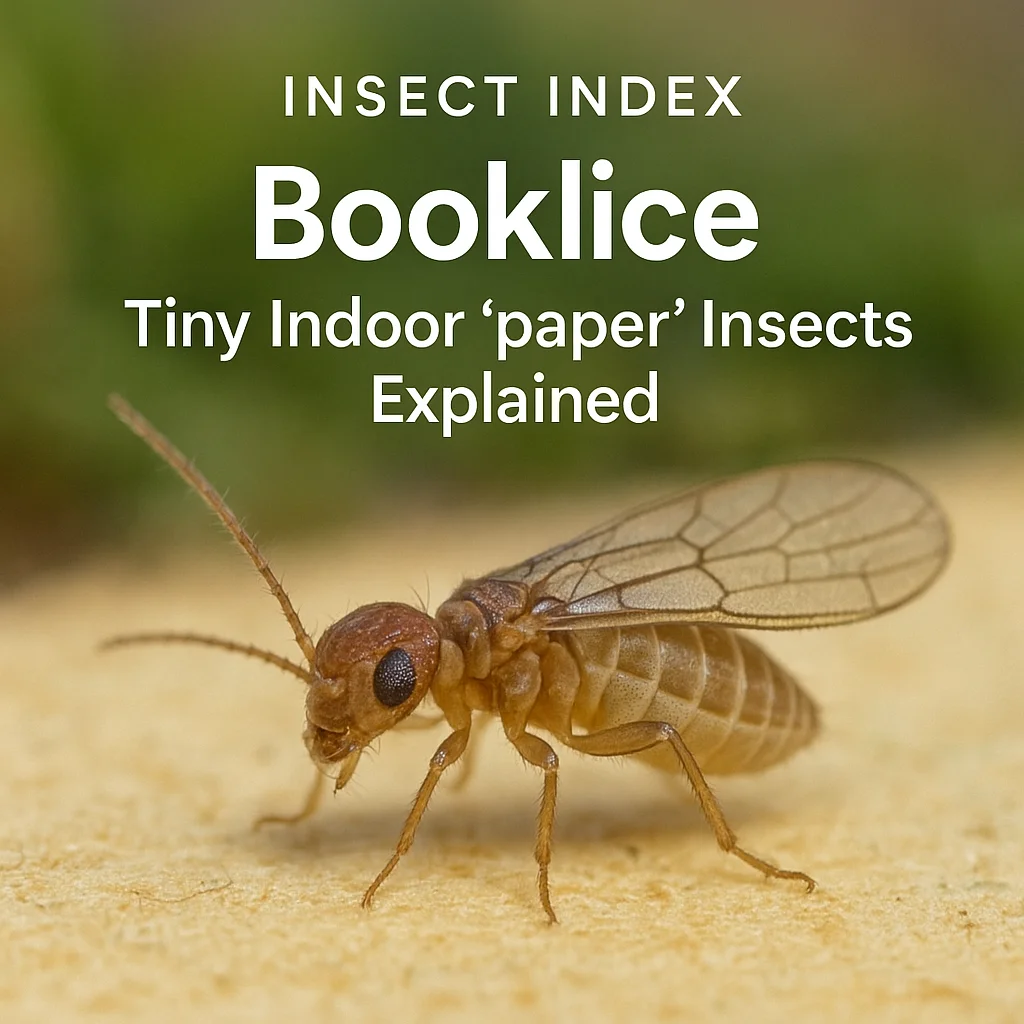
Also known as psocids, booklice are tiny insects that frequent indoor environments, particularly damp, paper-laden areas. Despite their name, these creatures aren't true lice but are instead related to barklice, thriving in different settings.
- Common Names: Booklice, psocids
- Scientific Name: Varies by species
- Insect or Not: Yes, they are insects
- Order / Family: Psocoptera
- Typical Size Range: 1-2 mm
- Key Colors/Patterns: Light brown to translucent
- Activity: Mostly nocturnal
- Typical Habitats: Indoors in humid areas; bookcases, wallpaper, storage areas
- Where in the World it Occurs: Worldwide in temperate climates
- Seasonality: Can be observed year-round in suitable indoor conditions
🔍 Identification
Recognizing booklice involves observing their small size and unique features. With slender bodies and long antennae, they can sometimes be confused with other small, indoor pests. However, booklice do not possess the hard body that other pests might have, making them somewhat easier to crush.
- Body Shape and Silhouette: Slender, soft-bodied
- Antennae Type: Long, thread-like
- Wing Features: Some species wingless, others have lightly veined wings
- Leg Traits and Movement Style: Six legs, swift movers
- Distinguishing Look-Alikes: Often mistaken for dust particles or tiny mites
- Top ID Tips:
- Very small, barely 1-2 mm
- Long antennae relative to body size
- Light brownish or clear color
- Soft-bodied, easily squished
- Found in humid areas
- Seen on paper or books
🧠 Basic Body Structure
Booklice showcase the typical insect body plan comprising a head, thorax, and abdomen. Like all insects, they have six legs and an exoskeleton which they molt periodically to grow. Despite their name, booklice are invertebrates, which means they lack a backbone, their bodies supported by an external shell called an exoskeleton.
🌍 Habitat & Distribution
Booklice favor environments with high humidity, making them common in homes, libraries, and storage areas where paper is abundant. They can also be found outdoors under tree bark or leaf litter. Geographically, they are widespread but most commonly noted in temperate zones due to the indoor heating systems that provide the warmth they require year-round.
📅 Seasonal Appearance & Activity
While booklice can thrive indoors throughout the year, their populations may increase during warmer, more humid months. They are typically more active during the night when they silently scuttle over surfaces.
- Best Time to Spot It:
- In humid conditions
- During warmer months
- At night
- In rooms with books or wallpaper
🥚 Reproduction & Egg-Laying
Booklice reproduce by laying eggs, which they do carefully to ensure high survival rates. Eggs are often deposited in small clusters within crevices or under paper materials. They lay several eggs at a time, but actual counts can vary widely depending on the environmental conditions and availability of resources.
🌀 Metamorphosis & Life Cycle
The life cycle of booklice involves incomplete metamorphosis, which includes stages of egg, nymph, and adult. The nymphs resemble smaller versions of the adults and gradually develop through successive molts.
During these stages, booklice predominantly feed on molds and mildews found in their environment. Nymphs and adults alike are often located in the same habitats, given their similar feeding requirements and environmental preferences.
🍽️ Diet & Feeding Behavior
Booklice primarily consume fungi, molds, and mildews that grow on paper and other organic materials. Their chewing mouthparts allow them to scrape off these microscopic food sources. They play a role as decomposers in the ecosystem, breaking down organic matter.
🦉 Predators & Defense
Various natural predators of booklice include spiders, beetles, and other small insectivores. Their primary defense mechanisms rely on their diminutive size and preference for hidden environments, which offer some protection from larger predators. Booklice lack complex defense mechanisms like stings or bites.
- Defense Highlights:
- Small size provides stealth
- Hide in narrow, hidden niches
- Swift, evasive movements
👥 Social Behavior & Swarms
Booklice are largely solitary insects. They do not form swarms or colonies but can sometimes be found in aggregations simply due to shared environmental preferences rather than any inherent social structure. Mating generally occurs opportunistically when two individuals encounter one another.
🧭 Senses & Communication
Booklice rely heavily on touch, taste, and smell to navigate their environment and locate food. They lack advanced vision capabilities, instead depending on their antennae to sense the world around them. Communication is minimal and typically limited to simple, chemical cues in their immediate vicinity.
🌱 Role in the Ecosystem
Booklice serve a crucial role in ecosystems as decomposers, aiding in the breakdown of organic materials, particularly in indoor settings. They help control mold levels by feeding on these fungi and contribute to the recycling of nutrients in their habitats. There is little evidence of major negative impacts on human activities, other than potentially being nuisance pests when abundant.
📉 Population & Conservation Notes
Booklice populations are generally stable and not considered at risk. Their prevalence can vary locally, often correlating with indoor moisture levels. As decomposers, they adapt well to human-altered environments.
- How to Help (Low-Impact):
- Maintain adequate ventilation to reduce humidity
- Store books and paper goods in dry conditions
- Avoid excessive use of chemical pesticides indoors
⚠️ Human Interaction & Safety
Booklice do not bite or sting, posing virtually no direct threat to humans or pets. Their presence is primarily an indicator of humidity and the potential for mold. Efforts to manage their populations should focus on environmental control, with observation encouraged without the need for direct interference.
📌 Summary
- Booklice are tiny, soft-bodied insects found indoors.
- They thrive in humid, paper-rich environments.
- Active mostly at night, they feed on mold and fungi.
- Identifiable by long antennae and translucent color.
- Year-round presence depends on indoor climate conditions.
- Play roles in decomposition and mold control.
- Avoid using heavy pesticides; simple moisture control suffices.
- Non-threatening to human health and safety.