🕷️ Centipedes vs insects (quick clarification)
🧾 Quick Facts
Centipedes are often confused with insects due to their segmented bodies and presence in similar habitats. However, they belong to a separate class of arthropods. Here are some key facts.
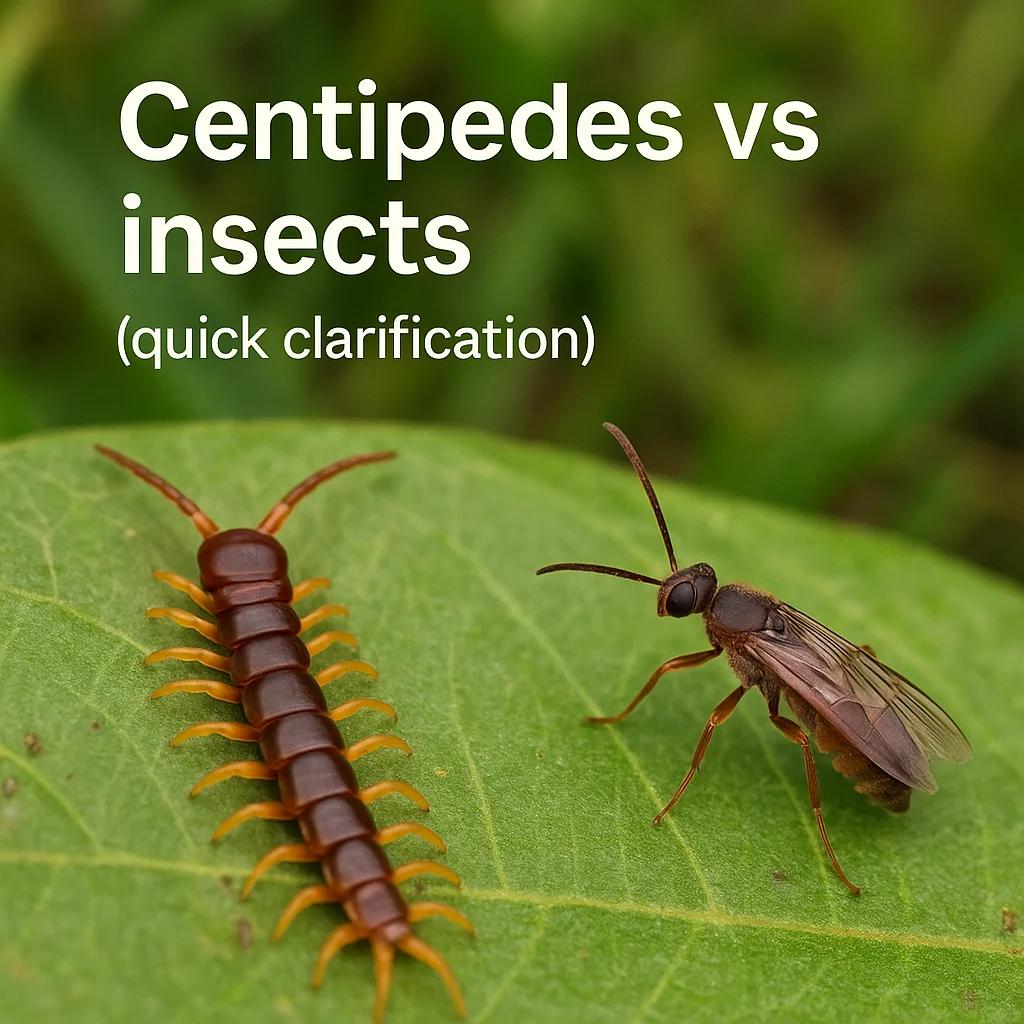
- Common Names: Centipede
- Scientific Name: Varies among species
- Insect or Not: Not an insect; centipedes are arthropods but belong to the class Chilopoda
- Order / Family: Varies
- Typical Size Range: 3 to 300 mm (0.12 to 11.8 inches)
- Key Colors/Patterns: Brown, reddish-brown, or yellowish; often uniform color
- Activity: Primarily nocturnal
- Typical Habitats: Soil, leaf litter, under stones, inside logs
- Where in the World: Worldwide, prominent in tropical and temperate regions
- Seasonality: Most visible in warmer months
🔍 Identification
Centipedes can be recognized by their elongated, multi-segmented body and numerous legs. Unlike insects, they have more than six legs, with one pair per body segment. Their antennae are long and slender. Centipedes lack wings and have a distinctive swift, flexible movement. They are often confused with millipedes, which have two pairs of legs per segment.
- Elongated, segmented body
- One pair of legs per body segment
- Long, slender antennae
- Swift, undulating movement
- No wings
- Often mistaken for millipedes
- Color typically monochromatic
- No visible body hair
- Commonly found in damp environments
- Legs extend noticeably from body
🧠 Basic Body Structure
The centipede's body is divided into three main parts: the head, thorax, and abdomen, although the thorax is not as distinguished from the abdomen as in insects. They have an exoskeleton made of chitin, which they shed periodically through molting. Unlike insects, centipedes are not limited to six legs; they can have a few to several hundred legs, with one pair per segment. They are invertebrates, meaning they do not have a backbone.
🌍 Habitat & Distribution
Centipedes are primarily found in moist environments where they can maintain their hydration and evade predators. They thrive in leaf litter, under rocks, logs, and within soil crevices. Geographically, they are distributed worldwide but are especially abundant in tropical and temperate regions. Urban gardens, forests, and grasslands are common places to find them. Changes in habitat, such as deforestation and urban development, can affect their local populations.
📅 Seasonal Appearance & Activity
Centipedes are most active during warmer months when they emerge from their shelter in search of food. Nocturnal by nature, they prefer exploring in the dark, making nighttime or early morning the best time for observation. They tend to hide during dry periods, preferring moist surroundings.
- Active during warm months
- Best seen at night
- Favors moist conditions
- Less visible in cold or dry seasons
🥚 Reproduction & Egg-Laying
Mating practices in centipedes vary among species. Typically, males deposit a spermatophore that females pick up. Females lay eggs in soil or leaf litter, where the environment is humid enough to ensure their development. The number of eggs can vary greatly, depending on the species, ranging from ten to over a hundred. Females of some species exhibit protective behavior, curling around their eggs during incubation.
🌀 Metamorphosis & Life Cycle
Centipedes undergo incomplete metamorphosis, developing through a series of molts. After eggs hatch, juveniles resemble small adults and mature through successive molts, gaining additional segments and legs with each stage. The duration of each life stage can vary depending on environmental conditions and species specifics.
Juveniles feed on smaller prey and continue to grow, molting several times until reaching adulthood. This process may take a year or more, depending on species and climate.
🍽️ Diet & Feeding Behavior
Centipedes are predominantly carnivorous, preying on insects, spiders, and other small invertebrates. They possess claw-like structures equipped with venom glands that help immobilize their prey. These mandibularized claws inject venom into the prey, aiding in digestion. As efficient hunters, centipedes play an essential role in controlling insect populations.
🦉 Predators & Defense
Common predators of centipedes include birds, amphibians, reptiles, and small mammals. Centipedes have several defense strategies, such as quick escape due to their swift motion and the secretion of repelling chemicals. Their coloration often serves as camouflage, blending them into their natural environment.
- Quick, undulating escape
- Chemical secretion as a deterrent
- Camouflage in natural surroundings
- Venomous bite, though not lethal to humans
👥 Social Behavior & Swarms
Centipedes are generally solitary creatures, coming together only during mating encounters. Unlike social insects, they do not form colonies or swarms. Each centipede fends for itself, actively maintaining its territory to some extent.
🧭 Senses & Communication
Centipedes rely heavily on their touch and smell senses, facilitated by their long antennae and multiple legs. Light detection is modest, with simple eyes or ocelli. Communication is primarily through pheromone trails that aid in mating and locating potential mates.
🌱 Role in the Ecosystem
Centipedes play a critical ecological role as secondary consumers by controlling populations of other invertebrates, ensuring a balanced ecosystem. Although they are not pollinators, they contribute to the decomposition process by breaking down organic material indirectly. They provide a food source for many higher-level predators, contributing to the food web.
📉 Population & Conservation Notes
Centipedes are generally plentiful in suitable habitats, although local abundance can vary. They face threats from habitat destruction and pesticide use, which can impact their numbers. Light pollution and climate change also play a role in their population dynamics. Data on specific population trends is limited, but conservation of natural habitats supports their sustainable presence.
- Encourage native plant growth for habitat
- Avoid pesticide use in gardens
- Leave organic matter like leaf litter to promote thriving habitats
- Maintain moist environments
⚠️ Human Interaction & Safety
Centipedes possess venomous bites used to subdue prey, which can cause mild irritation in humans if bitten, although serious effects are rare. It is advised to clean the affected area and seek professional advice if a severe reaction occurs. It is best to observe these creatures without handling or collecting, respecting their role in nature.
📌 Summary
- Centipedes are not insects; they belong to Chilopoda.
- Identifiable by their many legs, one pair per segment.
- Found worldwide, favoring moist environments.
- Active mainly during warmer months, especially at night.
- Exhibit incomplete metamorphosis; growth occurs through molts.
- Carnivorous, feeding on other invertebrates.
- Sensitive to habitat changes and climate variations.
- Play a significant role in controlling pest populations.
- Interaction with humans should remain respectful and observational.