🕷️ Earwigs: pincers and misconceptions
🧾 Quick Facts
Earwigs are enigmatic insects that have sparked numerous misconceptions throughout human history. Despite their daunting pincers, these insects are harmless to humans and play a significant role in various ecosystems.
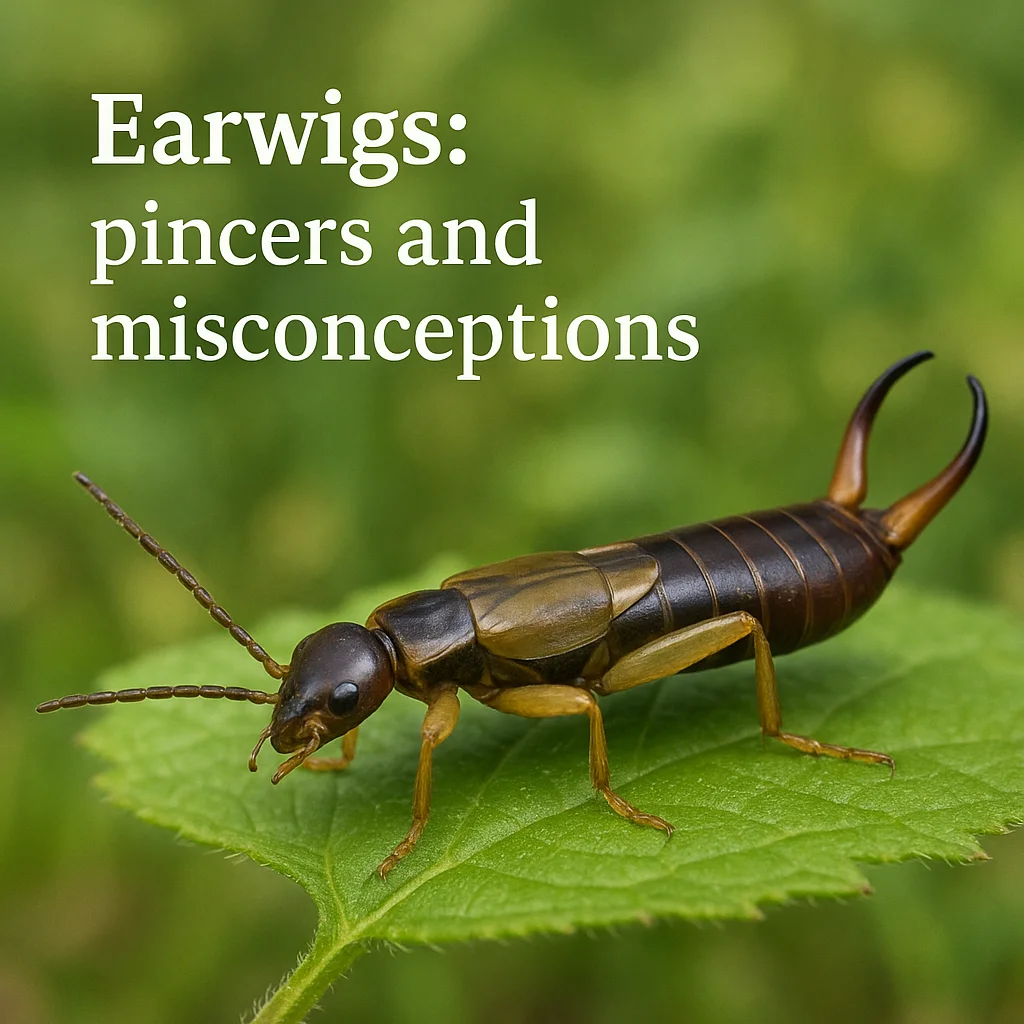
- Common names: Earwig, pincer bug
- Scientific name: Varies (Common earwig: Forficula auricularia)
- Insect or not: Yes, they are invertebrate insects
- Order / family: Dermaptera / Forficulidae
- Typical size range: 5 to 25 mm (0.2 to 1 inch)
- Key colors/patterns: Dark brown to black with lighter legs
- Activity: Generally nocturnal
- Typical habitats: Moist soil, under rocks, leaf litter, gardens
- Where in the world it occurs: Most regions worldwide, excluding very cold climates
- Seasonality: Most visible in warmer months
🔍 Identification
Earwigs can be easily recognized by their elongated bodies, cerci resembling forceps or pincers, and membranous hind wings tucked beneath short forewings.
- Elongated and flattened body
- Long, thread-like antennae
- Short forewings with visible hindwings when unfurled
- Three pairs of legs, adapted for speed and agility
- Often confused with beetles or rove beetles
- Distinctive pincers at the end of the abdomen
- Sleek, flattened profile enables them to squeeze into tight crevices
- When wings are noticed, expect a fan-like pattern
- Dark colors with shiny exoskeletons
- Watch for their quick, scuttling movements in damp environments
🧠 Basic Body Structure
Earwigs, like other insects, have a body divided into three parts: the head, thorax, and abdomen. They possess six legs, typical of insects, which allow swift movement. Their body is protected by a tough exoskeleton, which periodically molts to accommodate growth.
Being invertebrates, they lack a backbone, relying on their exoskeleton for structure and protection. This feature differentiates them from vertebrates, which have an internal skeleton.
🌍 Habitat & Distribution
Earwigs favor moist environments and can be found in gardens, under rocks, in leaf litter, and within decaying wood. They are commonly found in temperate regions, thriving in both rural and urban gardens. Global distribution includes most continents, excluding regions with extreme cold.
Changes in their habitat, such as deforestation and urbanization, can influence their sightings, often leading to increased presence in gardens and homes.
📅 Seasonal Appearance & Activity
Although earwigs are active year-round in mild climates, they are most commonly observed during warm months. As nocturnal creatures, they are typically seen at night, often drawn to lights. Their activity can be influenced by weather conditions, becoming more visible after rains when they emerge from hiding spots.
- Most common during spring and summer
- Primarily active at night (nocturnal behavior)
- After rain, when the ground is moist
- Warm, humid evenings boost activity
🥚 Reproduction & Egg-Laying
Earwigs exhibit unique reproductive behaviors, with courtship prevailing through pheromone communication. Mated pairs often remain in close proximity until egg-laying occurs.
Females lay their eggs in hidden locations, including burrows in the soil or under detritus. A mother can lay anywhere from 20 to 80 eggs, exhibiting maternal care by tending to the eggs and early instar nymphs until they are more independent.
🌀 Metamorphosis & Life Cycle
Earwigs undergo incomplete metamorphosis, with their life cycle consisting of three stages: egg, nymph, and adult. Nymphs resemble miniature adults and lack fully developed wings.
After hatching, nymphs emerge and gradually mature, undergoing various molts to reach adulthood. Nymphs and adults consume similar diets, primarily focused on decaying matter, plant material, and occasionally small insects.
🍽️ Diet & Feeding Behavior
Earwigs are primarily scavengers and omnivores. Their diet includes decaying organic matter, various plants, and occasionally living prey like aphids. Earwigs possess chewing mouthparts, enabling them to effectively break down their food.
As scavengers, they play a vital role in decomposition and nutrient cycling within ecosystems, assisting in breaking down organic materials.
🦉 Predators & Defense
Earwigs face predation from birds, amphibians, small mammals, and other insects. Their primary defense mechanisms include using their cerci to pinch, releasing foul-smelling chemicals, and employing speed and hiding tactics.
- Camouflage with surroundings
- Forceful pinching with cerci
- Releasing odorous secretions
- Swift movements to escape threats
👥 Social Behavior & Swarms
Earwigs are typically solitary, primarily encountering one another during mating periods. Short-term aggregations may occur in favorable environments, but they do not form structured colonies or swarms.
🧭 Senses & Communication
Earwigs utilize a combination of senses for navigation and communication. They have compound eyes for vision, although less developed than other insects. Their reliance on touch and chemical signals through pheromones is crucial for mating and identifying suitable habitats.
Pheromone communication often alerts other earwigs to potential mates or suitable environmental conditions.
🌱 Role in the Ecosystem
Earwigs contribute to various ecosystem processes, aiding in decomposition by consuming decaying materials and participating in nutrient cycling. They also assist in pest control, predating on garden pests like aphids, offering indirect benefits for agriculture.
While they can occasionally damage plants, their ecological role is predominantly positive, balancing pest populations and aiding in organic matter breakdown.
📉 Population & Conservation Notes
Earwigs are generally common in suitable habitats. However, habitat destruction, pesticide use, and climate change pose threats, potentially impacting local populations.
- Maintain garden areas with native plants
- Avoid excessive pesticide use
- Leave leaf litter as natural habitat
- Create small ground cover for hiding
⚠️ Human Interaction & Safety
Earwigs do not pose any serious threat to humans. They may pinch with their cerci if disturbed, but this is not harmful. Simple first-aid includes washing any pinched area with soap and water and avoiding scratching.
It is advised to observe them respectfully and refrain from collecting them from the wild.
📌 Summary
- Identifiable by their pincers and flattened bodies
- Found in moist environments and gardens
- Most active in warm, humid conditions
- Undergo incomplete metamorphosis
- Omnivorous diet includes plants and insects
- Natural predators include birds and mammals
- Enhance decomposition and pest control
- Populations often stable but influenced by habitat changes