🕷️ Scorpions are not insects (quick guide)
🧾 Quick Facts
Scorpions are fascinating creatures often mistaken for insects, but they belong to a different group of animals within the invertebrates. This guide explores the fundamental aspects of scorpions and dispels common myths about them.
- Common names: Scorpion
- Scientific name: Varies (over 2,500 known species)
- Insect or not: Not an insect; they are arachnids, which are a distinct group of invertebrates
- Order / family: Order Scorpiones, family varies
- Typical size range: 2.5 cm to 21 cm (adult)
- Key colors/patterns: Varies, includes shades of brown, black, yellow, and more; sometimes glow under UV light
- Activity: Primarily nocturnal
- Typical habitats: Deserts, grasslands, forests, caves, mountains
- Where in the world it occurs: Almost worldwide, except Antarctica
- Seasonality: Most active in warmer months; varies by region
🔍 Identification
Identifying scorpions in the field can be intriguing, given their unique physical attributes and behavioral patterns.
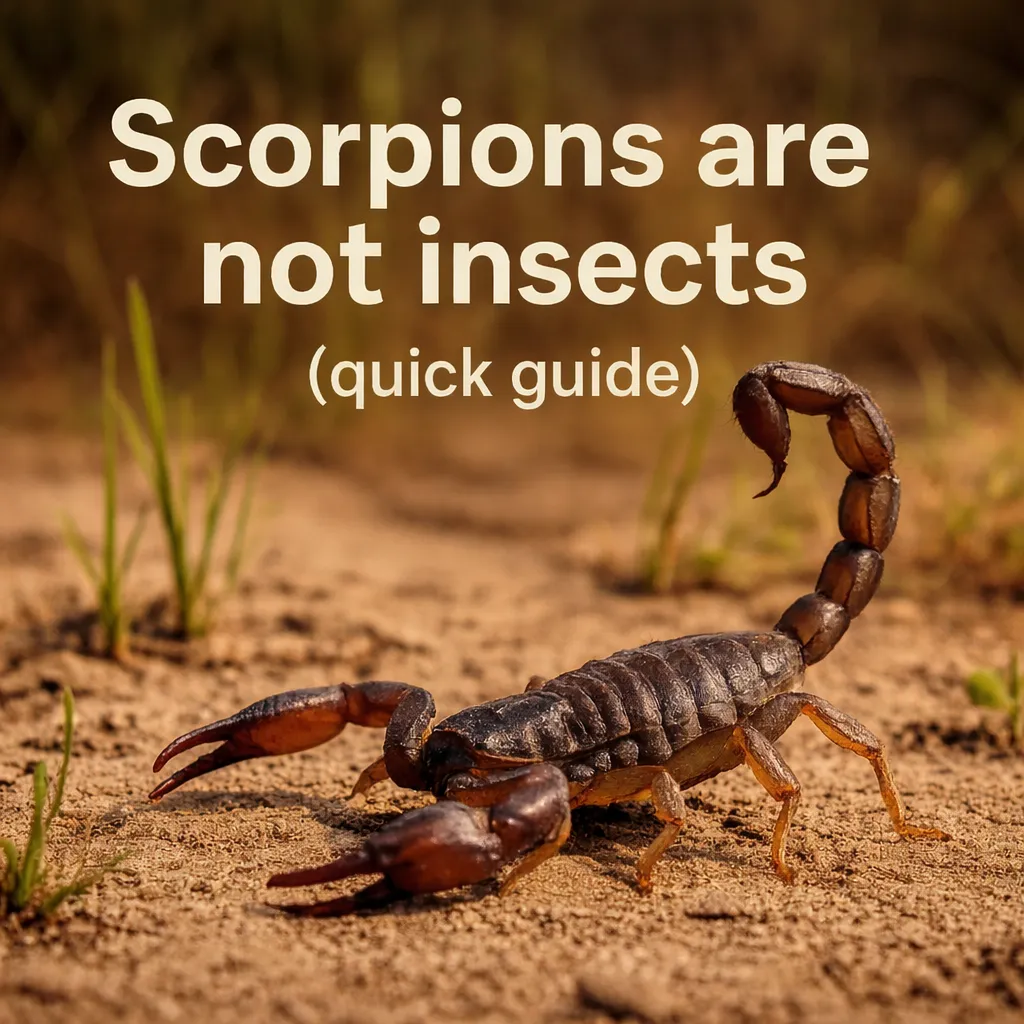
Scorpions are easily recognized by their elongated bodies, segmented abdomens, and their most distinctive feature—pincer-like pedipalps at the front and a segmented tail ending with a venomous stinger. They lack antennae, a common feature in insects, which can help distinguish them. While some might confuse scorpions with certain insects or arachnids, observing their eight legs and characteristic tail quickly clarifies their identity.
- Top ID Tips:
- Look for a robust, elongated body with broad, flat segments
- Note the presence of pincer-like pedipalps instead of antennae
- Check for a long, curved tail with a stinger at the end
- Count eight legs, differentiating them from six-legged insects
- Observe color variations; many glow under UV light
- Notice nocturnal activity, especially around rocks and crevices
🧠 Basic Body Structure
Scorpions, a type of arachnid, have a basic body structure that distinguishes them from insects. They have a head combined with the thorax to form a cephalothorax, and a segmented abdomen divided into a preabdomen and a postabdomen. Unlike insects, scorpions possess eight legs, reinforcing their classification as arachnids. Their tough exoskeleton provides protection and allows for growth through molting, a process essential for development.
As invertebrates, scorpions lack a vertebral column, relying on their exoskeleton for structural support and protection against predators.
🌍 Habitat & Distribution
Scorpions are incredibly adaptable, inhabiting diverse environments ranging from arid deserts to lush forests. They are commonly found in microhabitats like under rocks, within leaf litter, or inside caves. Geographically, scorpions are widespread, inhabiting every continent except Antarctica. Their presence in urban gardens and backyards reflects their versatility, yet changes in habitat, such as urbanization, can influence their sightings.
📅 Seasonal Appearance & Activity
The best time to observe scorpions varies, largely dependent on environmental conditions. These arachnids are most active during warmer months and primarily at night when hunting for food. Weather factors such as temperature and humidity also affect their appearance; they might remain hidden during cold or excessively wet weather.
- Best Time to Spot It:
- Warm spring and summer evenings
- During dry, warm periods
- Clear nights, away from light pollution
- Under rocks or logs in natural settings
🥚 Reproduction & Egg-Laying
Scorpion mating involves an intricate courtship dance where the male engages the female using his pincers. Post-mating, the female carries the fertilized eggs inside her body until they hatch. Baby scorpions, known as scorplings, are carried on their mother's back until their first molt, providing them with safety and warmth.
Egg-laying is not applicable to scorpions as they give birth to live young. The size of the brood can vary, with some females giving birth to dozens of young at a time.
🌀 Metamorphosis & Life Cycle
Scorpions undergo a process called incomplete metamorphosis, progressing from the egg stage to nymph to adult, bypassing any pupal stage. Newly hatched scorplings resemble miniature adults, feeding and living in similar habitats. The lifecycle stages unfold over time, with individuals maturing over several molts.
As scorplings, their diet and habitat closely mimic that of adults—hunting small insects and finding shelter in the same natural crevices or leaf litter found in their habitats. The duration of each stage can differ by species and environmental conditions.
🍽️ Diet & Feeding Behavior
Scorpions are primarily nocturnal predators, using their strong pincers and venomous sting to capture prey. Their diet consists chiefly of insects and small arthropods, with some larger species also preying on small vertebrates. They utilize piercing mouthparts to consume their prey, liquefying it with digestive enzymes.
In their various life stages, scorpions play the role of predator, contributing to pest control by regulating insect populations within their ecosystems.
🦉 Predators & Defense
Numerous natural predators, including birds, reptiles, small mammals, and larger arachnids, prey on scorpions. To evade these threats, scorpions employ various defense strategies. Their strong exoskeletons enable resistance against attacks, and their venomous sting serves as a potent deterrent. Furthermore, their ability to blend into their surroundings with camouflage aids in evading detection.
- Defense Highlights:
- Thick exoskeleton for physical protection
- Venomous sting for active defense
- Camouflage to blend with natural environments
- Nocturnal activity reduces exposure to diurnal predators
👥 Social Behavior & Swarms
Scorpions are predominantly solitary, with interactions mainly occurring during mating seasons. They do not form colonies or swarms, maintaining individual territories to reduce competition for resources. Encounters between scorpions outside of mating contexts are rare and generally combative.
🧭 Senses & Communication
Scorpions rely on a variety of senses to interact with their environment. They possess poor vision but compensate with highly sensitive hairs that detect changes in air currents and vibrations—a crucial adaptation for nocturnal hunting. They communicate primarily through vibrational signals and occasionally through pheromones, essential during mating times.
🌱 Role in the Ecosystem
Scorpions contribute significantly to the ecological balance within their habitats. As predators, they help regulate insect populations, indirectly supporting agriculture by reducing pest numbers. Their presence in the food web also supports a diversity of predators, from birds to mammals, maintaining ecological health. While they do not pollinate, their role in pest management underscores their ecological value.
📉 Population & Conservation Notes
The population status of scorpions varies globally, with many species considered locally abundant in suitable environments. However, factors like habitat destruction, pesticide use, and climate change can impact specific scorpion populations. Conservation efforts include promoting natural habitats and reducing chemical impacts.
- How to Help (Low-Impact):
- Plant native vegetation to support natural habitats
- Avoid pesticide use to preserve ecological balance
- Maintain leaf litter and natural ground cover
- Educate others about the ecological role of scorpions
⚠️ Human Interaction & Safety
Scorpions can defend themselves with a sting when provoked, but most species are not dangerous. For people stung, immediate steps include washing the area with soap and water and avoiding scratching the site. If severe reactions occur, seeking professional medical advice is recommended. Observing these creatures with respect and care ensures safety and minimizes risks.
Advising against collecting or disturbing wild scorpions is crucial for both preservation and personal safety, ensuring these vital creatures continue to thrive in their natural habitats.
📌 Summary
- Scorpions are arachnids, not insects, distinguished by their eight legs and venomous tail
- They inhabit a wide range of environments globally, except Antarctica
- Primarily nocturnal, visible in warmer months
- Reproduce through live birth; young initially carried on mother's back
- Play crucial ecological roles as predators in controlling insect populations
- Defense strategies include stinging, camouflage, and nocturnal habits
- Solitary creatures, interacting mainly during mating seasons
- Serve as prey for numerous animals, maintaining food web balance
- Conservation focuses on habitat preservation and minimizing pesticide use
- Encouraging respectful observation benefits both humans and scorpions