🕷️ Silverfish: why they like paper and moisture
🧾 Quick Facts
Silverfish are small, wingless insects commonly found in homes and other buildings. Known for their distinctive movements and silvery-grey scales, they are often noticed around paper materials and areas of high moisture. This field guide provides insights into the world of these ancient insects.
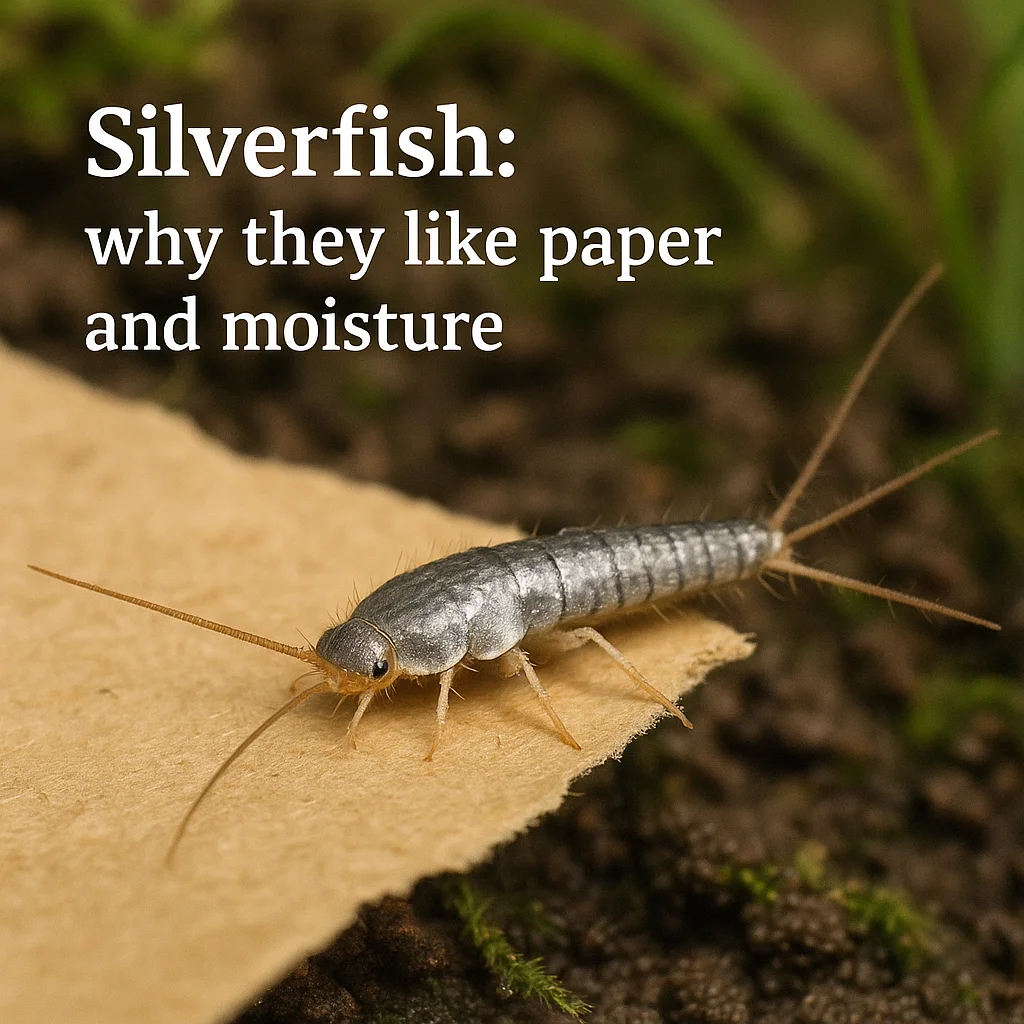
- Common names: Silverfish, Fishmoth
- Scientific name: Lepisma saccharinum
- Insect or not: Insect, as they are invertebrates with six legs.
- Order / family: Zygentoma / Lepismatidae
- Typical size range: 12-25 mm
- Key colors/patterns: Metallic silver-grey, scaled body
- Activity: Nocturnal
- Typical habitats: Urban environments, particularly damp and humid areas
- Where in the world it occurs: Cosmopolitan distribution; globally present
- Seasonality: Visible throughout the year in indoor environments
🔍 Identification
Silverfish are easy to identify due to their characteristic shape and movement. They have elongated, teardrop-shaped bodies covered in fine scales that give them a silvery appearance. Their long antennae and three distinct tail-like appendages at the end of their abdomen also help in their identification.
- Body shape: Elongated, teardrop
- Antennae type: Long, slender
- Wing features: Absent; silverfish are wingless
- Leg traits and movement style: Quick, darting motion reminiscent of a fish swimming
- Distinguishing look-alikes: Often confused with firebrats, which prefer warmer temperatures but have more mottled coloration
- Top ID Tips:
- Smooth movement across surfaces
- Silvery sheen of scales
- Long cerci and median caudal filament
- No jumping or flying; strictly crawling
- No visible wings
- Prefers dark, humid areas
🧠 Basic Body Structure
Silverfish, like all insects, have a body divided into three main parts: the head, thorax, and abdomen. They possess six legs attached to the thorax, and their body is protected by a tough exoskeleton made of chitin, which they molt several times throughout their lives. Being invertebrates, they lack a backbone, which distinguishes them from vertebrate animals.
🌍 Habitat & Distribution
Silverfish thrive in environments that provide warmth and moisture, often found in kitchens, bathrooms, basements, and attics. Outdoors, they inhabit leaf litter, under bark, and in humid microhabitats. These insects are adaptable and found across diverse geographic regions worldwide, favoring temperate climates but also inhabiting tropics and subtropics.
📅 Seasonal Appearance & Activity
Due to their preference for stable indoor environments, silverfish can be observed year-round. They are most active at night, avoiding light, and often remain hidden during daylight. External factors like temperature fluctuations and humidity levels influence their activity.
- Nocturnal behavior increases during warm, humid conditions
- Pervasive indoors irrespective of the season
- Plenty of sightings after rainfall
- Less active during dry, cold periods
🥚 Reproduction & Egg-Laying
Silverfish engage in a subtle courtship dance, involving antennae contact and synchronized movement. After mating, the female lays eggs in small cracks and crevices, often in hidden, dark spaces. These eggs are typically laid in batches, but the quantity can vary significantly based on environmental conditions.
🌀 Metamorphosis & Life Cycle
Silverfish undergo incomplete metamorphosis, transitioning from egg to nymph to adult without a pupal stage. Initially, nymphs resemble small, undeveloped adults and gradually acquire their full size and coloration through successive molts. The entire life cycle can span several months to years, depending on environmental stability and food availability.
🍽️ Diet & Feeding Behavior
Silverfish possess chewing mouthparts and primarily act as scavengers, feeding on starchy substances, debris, and fungi. During their nymph and adult stages, they may consume glue, book bindings, paper, fabrics, and dead insects. Despite this, their ecological role is minor in terms of direct predation or pollination.
🦉 Predators & Defense
Natural predators of silverfish include spiders, beetles, and certain birds. They rely on speed and agility to avoid capture and have evolved to hide in narrow, inaccessible spaces. Their silvery appearance provides a degree of camouflage in urban settings.
- Fast movements to elude predators
- Camouflaged bodies blend into surroundings
- Secrecy in dark, hidden areas
- Nocturnal habits reduce exposure to threats
👥 Social Behavior & Swarms
Silverfish are primarily solitary insects, leading discreet lifestyles. They do not form swarms or colonies, but may be found in groups in locations conducive to their survival, such as spaces with abundant food or moisture. Interactions are limited to reproduction.
🧭 Senses & Communication
Silverfish rely heavily on their sense of touch and smell to navigate the environment. Their long antennae and cerci (appendages at the rear) are sensitive to vibrations and chemical signals that help them locate mates or food sources. They do not produce sounds or visual displays as methods of communication.
🌱 Role in the Ecosystem
As detritivores, silverfish contribute to the decomposition of organic matter, recycling nutrients into the ecosystem. They interact minimally with other organisms, lacking significant mutualistic or parasitic relationships. However, they can sometimes be seen as nuisances in human dwellings when their dietary habits lead to damage of paper goods and textiles.
📉 Population & Conservation Notes
Silverfish are commonly encountered and not considered at risk. Their population levels remain stable despite urban expansion. Changes in building designs affecting moisture levels could influence local abundance. While data on population metrics is limited, they thrive in residential environments across the globe.
- Maintain indoor humidity below 50% to deter infestations
- Seal cracks and crevices to limit hiding spots
- Practice proper food storage to minimize available resources
- Avoid pesticides to prevent harm to non-target species
⚠️ Human Interaction & Safety
Silverfish do not bite or sting humans and are considered harmless. They rarely pose health risks, but can cause damage to personal belongings, particularly organic materials like books and fabric. Observations should be respectful, avoiding capturing or killing them without necessity. Maintaining cleanliness and proper humidity levels can deter their presence.
📌 Summary
- Identified by silvery scales and quick, darting motion
- Inhabit moist, dark places within buildings
- Visible all year round due to indoor environment stability
- Incomplete metamorphosis from egg to nymph to adult
- Feed on starchy materials and organic detritus
- Mainly solitary with minimal social interactions
- Rely on camouflage and speed for defense
- Contribute to nutrient recycling as detritivores