🕷️ Camel crickets: cave and basement visitors
🧾 Quick Facts
Camel crickets, often found in dark, damp environments, are intriguing creatures with unique adaptations. Here's a snapshot of their characteristics:
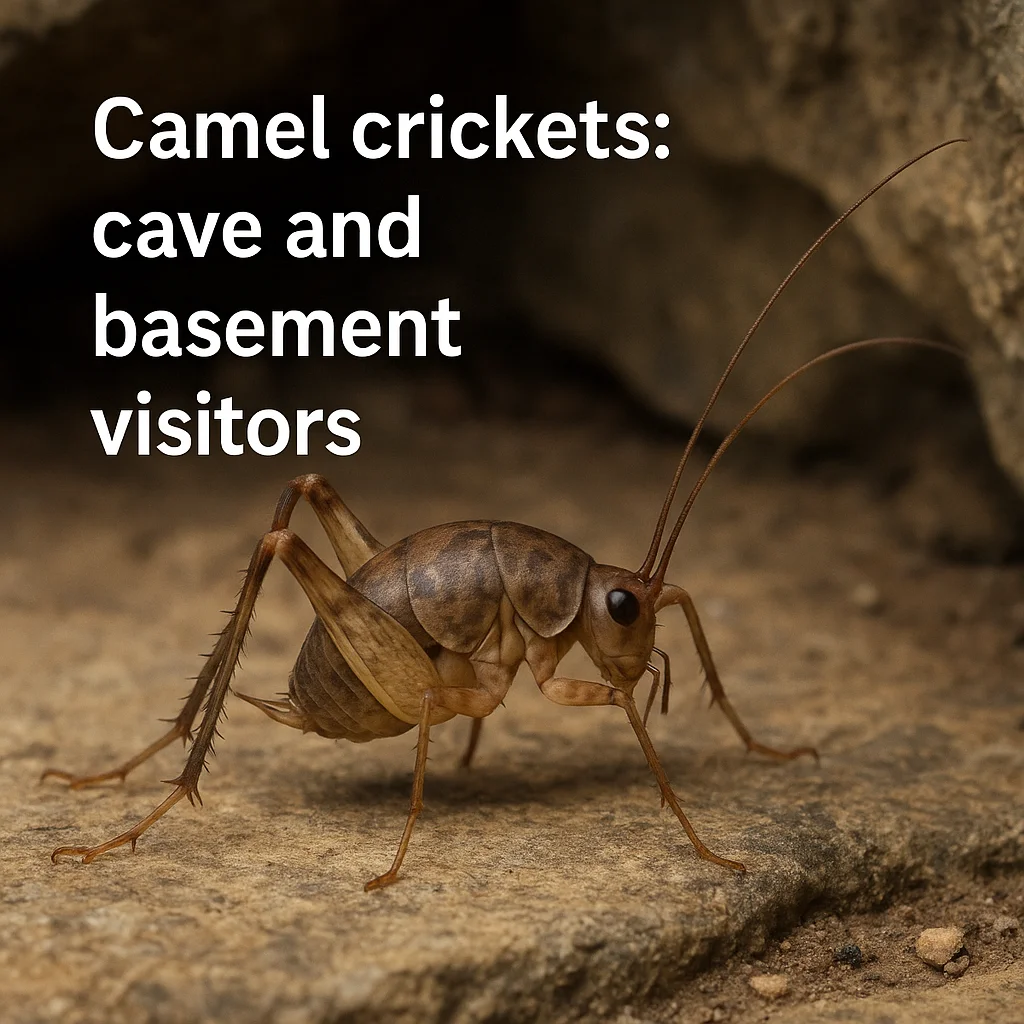
- Common Names: Camel crickets, cave crickets, spider crickets
- Scientific Name: Varies
- Insect or Not: Yes, they are insects and invertebrates.
- Order / Family: Orthoptera / Rhaphidophoridae
- Typical Size Range: 1/2 to 1 inch (13 - 25 mm)
- Key Colors/Patterns: Brown, tan, mottled patterns
- Activity: Nocturnal
- Typical Habitats: Caves, basements, under logs and stones
- Where in the World: Found globally, especially in temperate regions
- Seasonality: Most visible in late spring to early fall
🔍 Identification
Camel crickets can be recognized by their distinctive features. They possess a humpbacked appearance, which gives them their common name. Their antennae are long and slender, helping them to navigate their dark surroundings.
- Body Shape and Silhouette: Humpbacked, slightly spider-like
- Antennae Type: Long, thin, and sometimes longer than their body
- Wing Features: Wingless or very reduced wings
- Leg Traits and Movement Style: Strong hind legs for jumping; movement is often erratic
- Look-Alikes: Easily confused with spiders due to long legs and quick movement
- Top ID Tips:
- Look for a humpbacked, spider-like silhouette
- Presence in dark, damp environments
- Noticeable long antennae
- Strong, large hind legs
- Brownish, mottled coloration
- Erratic hopping movement
- No visible wings or rarely with reduced wings
- Often found in groups
🧠 Basic Body Structure
Like most insects, camel crickets have a body divided into three main parts: the head, thorax, and abdomen. They have six legs, with the hind legs well-adapted for jumping. As invertebrates, they possess an exoskeleton that they periodically molt. Unlike many insects, they usually lack developed wings or have reduced wings and do not fly.
🌍 Habitat & Distribution
Camel crickets inhabit a variety of environments that offer moisture and darkness. Common habitats include caves, basements, and woods, often hiding under logs, stones, or leaf litter. They are globally distributed, particularly in temperate zones, but can be found in tropical regions too. Habitat destruction may affect their distribution as they rely heavily on specific microhabitats for survival.
📅 Seasonal Appearance & Activity
These crickets are mostly active in the warmer months, typically from late spring to early fall. They are nocturnal, preferring to remain hidden during daylight hours and becoming active at night. High humidity and moist conditions are favorable for their activity, and they might be more visible after a rainy spell.
- Best Time to Spot It:
- Nighttime exploration in summer
- After periods of rain
- In caves or damp basements
- During late spring through early fall
🥚 Reproduction & Egg-Laying
Camel crickets engage in a courtship that includes specific signaling behaviors, though these vary by species and region. Eggs are generally laid in soil or organic debris, offering a safe environment for development. Egg-laying strategies differ among species, with some laying numerous eggs while others lay fewer.
🌀 Metamorphosis & Life Cycle
Camel crickets undergo incomplete metamorphosis, proceeding from egg to nymph to adult. Nymphs resemble small adults and undergo multiple molts as they grow. They mainly feed on fungi, decaying plant matter, and other organic materials in their habitats. The duration of each stage may vary based on environmental conditions.
🍽️ Diet & Feeding Behavior
These crickets have chewing mouthparts designed for a primarily herbivorous diet, feeding on fungi, decaying organic matter, seeds, and occasionally scavenging dead insects. Camel crickets play an essential role as decomposers in their ecosystems, contributing to nutrient recycling.
🦉 Predators & Defense
Camel crickets face threats from various predators, including birds, reptiles, amphibians, spiders, and small mammals. For defense, they rely on camouflage to blend into their environments and swift, erratic jumping to escape. Their ability to move unpredictably helps to disorient potential predators.
- Defense Highlights:
- Use of camouflage in natural settings
- Erratic jumping patterns
- Blending into leaf litter or undergrowth
- Hiding in crevices during the day
👥 Social Behavior & Swarms
Camel crickets are generally solitary insects but may be found in groups when conditions are favorable, such as in damp basements or natural caves. Any grouping is typically due to environmental conditions rather than deliberate social or cooperative behavior. They do not form swarms or colonies.
🧭 Senses & Communication
Camel crickets rely heavily on their senses of touch and vibration. Their long antennae are crucial for sensing their environment, detecting changes in their surroundings through vibrations. While they do not produce sounds for communication like some other crickets, they use tactile signals for interactions.
🌱 Role in the Ecosystem
Camel crickets contribute significantly to their ecosystems by aiding in the decomposition of organic material. Their feeding activities help recycle nutrients back into the soil, supporting plant growth. They also serve as food for many predators, maintaining ecological balance in their habitats.
📉 Population & Conservation Notes
These crickets are often common in suitable habitats, but their populations can be affected by habitat loss and environmental changes. They thrive in natural settings, and promoting biodiversity and habitat preservation can support their populations. Local abundance varies widely based on regional environmental conditions.
- How to Help (Low-Impact):
- Maintain natural habitats like leaf litter
- Avoid using chemical pesticides
- Preserve local wetland areas
- Create gardens with native plant species
⚠️ Human Interaction & Safety
Camel crickets are harmless to humans as they do not bite or sting. While they may enter homes, especially basements, they do not pose significant threats or cause damage. It's advisable to observe them respectfully without attempting to handle or collect them, promoting a healthy urban biodiversity.
📌 Summary
- Camel crickets have a humpbacked, spider-like appearance.
- They prefer dark, damp habitats such as caves and basements.
- They are most active at night and during the warmer months.
- Undergo incomplete metamorphosis with egg, nymph, and adult stages.
- Feed mainly on fungi and decaying organic matter.
- Predators include birds, amphibians, spiders, and small mammals.
- Contribute to nutrient recycling in ecosystems.
- No significant threat to humans; can be observed in basements and caves.