🕷️ Katydids: leaf-like camouflage explained
🧾 Quick Facts
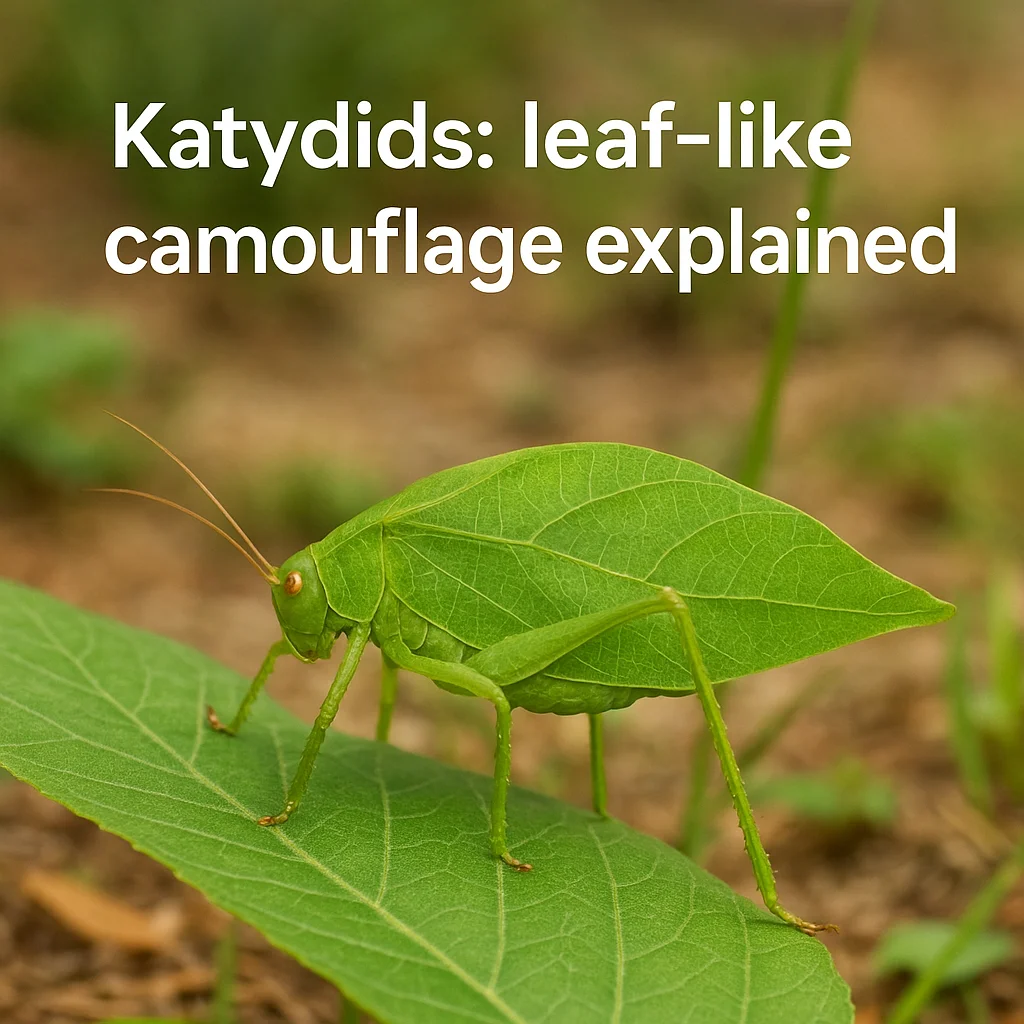
Katydids are fascinating insects known for their remarkable camouflage abilities, resembling leaves. Their adaptive strategy helps them evade predators, making them a captivating subject for nature enthusiasts.
- Common names: Katydid, Bush Cricket
- Scientific name: Tettigoniidae (varies across species)
- Insect or not: Yes, they are insects (invertebrates)
- Order / family: Orthoptera / Tettigoniidae
- Typical size range: 1 to 5 inches (2.5 to 12.7 cm) in length
- Key colors/patterns: Typically green with leaf-like veining
- Activity: Mostly nocturnal
- Typical habitats: Forests, grasslands, shrubs
- Where in the world: Found on every continent except Antarctica
- Seasonality: Most visible in late spring to early autumn
🔍 Identification
Katydids can be recognized by their unique leaf-like appearance which serves as effective camouflage. They have elongated, slender bodies with long, thin antennae that are often longer than their body.
Their wings are typically large and mimic the shape and texture of leaves, complete with veining patterns. Katydids have powerful hind legs adapted for jumping, similar to grasshoppers but are generally more brown or green in coloration.
While grasshoppers and crickets can often be mistaken for katydids, the latter's wings and the length of their antennae are distinguishing features.
- Long antennae often longer than body
- Green or brown wing patterns resembling leaves
- Powerful hind legs used for jumping
- Wings with leaf-veining patterns
- Nocturnal with song used for communication
- Slower movement compared to grasshoppers
🧠 Basic Body Structure
As insects, katydids have a segmented body divided into the head, thorax, and abdomen. They possess six legs, typical of insects, and a hard exoskeleton that they shed during molting as they grow.
Katydids are invertebrates, meaning they lack a backbone. Their sturdy exoskeleton provides structural support and protection from environmental threats.
🌍 Habitat & Distribution
Katydids predominantly inhabit areas with dense vegetation such as forests, grasslands, and shrublands. They are also found in gardens and urban areas where trees and bushes provide adequate cover.
Globally distributed, katydids adapt to a variety of climates, from temperate to tropical regions. Changes in habitat due to human activity can affect their distribution and local abundance.
📅 Seasonal Appearance & Activity
The best time to observe katydids is from late spring through early autumn when adults are active. They are primarily nocturnal, becoming more active at dusk and continuing their activities throughout the night.
Weather patterns such as rain and humidity can influence their visibility, as they prefer moist environments.
- Best observed at night
- Most active from spring to fall
- Warm, humid weather increases activity
- More visible after rains
🥚 Reproduction & Egg-Laying
Katydid reproduction involves elaborate courtship behaviors, often including distinct mating calls produced by vibrating their wings. After mating, females lay eggs on host plants, typically on leaves or stems.
The number of eggs laid varies widely among species, and environmental conditions can influence reproductive success and survival rates.
🌀 Metamorphosis & Life Cycle
Katydids undergo incomplete metamorphosis, progressing through stages of egg, nymph, and adult. The nymphs resemble miniature adults and gradually develop wings as they molt multiple times.
Their diet mainly consists of leaves and other plant materials throughout nymph and adult stages, with developmental times varying by species and environmental conditions.
🍽️ Diet & Feeding Behavior
As herbivores, katydids primarily consume leaves, but they may also feed on flowers, fruits, and occasionally, small insects. They possess chewing mouthparts adapted to manipulate and ingest plant materials.
In their ecosystem, katydids contribute to plant population control, aiding in the balance of natural habitats.
🦉 Predators & Defense
Natural predators of katydids include birds, reptiles, amphibians, and spiders. To defend against these threats, katydids employ leaf-like camouflage, mimicking their environment to avoid detection.
Some species can produce noises to startle predators, while others rely on their agility to escape through rapid jumps.
- Effective leaf camouflage
- Quick jumping ability
- Sound-making as a startle method
- Blending into plant foliage
👥 Social Behavior & Swarms
Katydids are generally solitary creatures, though they may gather in groups when conditions favor their presence, such as abundant food sources. Social interactions largely revolve around mating, with males using calls to attract females.
They do not typically form swarms, and interactions outside mating are limited.
🧭 Senses & Communication
Katydids have acute senses adapted for survival, including excellent vision and the use of sound for communication. Males produce distinctive mating calls via stridulation, rubbing their wings together to attract females.
They also sense their surroundings through vibrations, detecting the presence of predators or potential mates.
🌱 Role in the Ecosystem
Katydids play significant roles in their ecosystems as herbivores, helping control plant growth and serve as prey for numerous predators. Their presence supports the food web by providing nutrients for higher trophic levels.
They also contribute to ecosystem dynamics as pollinators, occasionally assisting in the reproductive processes of certain plants.
📉 Population & Conservation Notes
While many katydid species are common globally, localized threats such as habitat loss, pesticide use, and climate change can adversely impact populations. Conservation efforts aimed at preserving natural habitats are critical for their survival.
- Plant native vegetation to enhance habitats
- Minimize pesticide usage
- Foster biodiversity with diverse plantings
- Preserve leaf litter for habitat complexity
⚠️ Human Interaction & Safety
Katydids are generally harmless to humans and do not bite or sting. When encountered, they can be appreciated from a distance, respecting their role in the ecosystem. Handling should be avoided to prevent stress or harm to the insect.
Should a katydid accidentally bite, simply wash the area, avoid scratching, and seek professional advice if irritation persists.
📌 Summary
- Unique leaf-like camouflage for effective disguise
- Habitat: forests, grasslands, urban gardens
- Seasonality: Active in spring to autumn, mostly nocturnal
- Undergo incomplete metamorphosis: egg-nymph-adult
- Diet: Herbivorous, feeding primarily on leaves
- Predators include birds and reptiles
- Significant ecological roles in plant control and as prey
- Conservation efforts focus on habitat preservation
- Safe for humans, promoting peaceful coexistence