🕷️ Mole crickets: underground diggers
🧾 Quick Facts
Mole crickets are intriguing creatures primarily known for their burrowing abilities. As their name suggests, they resemble moles in their tunneling behavior. Here are some quick facts about these fascinating insects:
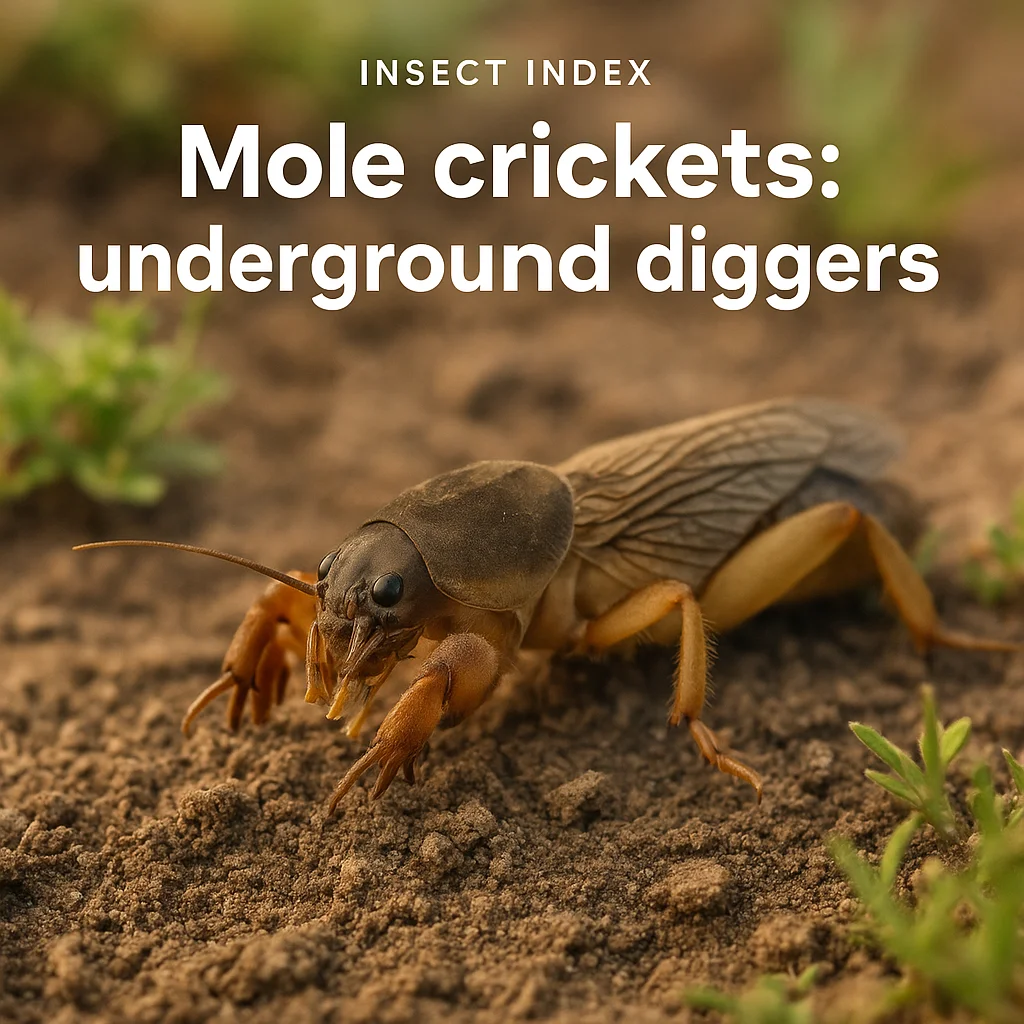
- Common names: Mole crickets
- Scientific name: Varies by region, with common genera including Gryllotalpa and Neocurtilla
- Insect: Yes, they are invertebrates with an exoskeleton and six legs
- Order/Family: Orthoptera/Gryllotalpidae
- Typical size range (adult): 3.2 to 5 cm (1.25 to 2 inches) in length
- Key colors/patterns: Brown or beige, sometimes with darker mottling
- Activity: Primarily nocturnal
- Typical habitats: Grasslands, agricultural fields, gardens
- Where in the world it occurs: Found on every continent except Antarctica
- Seasonality: Often most visible in late spring to early autumn
🔍 Identification
Identifying mole crickets involves observing several distinctive features. These subterranean creatures have a body shape that aids in their burrowing lifestyle. Their head is conical, adapted for digging, while their robust forelegs resemble those of a mole, enabling effective soil displacement. Mole cricket wings can range from fully developed to vestigial, depending on the species, allowing for occasional flight or none at all.
Their antennae are long and sensitive, used to navigate in the dark confines of their tunnels. Leg morphology is distinctive, with the front legs being spade-like for digging. Movement is mostly underground, and they can push soil efficiently with their broad limbs.
Despite their unique appearance, mole crickets are sometimes confused with other burrowing insects, such as ground beetles. Clarity can be achieved by noting their mole-like forelimbs.
- Top ID Tips:
- Look for mole-like forelegs adapted for digging
- Conical head with long antennae
- Brownish coloration with subtle patterns
- Nocturnal activity, making evening sightings likely
- Presence of burrow mounds in gardens or lawn areas
- Often heard, not seen; listen for their chirping at night
- Robust body structure aiding subterranean movement
- Best Time to Spot It:
- Late spring to early autumn evenings
- Following rain when soil is moist
- Warm and mild nights
- Period following grass cutting, as this disturbs their habitat
- Defense Highlights:
- Rapid burrowing to escape danger
- Soil-colored camouflage
- Subterranean lifestyle decreases predation chances
- Some species emit stridulating sounds as an alarm
- How to Help (Low-Impact):
- Plant native grasses and shrubs to sustain natural habitats
- Minimize pesticide use in gardens and lawns
- Leave areas of undisturbed soil for burrowing
- Promote awareness of their ecological role
- Mole crickets are identifiable by their burrowing forelegs and distinct calls
- Habitats include grasslands, fields, and gardens
- Active primarily at night from spring to autumn, especially post-rain
- Undergo incomplete metamorphosis from egg through nymph to adult
- Feed on plant roots, contributing to soil nutrient recycling
- Natural predators include birds, amphibians, and parasitoid wasps
- Improve soil aeration and play a role in ecosystem stability
- Respect local populations by minimizing disturbances and pesticides
🧠 Basic Body Structure
Like all insects, mole crickets have a body divided into three main parts: the head, thorax, and abdomen. They possess six legs, with the specialized front legs adapted for digging. As invertebrates, they lack a backbone, relying on their tough exoskeleton for support and protection.
Mole crickets go through a molting process as they grow, shedding their exoskeleton in stages. Wing development varies, with some species capable of flight, while others remain wingless.
Invertebrate: As invertebrates, mole crickets are part of a vast group of animals that do not have a vertebral column. Their rigid external covering, or exoskeleton, provides structural support.
🌍 Habitat & Distribution
Mole crickets show a preference for habitats where the soil conditions facilitate their burrowing behavior. They are commonly found in grasslands, agricultural fields, and gardens. Urban lawns and parks can also serve as suitable environments.
These insects tend to create microhabitats within the soil, forming extensive tunnel systems beneath the ground's surface. Geographic distribution includes most continents, barring Antarctica, with presence in temperate, tropical, and sub-tropical climates. Changes in habitat, such as urban development or agricultural intensification, can impact local mole cricket observations as these alterations affect soil structure and availability.
📅 Seasonal Appearance & Activity
Mole crickets are mostly active during the night and can be observed in different seasons globally, with regional variations. Generally, their activity peaks between late spring and early autumn, coinciding with milder weather conditions and breeding seasons.
Weather influences play a significant role; they are more likely to be encountered during or after rain, which softens the soil, making it easier to burrow.
🥚 Reproduction & Egg-Laying
Mole cricket reproductive behaviors are complex, often involving nocturnal calling from males to attract females. This acoustical signaling plays a crucial role in locating mates. After mating, females lay their eggs in the soil, creating specially constructed chambers to protect them.
The number of eggs can vary considerably, influenced by species and environmental conditions. Eggs are generally laid in clusters within the soil, ensuring a secure environment for development.
🌀 Metamorphosis & Life Cycle
Mole crickets undergo incomplete metamorphosis, passing through three life stages: egg, nymph, and adult. This process begins with the egg stage, where eggs are deposited underground and undergo development before hatching.
Upon hatching, nymphs emerge as miniature versions of the adults but lack developed wings. They continue to grow through molting, gradually developing adult characteristics over several molts. Nymphs typically feed on plant roots and organic detritus during their development.
Adult mole crickets have the capability to reproduce and further the cycle. Depending on environmental factors, the complete lifecycle may span several months to a year.
🍽️ Diet & Feeding Behavior
Mole crickets are primarily herbivorous, feasting on plant roots and organic material found in the soil. Both nymphs and adults display similar feeding habits. Their mouthparts are adapted for chewing, making them efficient at breaking down fibrous plant matter.
While not usually considered predators, mole crickets do play a role in soil aeration and the incorporation of decomposing organic material back into the soil, benefiting agricultural ecosystems.
🦉 Predators & Defense
Mole crickets face threats from a variety of natural predators, including birds, reptiles, amphibians, and certain mammals. Additionally, they are often targeted by specialized parasitoid wasps that can locate and infest their burrows.
Defense strategies involve their ability to burrow quickly below ground when threatened, using their strong forelegs. Camouflage also plays a role, as their coloration allows them to blend into the soil surface effectively.
👥 Social Behavior & Swarms
Mole crickets are largely solitary insects, focusing on individual survival rather than forming large social groups. They establish their own territories underground. The main social interactions occur during mating when males court females with their calls.
These crickets do not typically swarm; instead, they maintain discrete tunnels and chambers. Their tunneling efforts are driven by personal survival needs, such as feeding and reproduction.
🧭 Senses & Communication
Mole crickets rely on several senses to navigate and survive underground. Their antennae are highly sensitive to touch and chemical cues, aiding in their navigation through subterranean environments.
Sound is a pivotal element in their communication, with males producing calls by rubbing their wings together, a behavior known as stridulation. This acoustic signaling is central to attracting mates.
🌱 Role in the Ecosystem
Mole crickets contribute significantly to the ecosystem through their burrowing actions, which improve soil aeration and nutrient recycling. While their feeding habits can cause damage to plants, they assist in decomposing organic material, benefiting soil fertility.
These insects form part of the food web, serving as prey for various wildlife species. Despite potential agricultural impacts, they help maintain soil health and structure, demonstrating an essential ecological role.
📉 Population & Conservation Notes
Mole crickets are often considered common in areas with appropriate habitats, although population levels can fluctuate based on environmental pressures like habitat degradation and pesticide use. Local abundance can vary, with conservation efforts focused on habitat preservation.
While data on global population trends is limited, conservation emphasis is on maintaining sustainable ecosystems that support their lifestyle.
⚠️ Human Interaction & Safety
While mole crickets are not known for biting or stinging, their presence in lawns and gardens can lead to plant damage due to their feeding activities on roots. Observing them respectfully without attempting to handle or collect wild specimens is advised.
Should any bites occur, general care involves washing the area with soap and water and avoiding excessive scratching. For severe reactions, professional medical advice should be sought.