🕷️ Why crickets chirp (mating calls)
🧾 Quick Facts
Crickets are one of the most recognizable insects, known for their characteristic chirping sounds. These sounds are primarily mating calls produced by males to attract females. Here are some quick facts about crickets:
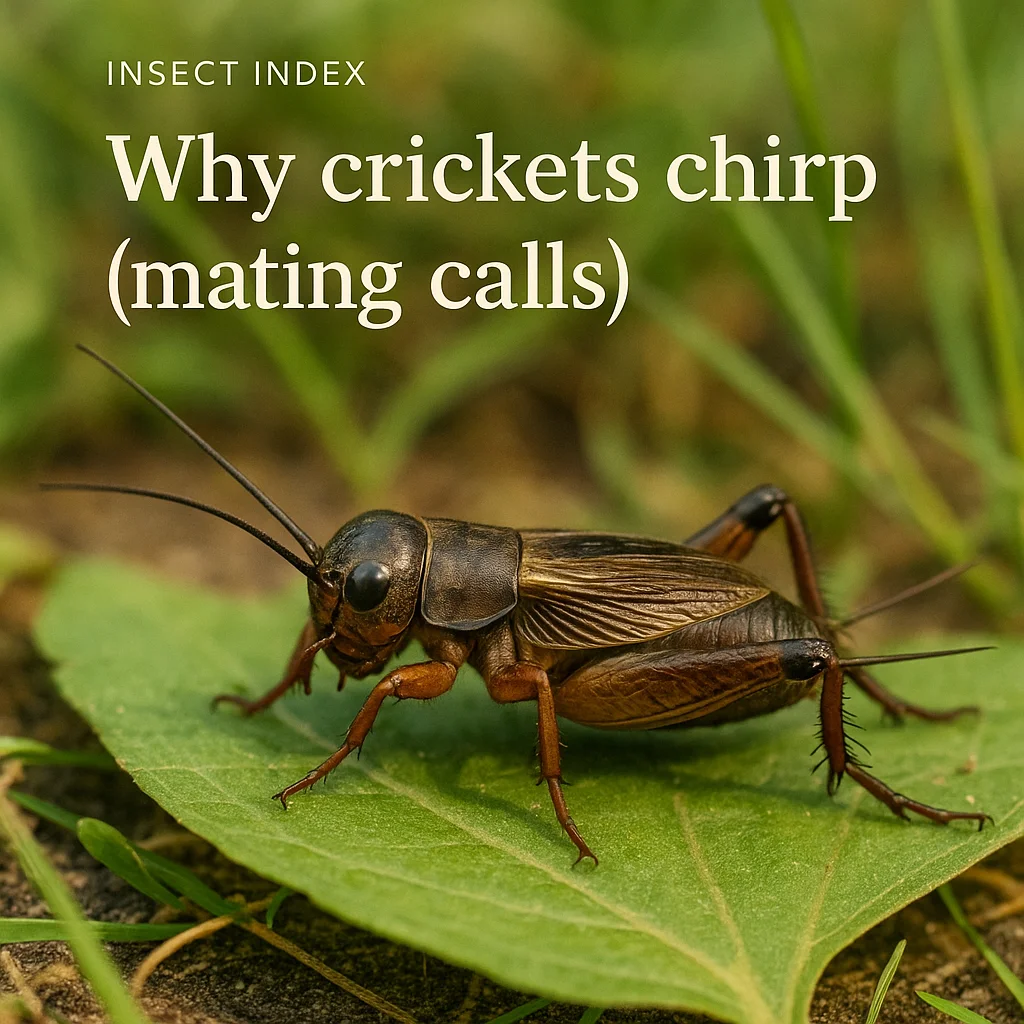
- Common Names: Crickets
- Scientific Name: Varies (e.g., Gryllus species)
- Insect: Yes, they are invertebrates
- Order/Family: Orthoptera/Gryllidae
- Typical Size Range: 0.5 to 1.25 inches (1.2 to 3 cm)
- Key Colors/Patterns: Brown, black, sometimes green
- Activity: Nocturnal
- Typical Habitats: Fields, forests, gardens
- Where in the World: Found on all continents except Antarctica
- Seasonality: Most visible in spring and summer
🔍 Identification
Crickets can be identified by their distinct body shape and chirping sounds. Here's how you can recognize them in the field:
- Body Shape: Slender with a round head and elongated hind legs for jumping
- Antennae Type: Long and thin
- Wing Features: Two pairs of wings, with the front pair being leathery
- Leg Traits: Large hind legs for jumping; three pairs of legs in total
- Common Confusion: Often confused with grasshoppers, which have shorter antennae
- Top ID Tips:
- Listen for distinctive chirping at night
- Look for long antennae and large hind legs
- Note the general brown or black coloration
- Check for the presence of two pairs of wings
- Observe the slow, deliberate movement when not jumping
- Distinguish from grasshoppers by antennae length
🧠 Basic Body Structure
Like all insects, crickets have a body divided into three main sections: the head, thorax, and abdomen. They possess six legs and two pairs of wings. Crickets are invertebrates, meaning they lack a backbone. Instead, they have an exoskeleton that provides structure and protection. They undergo molting, shedding their old exoskeleton as they grow.
🌍 Habitat & Distribution
Crickets are highly adaptable and can be found in diverse environments. Preferred habitats include forests, grasslands, and urban gardens. They often inhabit microhabitats such as under rocks, within leaf litter, or in crevices. Crickets are prevalent in temperate to tropical climates and are versatile enough to survive in a range of geographical locations across the globe. Changes in habitat, due to urban development or agriculture, can affect their local abundance.
📅 Seasonal Appearance & Activity
Crickets are most commonly observed during the warmer months, particularly in spring and summer. They are nocturnal insects, most active after sunset when they produce their distinctive chirping sounds. Weather conditions like temperature and humidity may influence their activity rate, with warm, humid nights being ideal for cricket activity.
- Best Time to Spot It:
- Spring and summer evenings
- Warm nights with high humidity
- Following rain showers
- Near sources of light where they might be attracted
🥚 Reproduction & Egg-Laying
Crickets rely on sound for mating. Males produce chirping sounds by rubbing their wings together, a behavior known as stridulation, to attract females. Once a female is attracted, mating ensues. Females lay their eggs in the soil or within plant material. The number of eggs varies by species, but a single female can lay hundreds of eggs during her lifetime.
🌀 Metamorphosis & Life Cycle
Crickets undergo incomplete metamorphosis, progressing from egg to nymph to adult without a pupal stage. Nymphs resemble miniature adults without fully developed wings and reproductive organs. They feed on plants, detritus, and small insects. The nymph stage lasts a few weeks to months before they mature into adults. Overall, the life cycle is highly dependent on environmental factors such as temperature and food availability.
🍽️ Diet & Feeding Behavior
Crickets are omnivorous, using chewing mouthparts to consume a diet comprising plant material, seeds, and small insects. Nymphs and adults share similar dietary habits. As scavengers, crickets contribute to the decomposition of plant material, playing a minor role in nutrient cycling within ecosystems.
🦉 Predators & Defense
Crickets face predation from a diverse array of animals, including birds, reptiles, small mammals, amphibians, and other insects. They have developed several defense mechanisms, such as camouflage and sudden jumping to escape predators. Typically, crickets rely on their color and behavior to blend into their surroundings.
- Defense Highlights:
- Quick jumping to evade capture
- Camouflage with surroundings
- Remaining still to avoid detection
- Producing warning sounds when startled
👥 Social Behavior & Swarms
Crickets are primarily solitary insects. Males establish territories and use sound to communicate, especially during the mating season. While they do not form swarms in the same way as some other insects, they can be found in large groups when environmental conditions attract them to a particular area, such as food sources or breeding grounds.
🧭 Senses & Communication
Crickets possess well-developed senses, including vision, smell, and vibration detection. Sound is the most significant form of communication, primarily during mating. Through stridulation, crickets produce varying frequencies to convey different messages. Females can discern these sounds to locate and select potential mates.
🌱 Role in the Ecosystem
Crickets play a valuable role in the ecosystem as both prey and scavengers. They help in the decomposition of organic matter, recycling nutrients back into the soil. Additionally, crickets serve as a crucial food source for a wide array of predators, including birds, small mammals, and reptiles, thus sustaining the food web. While they can occasionally be pests by feeding on crops, their overall impact on agriculture is minor and manageable.
📉 Population & Conservation Notes
Crickets are often abundant in suitable habitats, though habitat loss and pesticide use can impact populations locally. Generally, data on their global population is limited. Crickets are not considered threatened, but conservation efforts in certain regions focus on maintaining diverse ecosystems that support cricket populations.
- How to Help (Low-Impact):
- Maintain native plant gardens to provide habitat
- Avoid use of broad-spectrum pesticides
- Preserve areas of leaf litter and vegetation
- Reduce light pollution by minimizing artificial lighting
⚠️ Human Interaction & Safety
Crickets are harmless to humans and do not bite or sting. They may enter homes, attracted by light, but are not a threat. If encountered indoors, they can be safely relocated outdoors. Respectful observation of crickets is encouraged as they contribute positively to the environment. Collecting wild specimens is not recommended.
📌 Summary
- Crickets are known for their chirping mating calls
- They are adaptable to many habitats worldwide
- Most visible during warm months, especially at night
- Undergo incomplete metamorphosis: egg, nymph, adult
- Omnivorous diet: plants, small insects
- Predators include birds, reptiles, amphibians
- Play a role in decomposition and as a food source
- Population health varies; avoid habitat disruption