🕷️ Grasshopper habitats: fields and meadows
🧾 Quick Facts
Grasshoppers are common insects that thrive in fields and meadows across the globe. With their ability to blend into the environment and their distinctive hopping movements, these invertebrates are an integral part of many ecosystems.
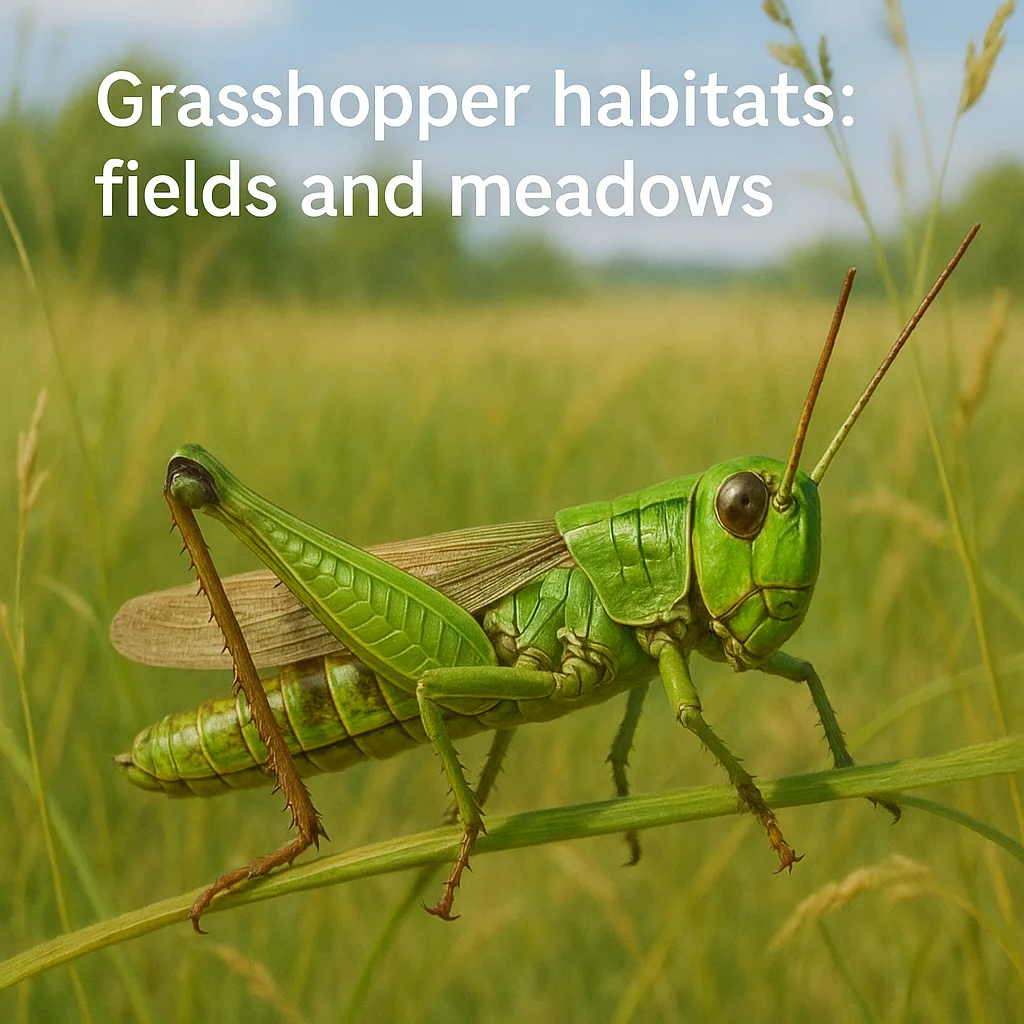
- Common names: Grasshopper
- Scientific name: Varies by species
- Insect: Yes, they are invertebrates
- Order: Orthoptera; Family: Acrididae
- Typical size range: 1 to 5 inches as adults
- Key colors/patterns: Greens, browns, and occasionally bright colors
- Activity: Mostly diurnal
- Typical habitats: Fields, meadows, prairies
- Where in the world: Globally, especially temperate and tropical regions
- Seasonality: Most visible in warmer months
🔍 Identification
Grasshoppers can be recognized by their elongated bodies, large hind legs adapted for jumping, and relatively short antennae. They have straight wings which, when present, lay flat against their bodies. Their movement style is characterized by both hopping and flying short distances.
- Top ID Tips:
- Long, muscular hind legs for jumping
- Short antennae compared to body length
- Long body with straight wings resting along the sides
- Varied coloration: camouflaged in green, brown, sometimes brightly colored
- Often found in grass; they blend well with surroundings
- Dorsal view: head narrower than thorax and abdomen
- Active during the day in sunny conditions
- Produces a characteristic chirping sound by stridulation
- Whole specimen in frame: best viewed from the side or above
🧠 Basic Body Structure
Grasshoppers have a basic insect anatomy consisting of a head, thorax, and abdomen. They possess six legs and are characterized by their robust exoskeleton which provides protection and support. As invertebrates, they do not have a backbone. They periodically molt to grow, shedding their exoskeleton. Many species have fully developed wings for flight.
Being invertebrates, grasshoppers lack an internal skeleton, relying instead on their exoskeleton to perform the functions that vertebrate backbones would.
🌍 Habitat & Distribution
Grasshoppers are commonly found in fields and meadows. These open environments provide ample food and the right conditions for breeding and development. They thrive in both natural and human-tended agricultural lands. The geographic distribution is broad, including all continents except Antarctica, with the highest diversity found in warm and temperate regions. Habitat changes, such as urbanization and deforestation, can significantly impact their populations and the frequency of sightings.
📅 Seasonal Appearance & Activity
Grasshoppers are most frequently observed during the warmer months of the year when conditions are optimal for their activity and reproduction. They are predominantly diurnal, with peak activity during sunny, warm days. Their appearances are influenced by temperature and humidity, becoming less visible during extreme heat or rainfall.
- Best Time to Spot It:
- Late spring through early autumn
- Sunny and warm days
- Mid-morning to late afternoon
- Avoids extreme temperatures and heavy rain
- Most active during moderate humidity
🥚 Reproduction & Egg-Laying
Grasshopper mating involves a visually striking courtship display where males often stridulate to attract females. They typically lay eggs in soil, making them vulnerable to environmental changes. The number of eggs can vary significantly among species, with some species laying in clusters while others distribute them sparsely.
🌀 Metamorphosis & Life Cycle
Grasshoppers undergo incomplete metamorphosis, which consists of three stages: egg, nymph, and adult. The nymph stage resembles a smaller version of the adult but lacks fully developed wings and reproductive organs. Nymphs usually feed on the same plant materials as adults and inhabit similar environments. The overall lifecycle can take several weeks to months, depending on environmental conditions.
🍽️ Diet & Feeding Behavior
Grasshoppers are primarily herbivores, consuming a variety of plant materials including leaves, stems, and flowers. They possess chewing mouthparts that allow them to efficiently break down tough plant matter. In their ecosystem role, grasshoppers help control plant populations but can also become agricultural pests in large numbers.
🦉 Predators & Defense
Grasshoppers have numerous natural predators, including birds, lizards, rodents, spiders, and insectivorous mammals. Their primary defense mechanisms include camouflage, rapid jumping ability, and flight to escape threats. Some species may also employ startle displays or produce noxious chemicals to deter predators.
- Defense Highlights:
- Camouflage coloration to blend into vegetation
- Strong hind legs for powerful, quick jumps
- Ability to fly short distances to evade capture
- Some species release unpleasant chemicals when threatened
👥 Social Behavior & Swarms
Most grasshoppers are solitary creatures, focusing on individual survival and reproduction. However, certain environmental conditions, such as an abundance of food and optimal breeding conditions, can lead to population explosions resulting in swarms. Swarming behavior, particularly in locust species, is a well-documented phenomenon where individuals band together for migration to new areas.
🧭 Senses & Communication
Grasshoppers have well-developed senses. They rely on vision to navigate their surroundings, with their large compound eyes allowing for a broad visual field. Their antennae detect chemical signals, and their legs sense ground vibrations. Communication predominantly occurs through stridulation, where rub their leg against their wing to produce sound.
🌱 Role in the Ecosystem
Grasshoppers play a crucial role in ecosystems as herbivores, contributing to the regulation of plant populations and serving as a food source for numerous predators. Their feeding activities can impact plant community dynamics and competition. In some scenarios, grasshoppers can facilitate seed dispersal or contribute to soil nutrient cycling through their waste products.
📉 Population & Conservation Notes
The population status of grasshoppers varies globally. In some areas, they are abundant and stable, whereas in others, threats such as habitat loss and pesticide use have led to declines. Climatic changes can influence their distribution and abundance. Generally, maintaining natural habitats and reducing pesticide usage can support grasshopper populations.
- How to Help (Low-Impact):
- Plant native grasses and plants to provide suitable habitat
- Avoid unnecessary pesticide use in gardens and fields
- Support conservation efforts in natural grasslands
- Leave areas of unmanaged vegetation to encourage natural habitats
- Participate in citizen science projects monitoring insect populations
⚠️ Human Interaction & Safety
Grasshoppers are generally harmless to humans. They do not bite or sting; their interactions with humans typically involve agricultural impacts. For those engaging in field studies or observations, it is advisable to maintain a respectful distance and avoid disturbing natural habitats. Avoid tampering with or collecting wild grasshoppers to preserve ecological balance.
📌 Summary
- Identifiable by long hind legs, short antennae, and straight wings
- Common in fields and meadows worldwide, most active during warm, sunny conditions
- Undergoes incomplete metamorphosis with egg, nymph, and adult stages
- Feeds on plant material, significant herbivores and occasionally pests
- Predators include birds, reptiles, and insects; employs camouflage and quick movements for defense
- Mostly solitary but capable of forming swarms under specific conditions
- Important in ecosystems as part of the food web and in regulating plant dynamics
- Population affected by habitat loss and pesticides, conservation efforts needed
- Safe to observe; best practices include non-disturbance and respecting natural habitats