🕷️ Grasshopper myths and facts
🧾 Quick Facts
The common image of grasshoppers involves their incredible jumping abilities and their distinct sounds during warm seasons. These intriguing insects inspire many myths and facts worth understanding.
- Common names: Grasshopper
- Scientific name: Varies by species
- Insect or not: Insect (invertebrate)
- Order / family: Orthoptera / Acrididae
- Typical size range (adult): 1.5 to 4 inches
- Key colors/patterns: Green, brown, yellow, with variations
- Activity: Primarily diurnal
- Typical habitats: Grasslands, fields, meadows, gardens
- Where in the world it occurs: Found on all continents except Antarctica
- Seasonality: Most visible in warm seasons
🔍 Identification
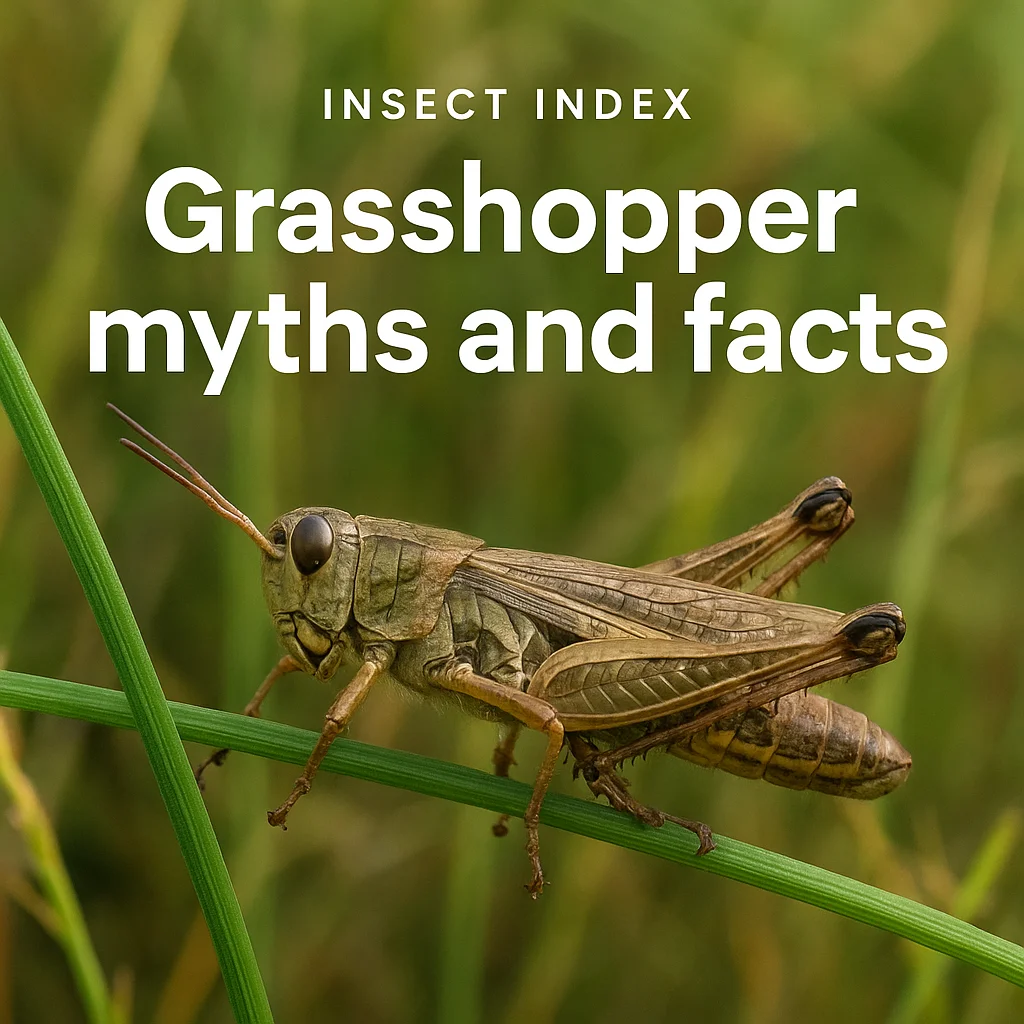
Grasshoppers exhibit a distinctive and recognizable body shape. They have a somewhat cylindrical body, large hind legs designed for jumping, and relatively short antennae compared to other similar species.
- Body shape and silhouette: Sturdy, with a hump-backed appearance
- Antennae type: Short and thin compared to other similar insects like katydids
- Wing features: Forewings narrow and leathery; hind wings broad and membranous
- Leg traits and movement style: Long, muscular hind legs for jumping
- Distinguishing look-alikes: Differ from crickets and katydids by shorter antennae and distinct coloration
Top ID Tips:
- Sturdy, cylindrical body with a hump-backed shape
- Short, thin antennae compared to katydids
- Narrow forewings and broad hind wings
- Muscular hind legs for powerful jumping
- Loud stridulation sounds during warm days
- Typically found in grass-heavy environments
- Variety of color variations help in local adaptation
🧠 Basic Body Structure
Grasshoppers have three main body segments: the head, thorax, and abdomen. They possess six legs, with the hind legs being large for jumping. Their exoskeleton provides necessary protection and support. Being invertebrates, grasshoppers periodically molt as they grow. Most species have fully developed wings enabling flight.
🌍 Habitat & Distribution
Grasshoppers thrive in grass-rich environments and are adaptable to landscapes such as grasslands, fields, meadows, and gardens. They can also occupy microhabitats like under leaf litter or grass tufts. Their broad geographic distribution covers all continents except Antarctica. However, local habitat changes, such as urban development, can affect sightings.
📅 Seasonal Appearance & Activity
Grasshoppers are primarily visible during the warmer months. They are most active during daylight hours—being diurnal—and prefer sunny, warm weather conditions. Their visibility can be affected by rain and cooler temperatures.
- Most active during spring and summer
- Daytime sightings are common
- Seek out open, sunny areas
- Less active during heavy rain or in cooler months
🥚 Reproduction & Egg-Laying
Grasshopper mating involves courtship where males produce specific sounds to attract females. They typically lay eggs in soil, preferring soft earth where they can deposit clusters. The number of eggs laid varies widely across species, often influenced by environmental factors.
🌀 Metamorphosis & Life Cycle
Grasshoppers undergo incomplete metamorphosis, comprising the stages of egg, nymph, and adult. Eggs are laid in the soil and hatch into nymphs, which resemble miniature adults without developed wings. Nymphs molt several times, growing larger with each stage. The entire life cycle from egg to adult depends on species, climate, and environment.
🍽️ Diet & Feeding Behavior
Grasshoppers are primarily herbivores, using their chewing mouthparts to feed on a variety of plants, particularly grasses. While nymphs and adults have similar diets, nymphs often concentrate on tender, new growth. Grasshoppers play a substantial role as herbivores in their ecosystems.
🦉 Predators & Defense
Grasshoppers face predation from birds, reptiles, amphibians, mammals, and spiders. Their predominant defense mechanisms include camouflage within grassy environments, sudden jumps to elude predators, and some species can produce a clicking sound when airborne to startle foes.
Defense Highlights:
- Camouflage with grasses
- Quick, powerful jumps
- Clicking sounds in flight
- Loud stridulations to confuse predators
👥 Social Behavior & Swarms
Grasshoppers are generally solitary, interacting primarily for mating. However, under specific environmental conditions, some species can form large swarms, known as locusts, that migrate to new areas in search of food and better living conditions. This behavior is environmentally triggered and not constant.
🧭 Senses & Communication
Grasshoppers have well-developed senses of vision and hearing. Their compound eyes provide a broad field of view, essential for spotting predators. They communicate mainly through sounds produced by stridulation, helping them during mating rituals and territorial displays.
🌱 Role in the Ecosystem
Grasshoppers hold a crucial role as primary consumers, converting plant matter into biomass, which then feeds a range of predators. While they are often seen as pests due to their plant consumption, they are vital for nutrient cycling. They also contribute to seed dispersal through their digestive processes.
📉 Population & Conservation Notes
Grasshopper populations are generally stable, though they can locally fluctuate due to environmental pressures, habitat alteration, and pesticide use. Conservation efforts should focus on maintaining natural habitats and reducing pesticide reliance to support biodiversity.
- Preserve native habitats
- Minimize pesticide use
- Encourage growth of native plants
- Allow natural leaf litter decomposition
⚠️ Human Interaction & Safety
Grasshoppers do not pose danger to humans as they neither bite nor sting. They can be observed safely from a distance. Respectful observation and engagement with grasshoppers in the wild are recommended. Avoid collecting or disturbing their natural behaviors.
📌 Summary
- Recognizable by sturdy, cylindrical bodies and loud stridulations
- Found worldwide except Antarctica, favor grass-rich habitats
- Highly visible during warm months and daylight hours
- Undergo incomplete metamorphosis from eggs to nymphs to adults
- Primarily herbivorous, using chewing mouthparts to feed on plants
- Natural predators include birds, reptiles, and spiders
- Vital ecological role as primary consumers and prey species
- Stable populations, preservation focuses on habitat management and pesticide reduction