🕷️ How Grasshoppers Make Sound (Stridulation)
🧾 Quick Facts
Grasshoppers are fascinating insects known for their ability to produce sound through the process called stridulation. This capability is common among various grasshopper species around the world.
- Common Names: Grasshoppers, Short-Horned Grasshoppers
- Scientific Name: Varies by species
- Insect or not: Yes, they are invertebrates
- Order / Family: Orthoptera / Acrididae
- Typical Size Range (adult): 1 to 4 inches in length
- Key Colors/Patterns: Green, brown, yellow; often camouflaged to their habitat
- Activity: Primarily diurnal (active during the day)
- Typical Habitats: Grasslands, fields, meadows
- Where in the World It Occurs: Globally distributed, particularly abundant in grassland regions
- Seasonality: Most visible in late spring to early autumn when adults are active
🔍 Identification
Grasshoppers are typically recognized by their elongated bodies and powerful hind legs, which they use for jumping. They have short antennae, typically less than body length, distinguishing them from katydids and crickets, which have long antennae. Most grasshoppers possess functional wings, although wing length can vary among species.
- Top ID Tips:
- Elongated body shape with a robust structure
- Short antennae
- Powerful, thickened hind legs for jumping
- Often seen sitting with legs folded beneath body
- Camouflaged coloration matching their habitat
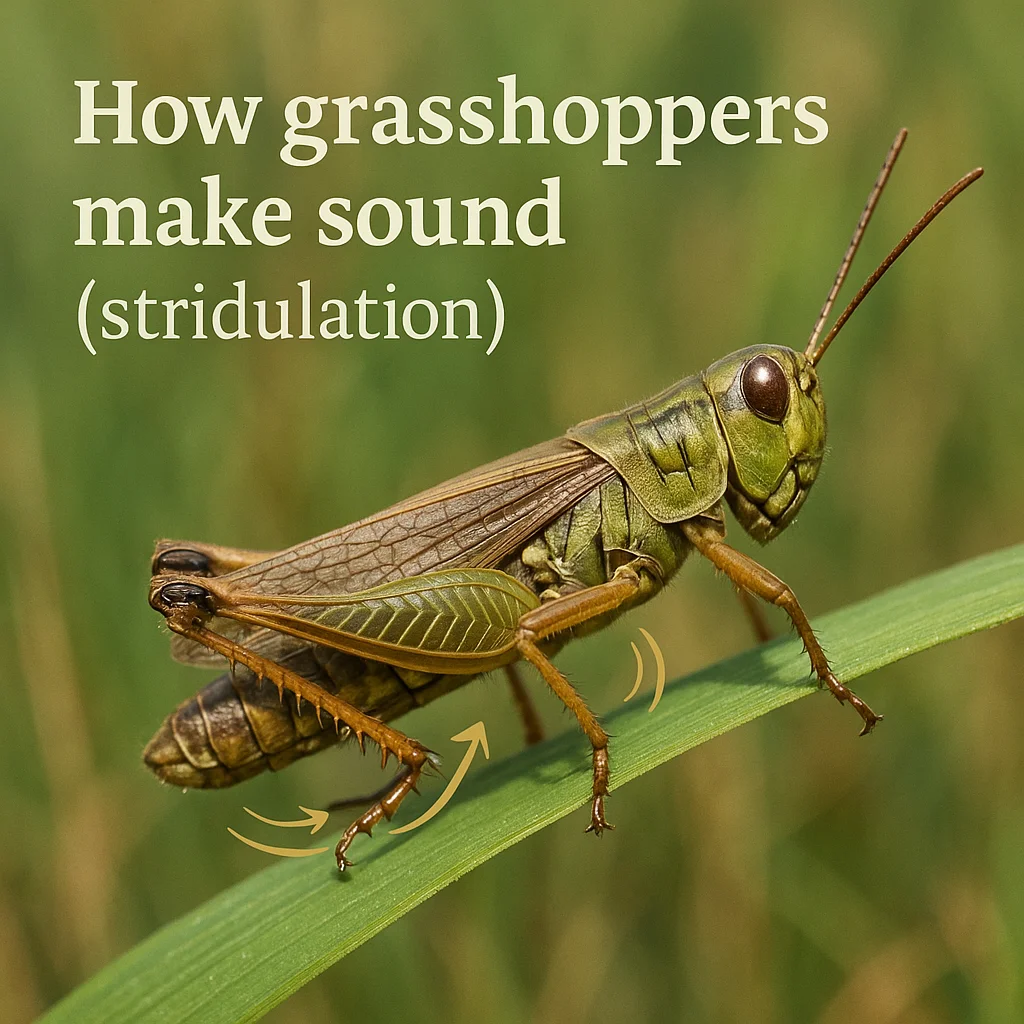
- Produces sound by rubbing hind legs against wings
- Pictures: whole specimen in frame, entire insect visible
- Entire insect body photographed clearly from head to abdomen tip
🧠 Basic Body Structure
Grasshoppers, like all insects, consist of three primary body segments: head, thorax, and abdomen. They have six legs, with the hind legs being adapted for jumping. An exoskeleton covers their bodies, providing protection and structural support. As invertebrates, they lack a backbone and undergo molting to grow. Many species have fully developed wings as adults, facilitating flight.
🌍 Habitat & Distribution
Grasshoppers thrive in open habitats such as grasslands, pastures, and meadows. They can also be found in agricultural fields and urban gardens. Their distribution is global, with significant populations in temperate, tropical, and subtropical regions. Changes in land use can affect local sightings, as grasslands become urbanized or converted to agricultural use.
📅 Seasonal Appearance & Activity
Grasshoppers are typically most visible during warmer months. In temperate regions, adults are commonly seen from late spring through autumn. Being diurnal, they are active during daylight hours, with activity levels influenced by temperature and weather conditions. Rain and cool temperatures may reduce their visibility.
- Best Time to Spot It:
- Late spring afternoons
- Warm summer days
- Early autumn mornings
- Sunny and dry weather conditions
🥚 Reproduction & Egg-Laying
Grasshopper courtship often involves males producing specific sounds to attract females. They typically lay eggs in the soil, where they are protected until hatching. The number of eggs laid can vary significantly depending on species and environmental conditions but generally ranges from a few dozen to a few hundred.
🌀 Metamorphosis & Life Cycle
Grasshoppers undergo incomplete metamorphosis, consisting of three stages: egg, nymph, and adult. After eggs are laid in the soil, they hatch into nymphs that resemble small adults but without fully developed wings. Nymphs undergo several molts as they grow, eventually developing into winged adults. This process can take several weeks to months.
🍽️ Diet & Feeding Behavior
Grasshoppers are primarily herbivores, feeding on various grasses and plants throughout their life stages. They possess chewing mouthparts suited for clipping and consuming vegetation. As generalist feeders, they play a role in controlling plant population dynamics and may sometimes impact crop agriculture.
🦉 Predators & Defense
Grasshoppers face predation from birds, reptiles, amphibians, and mammals. In response, they employ various defense mechanisms such as camouflage to blend in with their environment, sudden leaps to escape predators, and, in some species, noxious chemicals as a deterrent.
- Defense Highlights:
- Camouflage coloration
- Fast, powerful jumps
- Noxious chemical secretions (species-specific)
- Hiding among vegetation
👥 Social Behavior & Swarms
Grasshoppers are generally solitary animals but can exhibit swarming behavior under certain conditions, such as high population densities or resource availability changes. Swarming as locusts is triggered by environmental factors and can lead to significant agricultural impacts.
🧭 Senses & Communication
Grasshoppers rely on acute vision and sound for communication. They produce sounds through stridulation by rubbing their hind legs against their wings, a behavior mainly exhibited by males for attracting females during mating. Touch and vibration are also important senses for detecting predators and navigating their environment.
🌱 Role in the Ecosystem
Grasshoppers play a crucial role in ecosystems as herbivores, influencing plant community structure and functioning as prey for a variety of predators. Their feeding can aid in nutrient cycling and soil aeration. However, large populations can become agricultural pests, emphasizing their complex ecological roles.
📉 Population & Conservation Notes
Grasshopper populations vary widely based on regional environmental conditions and habitat availability. While some species are common and not threatened, habitat loss and changes due to agriculture and climate change can affect certain populations. Monitoring and conservation efforts focus on maintaining natural habitats and promoting biodiversity.
- How to Help (Low-Impact):
- Plant native grasses and plants
- Avoid pesticide use
- Preserve natural grassland habitats
- Support conservation initiatives
⚠️ Human Interaction & Safety
While grasshoppers generally pose no direct harm to humans, they can occasionally become nuisances in large swarms affecting crops. Respectful observation is encouraged, and handling should be minimized to prevent stress to the insects. In case of crop impacts, consult agricultural professionals for guidance.
📌 Summary
- Recognizable by their elongated bodies and short antennae
- Inhabit grasslands, fields, and agricultural areas globally
- Most visible during warm months, primarily active during the day
- Undergo incomplete metamorphosis: egg, nymph, adult stages
- Primarily herbivorous, impacting plant populations
- Predation from birds, reptiles, and mammals
- Ecological roles include plant consumption and serving as prey
- Populations vary, with habitat conservation being key
- Encourage respectful observation and care for their habitats