🕷️ How locust swarms form (overview)
🧾 Quick Facts
Locusts are a type of grasshopper that can transform their behavior and physiology dramatically, enabling them to form large, destructive swarms. These insects are notorious for their ability to devastate crops across vast areas, impacting agriculture and food security.
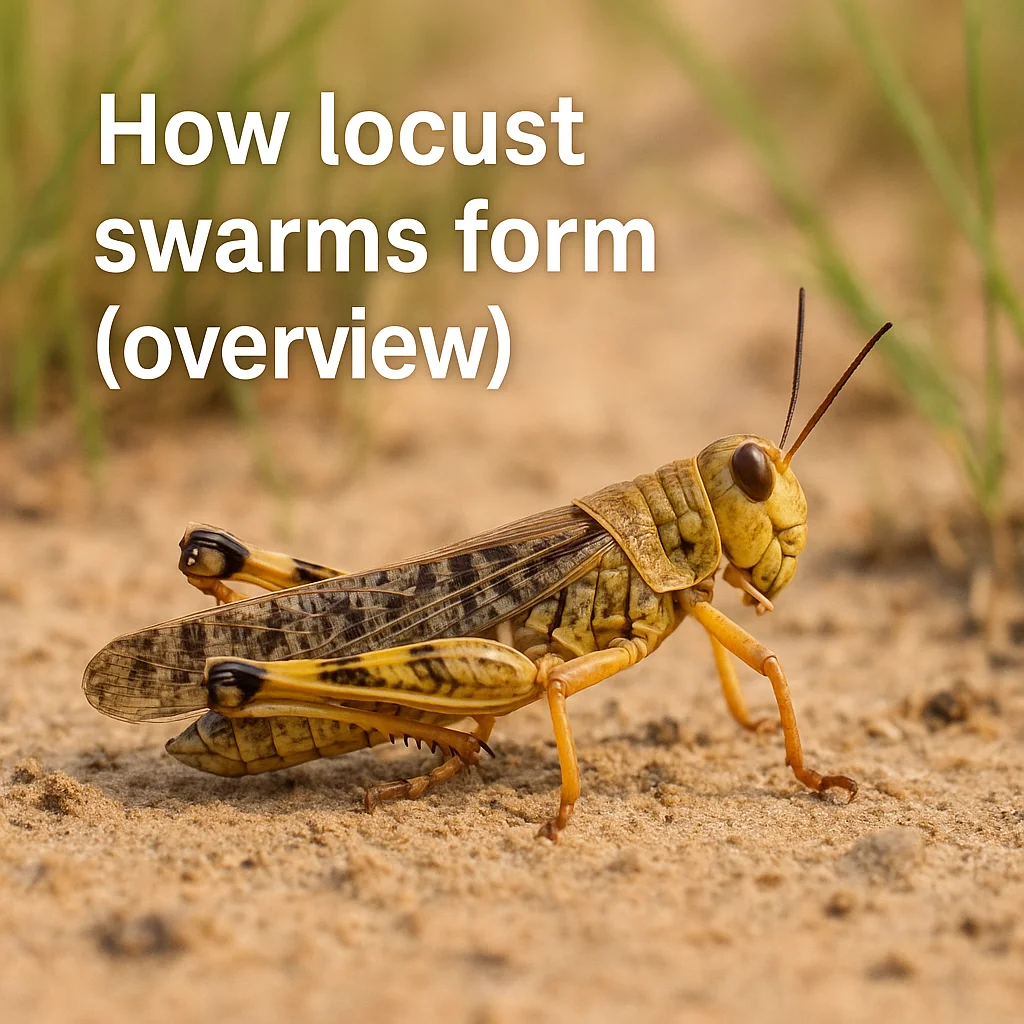
- Common names: Locust
- Scientific name: Varies by species
- Insect or not: Insect (invertebrate)
- Order / family: Orthoptera/Acrididae
- Typical size range (adult): 3–5 cm in length
- Key colors/patterns: Green, brown, yellow; varies with phase (solitary or gregarious)
- Activity: Primarily diurnal
- Typical habitats: Grasslands, savannas, agricultural fields
- Geographic range: Africa, Asia, Middle East, and parts of Australia
- Seasonality: Most visible during rainy seasons
🔍 Identification
Locusts can be identified by their robust build, large hind legs, and wings. In their gregarious phase, they may appear more uniform in color. One might confuse them with ordinary grasshoppers, but locusts typically have a slightly longer body and more streamlined abdomen when swarming.
- Top ID Tips:
- Robust, elongated body shape
- Whole specimen in frame, showing long hind legs suitable for jumping
- Pliable, thin antennae
- Translucent wings with visible veins
- Often seen in large groups or swarms
- Color changes more vibrant in swarming phase
- Rapid movement and agility in flight
- Loud, rustling sound during flight
🧠 Basic Body Structure
Locusts, like all insects, have a body divided into three main sections: the head, thorax, and abdomen. They have six legs and are characterized by a tough exoskeleton, which provides protection and structure. As invertebrates, they lack a backbone and rely on this external shell. Most locusts can fly, thanks to their well-developed wings.
🌍 Habitat & Distribution
Locusts thrive in a variety of terrestrial habitats, predominantly in grasslands, savannas, and agricultural regions where they can find abundant vegetation to consume. They are distributed across many regions, from Africa to Asia and parts of Australia. Climate and vegetation types impact where they are most common, with habitat destruction influencing their movements.
📅 Seasonal Appearance & Activity
Locusts are most commonly observed during the rainy seasons in their respective regions, as increased greenery provides nourishment and suitable conditions for egg-laying. They are chiefly active during the day, peaking in activity during warm, sunny weather when flying conditions are ideal.
- Best Time to Spot It:
- Rainy seasons in tropical areas
- Daytime on warm, sunny days
- Periods following rainfalls
- During agricultural planting seasons
🥚 Reproduction & Egg-Laying
Locusts’ mating rituals include males producing sounds by rubbing their hind legs against forewings. Eggs are laid in moist soil, with a preference for sandy or loose substrate. Female locusts can lay eggs in pods containing dozens to hundreds, leading to rapid increases in population when conditions are favorable.
🌀 Metamorphosis & Life Cycle
Locusts undergo incomplete metamorphosis, developing through three main stages: egg, nymph, and adult. Nymphs resemble miniature adults and will molt several times before reaching maturity.
Nymphs feed on the same vegetation as adults, grouping to facilitate their growth. This stage can last several weeks, and is impacted by environmental conditions. Adult locusts live for several months, focusing on feeding and reproduction.
🍽️ Diet & Feeding Behavior
Both nymph and adult locusts are herbivorous, feeding voraciously on grass, crops, and other vegetation. They use their strong mandibles to chew, consuming enormous quantities of food due to their swarming habits. Their feeding can result in significant agricultural damage and is a concern for food security in affected regions.
🦉 Predators & Defense
Natural predators of locusts include birds, reptiles, spiders, and small mammals. In their defense, locusts rely on rapid movement and sheer numbers to overwhelm predators. Some species have cryptic coloration in their solitary phase and more vibrant warning colors when in swarms.
- Defense Highlights:
- Cryptic coloration for hiding
- Aggressive group flying to avoid predators
- Predator deterrence via collective swarming
- Color changes in warning displays
👥 Social Behavior & Swarms
While locusts are typically solitary, specific environmental conditions trigger transformations into a gregarious phase, characterized by swarming behavior. Changes in population density, increased moisture, and food availability can prompt this shift. Swarming helps locusts find new food sources and is an evolutionary survival strategy.
🧭 Senses & Communication
Locusts rely on a well-developed sense of vision for navigation and identifying food sources. They communicate primarily through sounds and vibrations, with some species producing sounds by stridulation. Chemical cues are used for recognizing swarming phases and coordinating collective movements.
🌱 Role in the Ecosystem
Locusts play a dual role in their ecosystem. As herbivores, they contribute to the health of plant communities by trimming vegetation, although swarming locusts can devastate entire fields. They also serve as prey for various animals, thereby contributing to the food web. However, when in swarms, their impact on agriculture is significant, leading to economic challenges.
📉 Population & Conservation Notes
Locust populations can vary widely due to environmental conditions, often fluctuating between solitary and swarming phases. While not considered endangered, their sheer numbers during swarms can lead to calls for population control. Conservation strategies focus on habitat management to mitigate agricultural impact.
- How to Help (Low-Impact):
- Implement sustainable farming practices
- Promote biological control research
- Preserve natural habitats to support biodiversity
- Avoid excessive pesticide use
⚠️ Human Interaction & Safety
Though locusts are not dangerous to humans, their presence can greatly affect human activity through crop damage and economic stress. It is advisable to observe them respectfully and rely on professional management for infestation control.
📌 Summary
- Locusts are grasshoppers known for forming devastating swarms.
- Identified by their robust body and long legs.
- Observed primarily during the day and in rainy seasons.
- Life cycle consists of egg, nymph, and adult stages.
- Herbivorous diet, consuming vast amounts of vegetation.
- Defense through camouflage and swarming.
- Social behavior includes dramatic phase changes.
- Contributes to prey dynamics and food web interactions.
- Human impact mainly involves agricultural challenges.