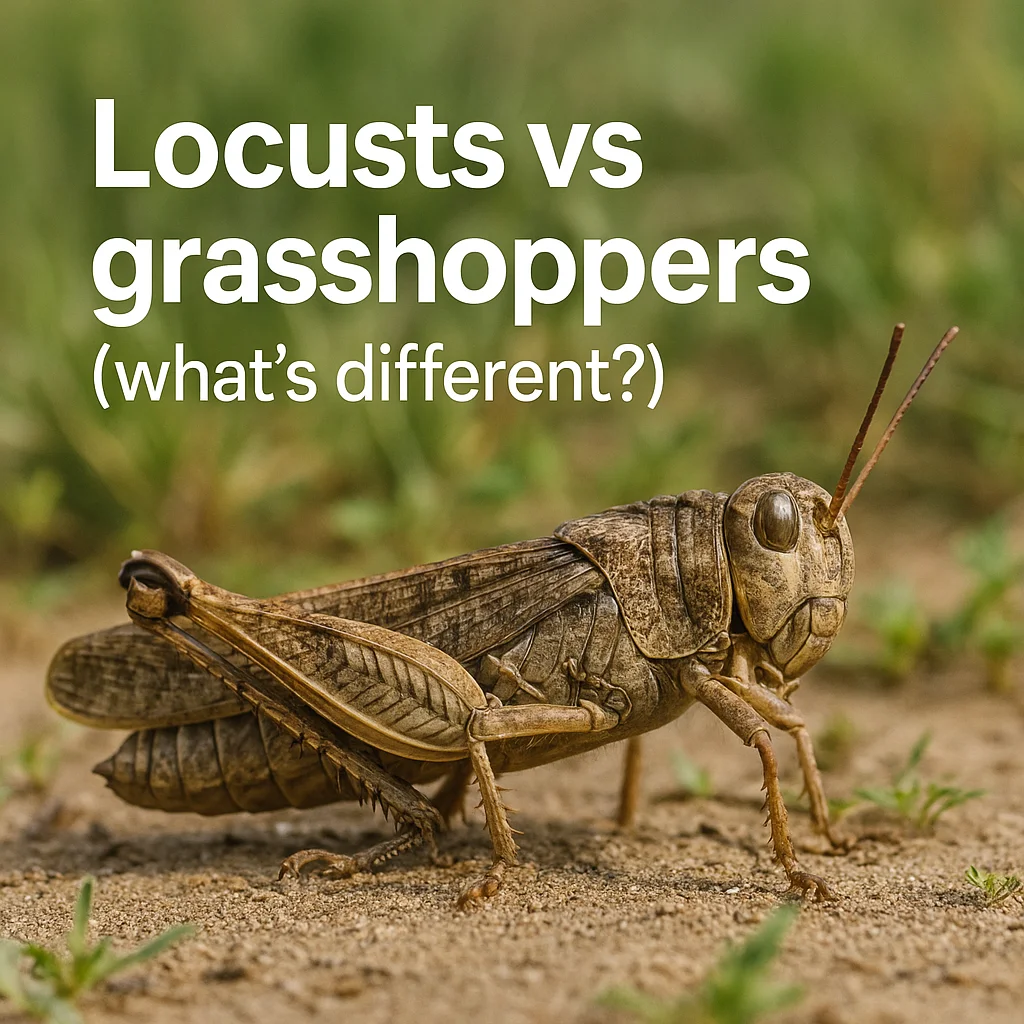
🕷️ Locusts vs grasshoppers (what’s different?)
🧾 Quick Facts
Locusts and grasshoppers are often confused due to their similar appearance and behavior. Here’s a quick run-down of the essential facts about these fascinating insects:
- Common names: Grasshoppers, Locusts
- Scientific name: Varies by species
- Insect or not: Yes, both are insects (invertebrates)
- Order / family: Orthoptera / Acrididae (typically)
- Typical size range (adult): 2 – 5 inches (5 – 13 cm)
- Key colors/patterns: Greens, browns, yellows; sometimes with stripes or spots
- Activity: Primarily diurnal (active during the day)
- Typical habitats: Grasslands, savannas, agricultural fields
- Where in the world they occur: Globally, except Antarctica
- Seasonality: Most visible in warmer months, varies regionally
🔍 Identification
To distinguish locusts from grasshoppers, observe their body shape and behaviors. While they are similar in appearance, subtle differences can help identify them:
- Body shape: Both have elongated bodies, strong hind legs, and relatively short antennae compared to other orthopterans.
- Antennae type: Shorter antennae than katydids and crickets.
- Wing features: Both have membranous hind wings under tougher forewings, used for flight and sound production.
- Leg traits: Adapted for jumping; hind legs are large and muscular.
- Distinguishing look-alikes: Grasshoppers are usually solitary, while locusts can form large, mobile swarms.
- Top ID Tips:
- Look for short, strong hind legs for jumping.
- Notice the short antennae, which set them apart from crickets.
- Pay attention to coloration and patterns; locusts may have more uniform colors.
- Observe behavior: locusts can be highly gregarious.
- Listen for distinctive chirping sounds made by rubbing hind legs against wings.
- Look for locust swarming behavior, especially after rains in dry regions.
🧠 Basic Body Structure
Locusts and grasshoppers share common insect features:
- Head: Contains compound eyes, antennae, and mouthparts.
- Thorax: Bears three pairs of jointed legs and two pairs of wings.
- Abdomen: Houses digestive and reproductive organs.
- Invertebrate: These insects have no backbone; protected by a hard exoskeleton.
🌍 Habitat & Distribution
Both locusts and grasshoppers predominantly inhabit areas with abundant grasses and shrubs. They can be found in:
- Preferred environments: Open fields, grasslands, savannas, and agricultural areas.
- Microhabitats: Often found in tall grass, under leaves, and shrubs.
- Geographic range: Present on every continent except Antarctica; commonly in tropical and temperate regions.
- Habitat changes: Deforestation and agriculture can lead to increased sightings as they adapt to open landscapes.
📅 Seasonal Appearance & Activity
These insects are typically more visible during warmer seasons when they are actively feeding and breeding:
- Best Time to Spot It:
- Most active during spring and summer (varies by region).
- Diurnal activity means they are seen during daylight.
- More noticeable after rain events when vegetation flourishes.
- Activity may decrease significantly in cold or very wet weather.
🥚 Reproduction & Egg-Laying
The mating behavior of these insects includes various displays and signals:
- Mating behavior: Males often produce sounds or vibrations to attract females.
- Egg-laying: Females lay eggs in the soil using an ovipositor.
- Egg counts: Each female can lay several pods, each containing dozens of eggs.
🌀 Metamorphosis & Life Cycle
Locusts and grasshoppers undergo incomplete metamorphosis:
- Life Stages: Egg – Nymph – Adult
- Nymphs: Hatch as small, wingless versions of adults. They molt several times, growing wings and reproductive capability.
- Adults: The final molt reveals fully developed wings for flight.
- Duration: The duration of each life stage can vary widely depending on species and environmental conditions.
🍽️ Diet & Feeding Behavior
These are primarily herbivores with a significant impact on vegetation:
- Diet: Leaves, stems, seeds, and flowers.
- Feeding tools: Chewing mouthparts ideal for grinding plant material.
- Ecological Role: Important in cycling nutrients in their habitats and can serve as both destructive pests and essential food sources for predators.
🦉 Predators & Defense
Various animals prey on locusts and grasshoppers:
- Natural enemies: Birds, reptiles, amphibians, small mammals, spiders.
- Defense strategies: Camouflage to blend with surroundings, quick leaps to escape threats.
- Other defenses: Some species can secrete toxins making them unpalatable.
- Defense Highlights:
- Excellent camouflage matching local vegetation.
- Able to turn and leap quickly to evade capture.
- For some, unpalatable chemicals deter predators.
- Strong physical build offers mechanical protection.
👥 Social Behavior & Swarms
Locusts are particularly noted for their dramatic swarming behavior, unlike solitary grasshoppers:
- Social behavior: Grasshoppers are largely solitary; locusts can become gregarious and form large swarms.
- Swarming triggers: Environmental stress, crowding, and resource availability can trigger swarming in locusts.
🧭 Senses & Communication
These insects rely on a range of sensory inputs to interact with their environment:
- Senses: Compound eyes for vision, chemoreceptors for smell.
- Communication: Sound production through stridulation by rubbing legs or wings; pheromones for signaling.
🌱 Role in the Ecosystem
Grasshoppers and locusts play a dual role as pest species and ecological participants:
- Ecological importance: Pollination (minor), decomposition, and serving as prey for many species.
- Human impact: Can cause significant agricultural damage during swarming events.
📉 Population & Conservation Notes
The status of locusts and grasshoppers varies greatly worldwide depending on the species and region:
- Often common in areas with suitable habitat.
- Large scale habitat changes and agricultural activity affect populations.
- How to Help (Low-Impact):
- Encourage diverse plant structures in gardens to support varied life stages.
- Avoid pesticide use which can harm non-target species.
- Support local conservation efforts that preserve natural habitats.
⚠️ Human Interaction & Safety
While these insects typically do not threaten humans, they can affect agriculture:
- Biting/stinging: They do not bite or sting humans but can affect crops.
- Observation: Observe with respect; avoid handling without need to prevent stress to the insects.
📌 Summary
- Locusts and grasshoppers are often mistaken for one another.
- They are crucial components of the ecosystem, serving as both pest and food sources.
- Swarming behavior defines locusts but not grasshoppers.
- Inhabit diverse environments, particularly favoring open and grassy landscapes.
- Use chemoreception and sound for communication.
- Metamorphosis is incomplete, transitioning directly to adult form after nymph stages.
- Pesticide reduction and habitat conservation aid their natural populations.