🕷️ Do mantises eat hummingbirds? (rare cases explained)
🧾 Quick Facts
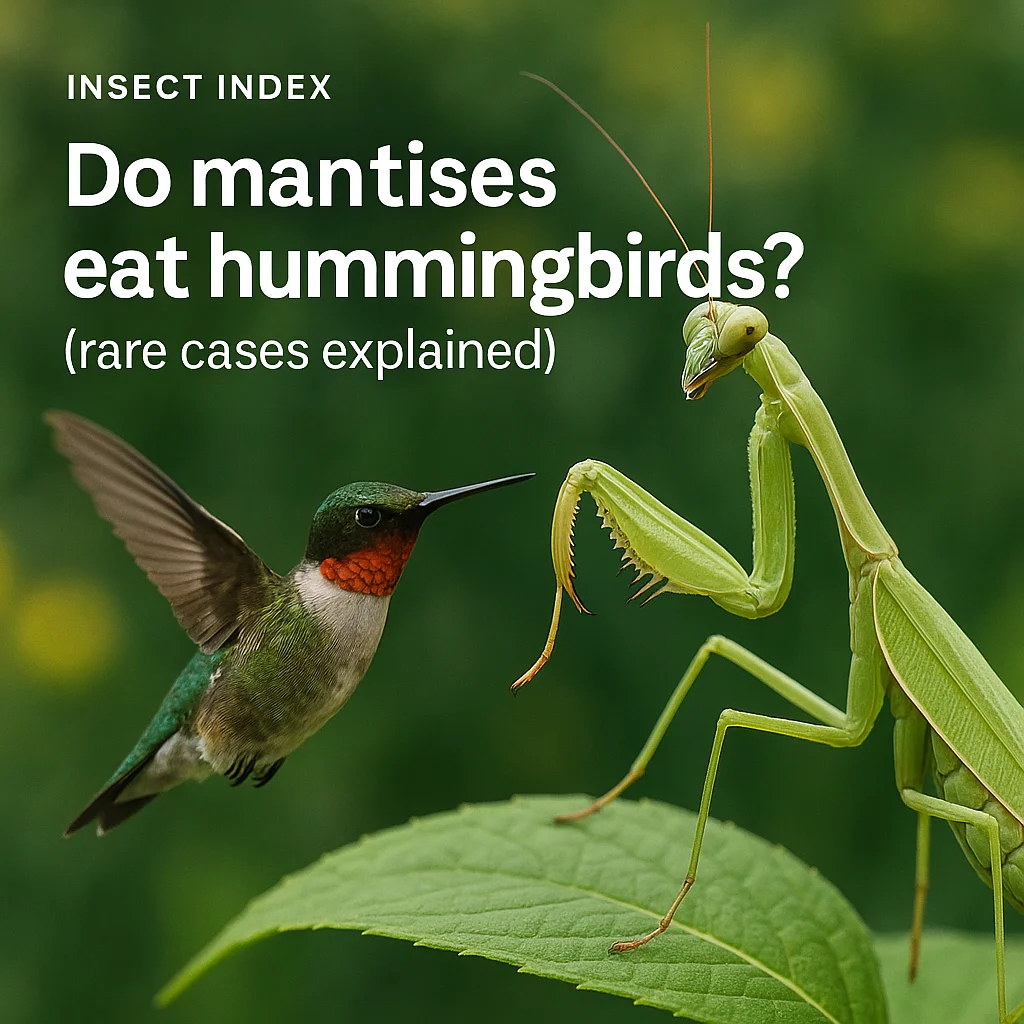
Mantises, known for their predatory prowess, are fascinating insects often associated with various unusual eating habits, including their occasional predation on hummingbirds. Although rare, these incidents have piqued the interest of nature enthusiasts and scientists alike.
- Common names: Praying mantis, Mantis
- Scientific name: Varies (order Mantodea)
- Insect or not: Insect (invertebrate)
- Order / family: Mantodea / varies
- Typical size range: 2 to 5 inches (adults)
- Key colors/patterns: Green, brown, occasionally pink or white depending on habitat
- Activity: Mostly diurnal but some are crepuscular
- Typical habitats: Grasslands, forests, gardens
- Where in the world it occurs: Worldwide, especially in temperate and tropical regions
- Seasonality: Most visible in late spring to early autumn
🔍 Identification
To identify a mantis, observe its unique body structure. Mantises have an elongated body with a distinct, triangular head that can rotate nearly 180 degrees. Their forelegs are modified as raptorial claws for grasping prey.
- Body shape and silhouette: Slender, elongated with a triangular head and large compound eyes
- Antennae type: Filiform (thread-like)
- Wing features: Some species have long, transparent wings folded onto their abdomen, while others may be wingless
- Leg traits and movement style: Enlarged, spiny forelegs used for predation
- Distinguishing look-alikes and common confusion: Often confused with stick insects; distinguishable by raptorial forelegs
- Look for a prayer-like stance
- Check for spiny forelegs
- Note the unique head shape
- Observe body color for camouflage capabilities
- Watch for their calculated, swaying movement
- Consider habitat and find chirping/clicking noises
🧠 Basic Body Structure
The praying mantis, like all insects, has a body divided into three main parts: the head, thorax, and abdomen. They possess six legs and their body is covered in an exoskeleton, which they molt as they grow. Most species have wings that may be used for flight or camouflage.
As an invertebrate, mantises lack a backbone, which is typical of insects. Their rigid exoskeleton provides support and protection.
🌍 Habitat & Distribution
Mantises are adaptable creatures found in a variety of environments, including grasslands, forests, and urban gardens. They prefer habitats that offer ample hiding spots and access to prey, often found perched on foliage or flowers. Microhabitats include leafy vegetation, under bark, and even in open fields.
Their geographic range spans continents including North and South America, Europe, Africa, Asia, and Australia, thriving in temperate to tropical climates. Habitat degradation may reduce sightings, affecting their distribution.
📅 Seasonal Appearance & Activity
Mantises are primarily observed from late spring through early autumn, with their activity peaking during warmer months when prey is abundant. They are mostly diurnal but can often be active during dawn or dusk.
- Best observed in spring and summer
- Activity peaks in July and August
- Look for them during warm, sunny days
- Prefer calm, quiet conditions for hunting
🥚 Reproduction & Egg-Laying
Mantises are known for their complex mating behaviors, which can sometimes involve the female consuming the male. Egg-laying usually occurs on plant stems or twigs where the female deposits egg cases known as oothecae. Each ootheca can contain dozens to hundreds of eggs, varying by species.
The strategies for egg-laying differ, with some using adhesive substances to secure their eggs, ensuring protection through the winter months.
🌀 Metamorphosis & Life Cycle
Mantises undergo incomplete metamorphosis, with life stages as egg, nymph, and adult. Nymphs look like small adults without wings and gradually grow and develop through a series of molts.
The nymph stage is vital for growth and survival, primarily feeding on small insects. As adults, they continue their carnivorous diet, contributing to pest control.
The entire life cycle from egg to adult can take several months and closely depends on environmental conditions.
🍽️ Diet & Feeding Behavior
Mantises are carnivorous predators, feeding on a variety of insects like flies, bees, and occasionally small vertebrates such as lizards or birds in rare cases. They have chewing mouthparts designed to consume their prey.
In their ecosystem, they play the role of a predator, helping to control pest populations. Their hunting method involves ambush and quick strikes using their specialized forelegs.
🦉 Predators & Defense
Mantises face natural threats from birds, reptiles, and large spiders. Their primary defense strategies include camouflage to blend into the environment and mimicry to resemble sticks or leaves.
Some species display threatening postures to scare off predators, while others rely on spiny forelegs for protection.
- Effective camouflage to avoid detection
- Mimicry to blend with surroundings
- Quick reflexes to escape danger
- Intimidating displays to deter attackers
👥 Social Behavior & Swarms
Mantises are generally solitary insects. They are known to be territorial during the breeding season but otherwise may be seen alone. Encounters with other mantises are typically related to mating purposes.
They do not form swarms or colonies, instead focusing on individual survival and predation.
🧭 Senses & Communication
Mantises possess strong vision with compound eyes capable of detecting movement, which aids in hunting. Their sense of smell through antennae helps in finding mates or prey.
Sound communication is not well-documented in mantises, but they may detect vibrations through their legs, adding to their sensory arsenal.
🌱 Role in the Ecosystem
Praying mantises serve as important biological control agents by managing insect populations. They play a significant role as predators within their food web, impacting the abundance and distribution of other insects.
They engage in parasitic relationships with some flowers that mimic their prey to attract pollinators, showcasing a dynamic interaction with their environment.
📉 Population & Conservation Notes
Mantises are widely reported as common in suitable habitats, but they face threats from habitat loss and pesticides, which can impact their populations. The introduction of non-native species can also affect local diversity.
- Encourage native plant growth
- Minimize pesticide use
- Allow natural predation cycles
- Maintain diverse habitats
⚠️ Human Interaction & Safety
Mantises are generally harmless to humans and do not pose significant threats. They have been known to bite only if provoked. In case of any interactions, gently wash the area and avoid irritation. Seek professional help if any severe reaction occurs.
Respectful observation in the wild is encouraged without disturbing or collecting them.
📌 Summary
- Distinctive triangular head and raptorial legs for predation
- Primarily found in grasslands, forests, and gardens worldwide
- Active during warm months, mainly day-active
- Egg-laying involves protective oothecae
- Carnivorous diet, occasionally preys on birds
- Natural predators include birds and reptiles
- Solitary but crucial in pest control
- Populations stable but affected by environmental changes
- Non-threatening to humans, best observed respectfully