🕷️ Keeping distance: safe observation tips
🧾 Quick Facts
When observing insects in their natural environment, it's crucial to maintain a safe distance, both for the observer's safety and the well-being of the insect. Here are some quick facts that outline general aspects and safety recommendations for insect observation.
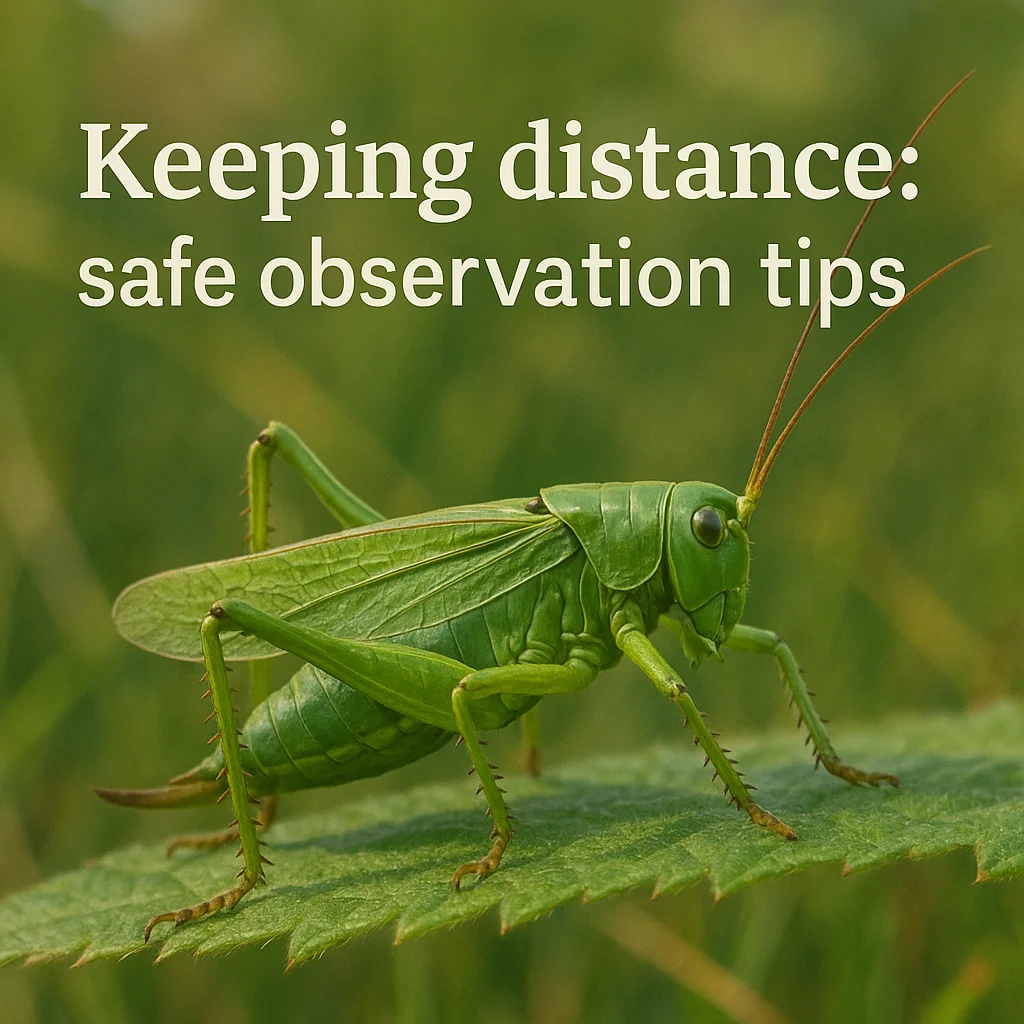
- Common names: Varies by species
- Scientific name: Varies
- Insect or not: Usually insects, which are invertebrates
- Order / family: Varies
- Typical size range (adult): 1mm to 100mm, depending on species
- Key colors/patterns: Bright colors, earthy tones, stripes, spots
- Activity: Day or night, varies by species
- Typical habitats: Forests, grasslands, gardens, wetlands
- Where in the world it occurs: Global, with regional concentrations
- Seasonality: Most visible in warm months or specific seasons
🔍 Identification
Identifying insects safely from a distance requires knowing what to look for in terms of body structure and behavior.
- Body shape and silhouette: Insects can have oval, elongated, or butterfly-like shapes.
- Antennae type: Varied, from long and slender to short and clubbed.
- Wing features: Wings might cover the body fully or be held out to the sides.
- Leg traits and movement style: Some have jumping legs, others walk or crawl.
- Distinguishing look-alikes: Look for differences in body markings and size.
- Top ID Tips
- Observe from a safe distance without touching.
- Use a notebook or camera for detailed observation.
- Notice behavioral patterns, e.g., flight or foraging habits.
- Identify key colors or patterns unique to the species.
- Avoid assumptions; confirm with a field guide.
- Take note of the environment where found.
🧠 Basic Body Structure
Insects are invertebrates, meaning they do not have a vertebral column. Their body consists of three main parts: the head, thorax, and abdomen. They typically have six legs, which is a distinguishing feature of true insects. Insects possess an exoskeleton for protection, which they must molt to grow. Some insects have wings, which can occur in one or two pairs.
🌍 Habitat & Distribution
Insects inhabit diverse environments ranging from forests and grasslands to urban gardens and wetlands. Their microhabitats can include under bark, in leaf litter, among flowers, or near water edges. Insects are found globally, but their exact distribution varies according to climate and environmental conditions. Changes in habitats due to urbanization or climate shifts can affect insect occurrences and visibility.
📅 Seasonal Appearance & Activity
Insects are most visible during warmer months and certain seasons, depending on their geographic location. Some are diurnal, active during the day, while others might be nocturnal or crepuscular, active at dusk and dawn. Weather such as temperature and humidity levels also influence their activity.
- Best Time to Spot It
- Spring and summer months
- Early mornings or late afternoons
- During warm, sunny days
- After rain, when humidity is high
🥚 Reproduction & Egg-Laying
The reproductive behavior of insects varies widely. Some engage in intricate courtship displays before mating, while others find partners based on pheromones. Eggs can be laid in soil, on plants, in water, or within wood, and the number of eggs varies significantly across species. Some insects protect their eggs, while others simply lay them in suitable environments.
🌀 Metamorphosis & Life Cycle
Insects undergo either complete or incomplete metamorphosis. Complete metamorphosis includes egg, larva, pupa, and adult stages. Larvae may consume leaves intensely, while pupae are typically inactive as they transform into adults. Incomplete metamorphosis involves eggs, nymphs, and adults, with nymphs gradually resembling adults as they grow.
🍽️ Diet & Feeding Behavior
Insect diets are as varied as their species. They may have chewing mouthparts for solid food or piercing-sucking mouthparts for liquid nutrition. Some insects are predators, others are herbivores, scavengers, or pollinators. Their feeding behavior affects their role in the ecosystem significantly.
🦉 Predators & Defense
Birds, reptiles, amphibians, spiders, and even other insects are common predators. Insects have evolved various defensive strategies like camouflage or mimicry, and some may use chemical defenses or physical displays to startle predators. Speed and armor-like exoskeletons also aid in their defense.
- Defense Highlights
- Camouflage for blending in with surroundings
- Mimicry to resemble more dangerous species
- Startle displays, like sudden movements or sounds
- Chemical defenses that deter predators
👥 Social Behavior & Swarms
Insects can be solitary or social. Social insects form colonies with roles like workers, queens, and soldiers, and communicate via pheromones and sometimes audible signals. Solitary insects might only interact for mating. Swarming or migration events can occur for breeding purposes or in response to environmental cues.
🧭 Senses & Communication
Insects rely heavily on their senses: vision, smell through pheromones, touch, and sometimes sound. Communication can involve complex behaviors, such as pheromone trails or specific movements like dances. Some insects, such as cicadas, produce sounds that play a key role in their interactions.
🌱 Role in the Ecosystem
Insects play crucial roles, such as pollinating plants, decomposing organic material, and acting as prey for numerous animals, thus forming essential links in food webs. They have symbiotic relationships, ranging from mutualism where both parties benefit, to parasitism.
📉 Population & Conservation Notes
The population status of insects can vary greatly. They are often common where habitats are suitable, but factors like habitat loss, pesticide use, and climate change can threaten their populations. Data on insect species can be limited, making precise population assessments difficult.
- How to Help (Low-Impact)
- Plant native flora to support insect habitats
- Avoid using pesticides and chemicals
- Leave leaf litter and organic debris
- Create diverse environments with water sources
⚠️ Human Interaction & Safety
Some insects can bite or sting, often in defense if threatened. General precautions include avoiding direct contact and observing from a distance. If bitten or stung, it's advisable to wash the area with soap and water, avoid scratching, and seek professional help if a severe reaction occurs. Observing insects respectfully means not disturbing their natural behavior or habitats and refraining from collecting specimens from the wild.
📌 Summary
- Maintain a safe distance to observe insects effectively.
- Identification involves noting body shape, color, and habitat.
- Insects are invertebrates with three-part bodies and distinct life cycles.
- Found globally, they thrive in diverse habitats, contributing to ecosystems.
- Visible primarily in warm or temperate seasons and weather conditions.
- Reproduce via varied strategies, often paying attention to habitat suitability.
- Diet and feeding behaviors shape their ecological roles.
- Various predators exist, with insects employing unique defenses.
- Behavior ranges from solitary to social, impacting survival and communication.
- Conservation efforts can support their populations in changing environments.