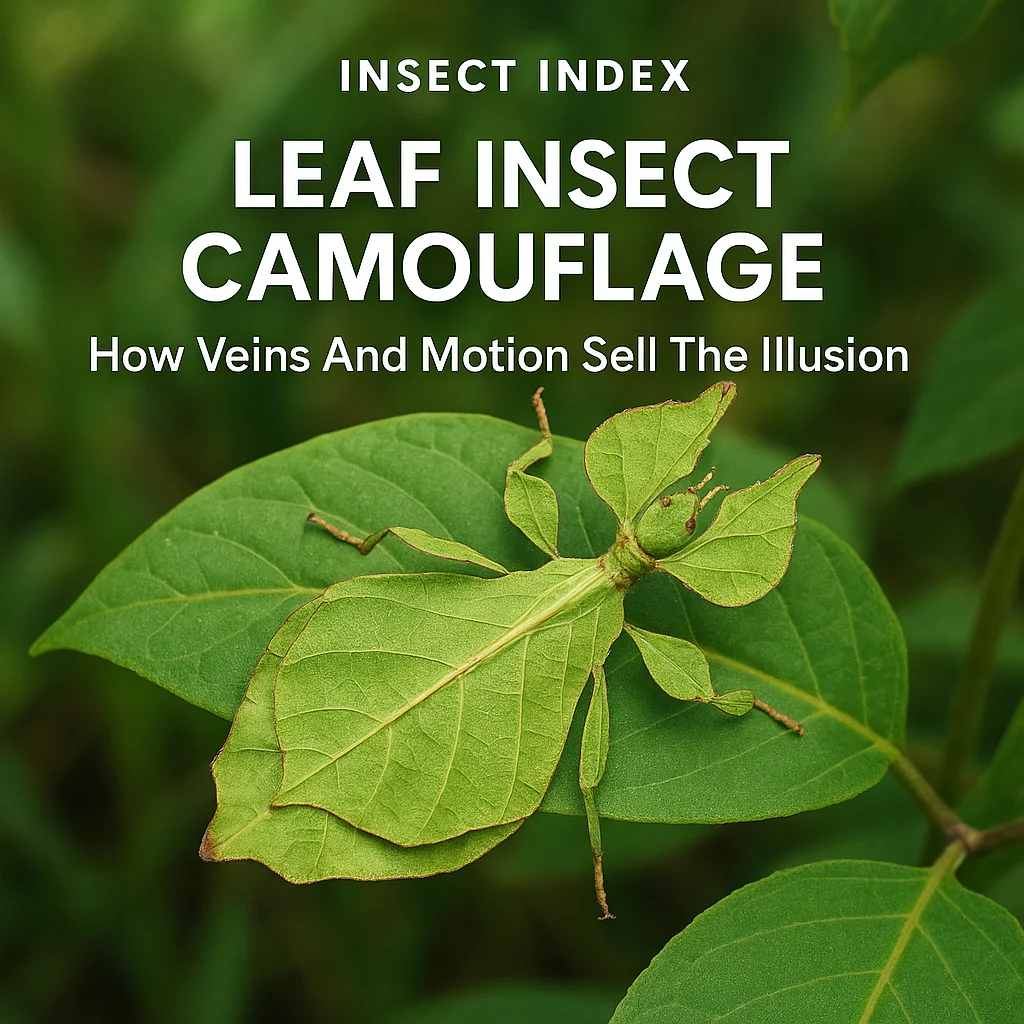
🕷️ Leaf Insect Camouflage How Veins And Motion Sell The Illusion
🧾 Quick Facts
The leaf insect is a remarkable example of evolutionary mimicry. Known for their uncanny resemblance to leaves, these insects have developed unique adaptations to avoid predation. Below are some quick facts about these extraordinary creatures:
- Common names: Leaf Insect, Walking Leaf
- Scientific name: Varies (Common genera include Phyllium and Chitoniscus)
- Insect or not: Insect, a type of invertebrate
- Order/Family: Order: Phasmatodea, Family: Phylliidae
- Typical size range (adult): 5–10 cm in length
- Key colors/patterns: Green, brown, vein-like patterns
- Activity: Primarily nocturnal
- Typical habitats: Tropical forests, shrublands
- Where in the world it occurs: Southeast Asia, Australia, some Pacific islands
- Seasonality: Most visible during the wet season but may vary by region
🔍 Identification
Leaf insects are masters of disguise, and recognizing them in the field requires a keen eye. They have a flat body that mimics the shape of a leaf, complete with veining patterns that enhance their illusion. Their antennae are often short and can be difficult to notice, blending seamlessly into the leaf-like body.
Winged forms exist, but the wings often mimic leaf damage, such as tears and edges. Their legs are adapted to mimic petioles (leaf stalks), and their movement often includes a rhythmic swaying motion, akin to a leaf caught in a breeze. Distinguishing them from similar species, like stick insects, involves looking for these specific adaptations.
- Flattened body resembling a leaf
- Veining patterns on wings and body
- Legs and antennae resemble leaf stems and veins
- Slight, swaying movement mimics a leaf in the wind
- Difficult to spot due to camouflage abilities
- More rounded and broad compared to stick insects
🧠 Basic Body Structure
Leaf insects, like all insects, exhibit three primary body regions: the head, thorax, and abdomen. They possess six legs, essential for their mobility and mimicry. Covered in a hard exoskeleton, these creatures undergo molting to grow. Many species also have wings, though they often remain folded to further enhance their leaf-like appearance.
As invertebrates, they lack a backbone, relying on their exoskeleton for structural support and protection. This classification sets them apart from vertebrates, such as mammals, reptiles, and birds, which possess internal skeletons.
🌍 Habitat & Distribution
The diverse environments that leaf insects call home include lush tropical forests and dense shrublands. These settings provide ample foliage for camouflage. They often reside under leaves or within dense foliage, avoiding predators through their ability to blend in seamlessly.
Geographically, they are commonly found in Southeast Asia, ranging into Australia and the Pacific islands. These regions provide the humid climates necessary for their survival. Environmental changes, like deforestation and climate change, can impact their distribution and visibility, often making them harder to spot in altered habitats.
📅 Seasonal Appearance & Activity
Leaf insects are most commonly observed during the wet season when foliage is abundant. They are nocturnal, becoming active at dusk when the risks from predators are minimized. Weather conditions, such as rain and humidity, often increase their activity levels.
- Best spotted during the wet season
- Nocturnal activity makes dusk and nighttime optimal
- High humidity and rainfall promote visibility
- Most active during warm, tropical weather
🥚 Reproduction & Egg-Laying
Leaf insects engage in fascinating reproductive behaviors. Courtship varies but may involve visual and sometimes chemical cues. Females are known to lay their eggs on the surface of leaves, sometimes dropping them to the ground in areas rich with vegetation.
The number of eggs a female produces can vary significantly depending on species and environmental factors. Eggs are often camouflaged, resembling seeds or other natural debris, aiding in their protection from potential predators.
🌀 Metamorphosis & Life Cycle
Leaf insects undergo incomplete metamorphosis, consisting of three life stages: egg, nymph, and adult. Upon hatching, the nymphs resemble miniature versions of the adults but lack fully developed wings.
Nymphs initially feed on a variety of leaves and gradually grow through successive molts, developing their characteristic leaf-like appearance. This nymph stage can last several months, varying by species. Once they reach adulthood, their appearance more closely mimics mature leaves, providing the best camouflage.
🍽️ Diet & Feeding Behavior
Leaf insects are herbivores, primarily consuming leaves from a variety of host plants. Their mouthparts are adapted for chewing, allowing them to effectively consume their leafy diet. This diet supports their role in the ecosystem as foliage consumers, helping to control plant overgrowth in their native habitats.
They select leaves based primarily on texture and taste, often showing preferences for leaves that provide the best nutrition or mimicry for their camouflage.
🦉 Predators & Defense
These remarkable insects face threats from various predators, including birds, reptiles, and certain mammals. Their primary defense strategy is their exceptional camouflage. By mimicking leaves, complete with veins and damage-like wears, they escape detection.
Additional defense mechanisms include a stilled posture and swaying to mimic leaves disturbed by wind. Some species might also drop lifelessly to the forest floor when threatened, furthering their disguise.
- Camouflage reduces visibility to predators
- Swaying motion imitates environmental stimuli
- Stillness and limb positioning enhance leaf mimicry
- Versatile disguise aids in avoidance of numerous predators
👥 Social Behavior & Swarms
Leaf insects are predominantly solitary, focusing on avoiding detection rather than seeking companionship. Their interactions are typically limited to mating encounters, and they do not form swarms or colonies. The lack of social structures or hierarchies allows them to maintain their disguise and focus on individual survival.
🧭 Senses & Communication
Tactile sensations are crucial for leaf insects, aiding in navigation and mating. Their vision is adapted to detect light and motion, essential for discerning environmental changes and potential threats. Some species employ subtle olfactory cues, using pheromones during reproductive periods to locate mates.
While they do not commonly make sounds or engage in notable communication rituals, these senses allow them to engage in the subtlety required to maintain camouflage and survival.
🌱 Role in the Ecosystem
Leaf insects play a significant ecological role as consumers of plant matter, participating in the intricate web of forest ecosystems. They aid in maintaining foliage balance, preventing overpopulation of dominant plant species in their habitats.
These insects also provide food sources for various native predators, further enriching biodiversity. Their presence helps in biological pest control by limiting excessive growth of certain vegetation, indirectly supporting a healthy ecological balance.
📉 Population & Conservation Notes
Data on leaf insect populations vary widely due to their elusive nature and habitat disturbances. While often locally abundant where conditions are favorable, deforestation, urbanization, and pesticide use pose threats to their existence. Preserving their natural habitats is crucial for maintaining their populations.
- Plant native flora to encourage habitat preservation
- Avoid pesticide use in gardens and natural areas
- Support conservation of tropical and subtropical environments
- Promote awareness of their ecological roles
⚠️ Human Interaction & Safety
Leaf insects are harmless to humans and do not bite or sting. Their nature is more inclined towards evasion and camouflage rather than confrontation. Observing them respectfully in their habitats and refraining from collecting or disturbing them is advised.
For those fortunate enough to observe these unique creatures, it's important to enjoy their presence without interference, as human interaction is best limited to observation and education.
📌 Summary
- Remarkable camouflage mimicking leaves
- Found in tropical forests and shrublands
- Nocturnal, best seen during wet seasons
- Incomplete metamorphosis with egg, nymph, and adult stages
- Herbivorous, consumes a variety of leaves
- Defends via camouflage and mimicry
- Solitary behavior, limited interactions
- Important roles in plant population control and food web
- Conservation requires habitat preservation
- Harmless to humans, best observed in natural settings