🕷️ Leaf insects: living leaves overview
🧾 Quick Facts
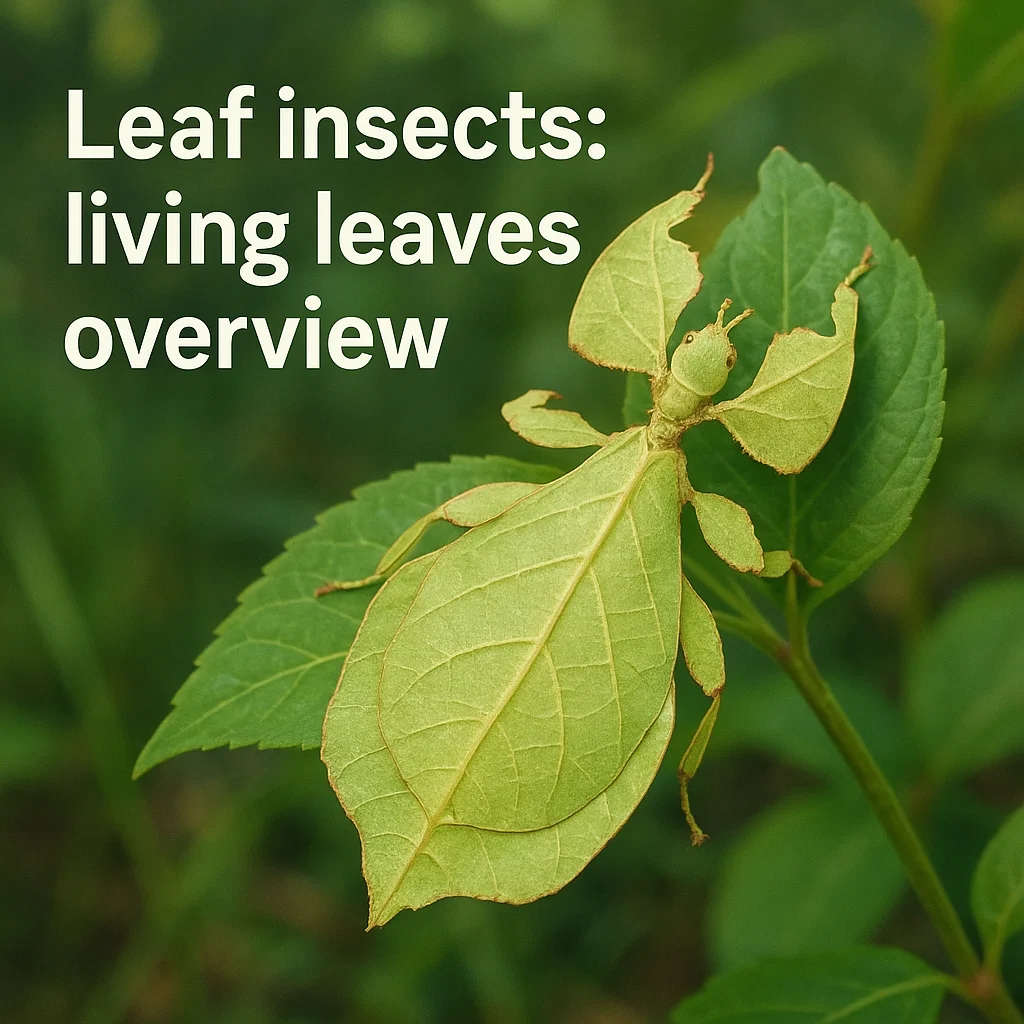
Leaf insects, known for their remarkable mimicry resembling leaves, are members of the family Phylliidae. They use their leaf-like appearance to blend seamlessly into their surroundings, evading predators. These unique insects are predominantly found in tropical regions where their natural camouflage provides the highest survival advantage.
- Common names: Leaf insect
- Scientific name: Varies (common genus: Phyllium)
- Insect status: Yes, they are insects (invertebrates)
- Order: Phasmatodea, Family: Phylliidae
- Typical size range: 5–10 cm (adults)
- Key colors/patterns: Green, brown; leaf vein patterns
- Activity: Mostly nocturnal
- Typical habitats: Tropical forests
- Where in the world: Southeast Asia, Australia, India, South Pacific islands
- Seasonality: Varies, but often more visible in wet season due to lush foliage
🔍 Identification
Leaf insects are easily recognized by their uncanny resemblance to leaves, which is more than mere imitation—it is evolutionarily perfected camouflage. Their broad, flat bodies and leaf-like wings have intricate patterns that mimic leaf veins and ridges. The color primarily ranges from vibrant green to brown, depending on the environmental foliage. Antennae are typically simple and short, adding to their leaf-like silhouette.
-
Top ID Tips:
- Look for rounded leaf-like body shapes.
- Check for wing patterns that resemble leaf veins.
- Observe coloration consistent with local foliage.
- Notable slow, swaying movements that mimic a leaf in the wind.
- Shorter antennae compared to other insects.
- Flat, wide body border resembling leaf margins.
🧠 Basic Body Structure
Leaf insects comprise three main body sections: the head, thorax, and abdomen, typical of all insects. They possess six legs used for crawling. As invertebrates, they have an external skeleton, or exoskeleton, which protects and supports their body. Leaf insects undergo molting as they grow, shedding the exoskeleton to allow further growth. Their leaf-like wings, although present, are not primarily used for flight, serving more as camouflage.
🌍 Habitat & Distribution
Leaf insects thrive in dense tropical forests, which provides ample foliage for their camouflage. They are commonly found among leaves in understorey vegetation, taking advantage of high humidity and consistent temperatures. Geographically, these insects are found in Southeast Asia, the Indian subcontinent, and parts of the South Pacific. They prefer regions with abundant leafy cover and are sensitive to habitat disturbances, making sightings less common in altered landscapes.
📅 Seasonal Appearance & Activity
Leaf insects are mostly observed during the wet seasons when the foliage is lush and provides optimal camouflage. They are primarily nocturnal, emerging at night to avoid daytime predators. Their activity coincides with temperatures that avoid extremes and sufficient humidity that supports their hydration needs. Weather fluctuations, such as temperature drops or reduced rainfall, might temporarily reduce sightings.
-
Best Time to Spot It:
- Wet seasons in the tropics
- Nighttime when they are less visible
- After rain when foliage is replenished
- In areas with dense undergrowth
🥚 Reproduction & Egg-Laying
Mating behaviors in leaf insects involve chemical and visual cues, although specifics can vary across regions. Female leaf insects lay eggs that closely resemble seeds or small plant parts, camouflaging them effectively. These eggs are typically laid on or dropped near host plants. The number of eggs laid can vary widely, but females generally produce a significant number to ensure species propagation.
🌀 Metamorphosis & Life Cycle
Leaf insects undergo incomplete metamorphosis, developing through stages of egg, nymph, and adult. Upon hatching, nymphs resemble tiny versions of the adults but are wingless and often lack full coloration. During the nymph stage, they feed on plant leaves and grow through several molts. The nymph stage lasts several months, depending on environmental factors, before they mature into adults.
As adults, leaf insects continue to feed on leaves, generally maintaining their solitary and nocturnal lifestyle. Adult females are typically larger than males, who often have more prominent wings.
🍽️ Diet & Feeding Behavior
Leaf insects are herbivores, feeding primarily on leaves. They possess chewing mouthparts suitable for consuming foliage. In their nymph stages, they have similar dietary needs as adults, focusing on soft new growth for easier consumption. Their role as primary consumers contributes to the plant community's balance, as they help control foliage density.
🦉 Predators & Defense
Natural predators of leaf insects include birds, reptiles, and some mammals. Their primary defense is mimicry; their leaf-like appearance helps them evade visual predators. When disturbed, some leaf insects display startle behaviors such as swaying to mimic leaves in the wind. While they do not possess physical defenses like bites or stings, their blend into the environment makes them adept at avoiding detection.
-
Defense Highlights:
- Exceptional leaf mimicry for camouflage
- Swaying movements when disturbed
- Nocturnal habits to avoid daytime predators
- Eggs are disguised as seeds or plant matter
👥 Social Behavior & Swarms
Leaf insects are typically solitary creatures, interacting mostly for mating purposes. They do not form colonies or swarms. Mating encounters are one of the few interactions between individuals outside of reproduction, emphasizing their solitary nature. Limited interaction reduces predator detection and competition for resources.
🧭 Senses & Communication
Leaf insects rely heavily on visual camouflage rather than active sensory communication. Their senses are adapted to detect subtle environmental changes and predator cues. Communication for mating may involve limited pheromone releases, though many aspects of their sensory capabilities remain under-researched. The reliance on passive camouflage instead of active signals is a testament to their evolutionary niche.
🌱 Role in the Ecosystem
Leaf insects play vital roles in their ecosystems as herbivores and leaf consumers. By feeding on foliage, they contribute to plant growth regulation and serve as a food source for various predators. Their interactions with plants, often non-destructive, form part of a mutual ecological framework that supports biodiversity. While not major pests, they contribute to a balanced ecosystem and enhance the complexity of their habitats.
📉 Population & Conservation Notes
Leaf insects, while locally common in undisturbed habitats, face potential threats from deforestation, habitat fragmentation, and pesticide use. Due to their specialized niche and reliance on intact habitats, conservation of tropical forests directly benefits their populations. While comprehensive global population data is limited, efforts to maintain natural habitats can support their survival.
-
How to Help (Low-Impact):
- Support tropical forest conservation efforts
- Minimize pesticide usage in affected areas
- Encourage native plant growth
- Avoid capturing or disturbing wild specimens
⚠️ Human Interaction & Safety
Leaf insects are harmless to humans. They do not bite or sting and pose no direct threat. For those observing these incredible creatures, it is important to approach them with respect and avoid handling. Observe them in their natural environments, ensuring no disruption to their lifecycle. Should one wish to interact, gentle and non-invasive observation is encouraged.
📌 Summary
- Leaf insects are expertly camouflaged with their leaf-like bodies.
- Found in tropical and subtropical forests, they are primarily nocturnal.
- They develop through incomplete metamorphosis: egg to nymph to adult.
- Herbivorous, they rely on chewing mouthparts to consume leaves.
- Natural predators include birds, reptiles, and small mammals.
- Inconspicuous in their habits, leaf insects are crucial in maintaining ecological balance.
- Their populations benefit from habitat conservation and reduced anthropogenic impact.
- Safe to observe, they are educational ambassadors of natural mimicry.