🕷️ Mantis egg cases (ootheca): what to know
🧾 Quick Facts
Mantis egg cases, known as oothecae, are protective structures produced by female mantids to safeguard their eggs. These fascinating structures showcase unique adaptations for ensuring the survival and success of the next generation of mantises.
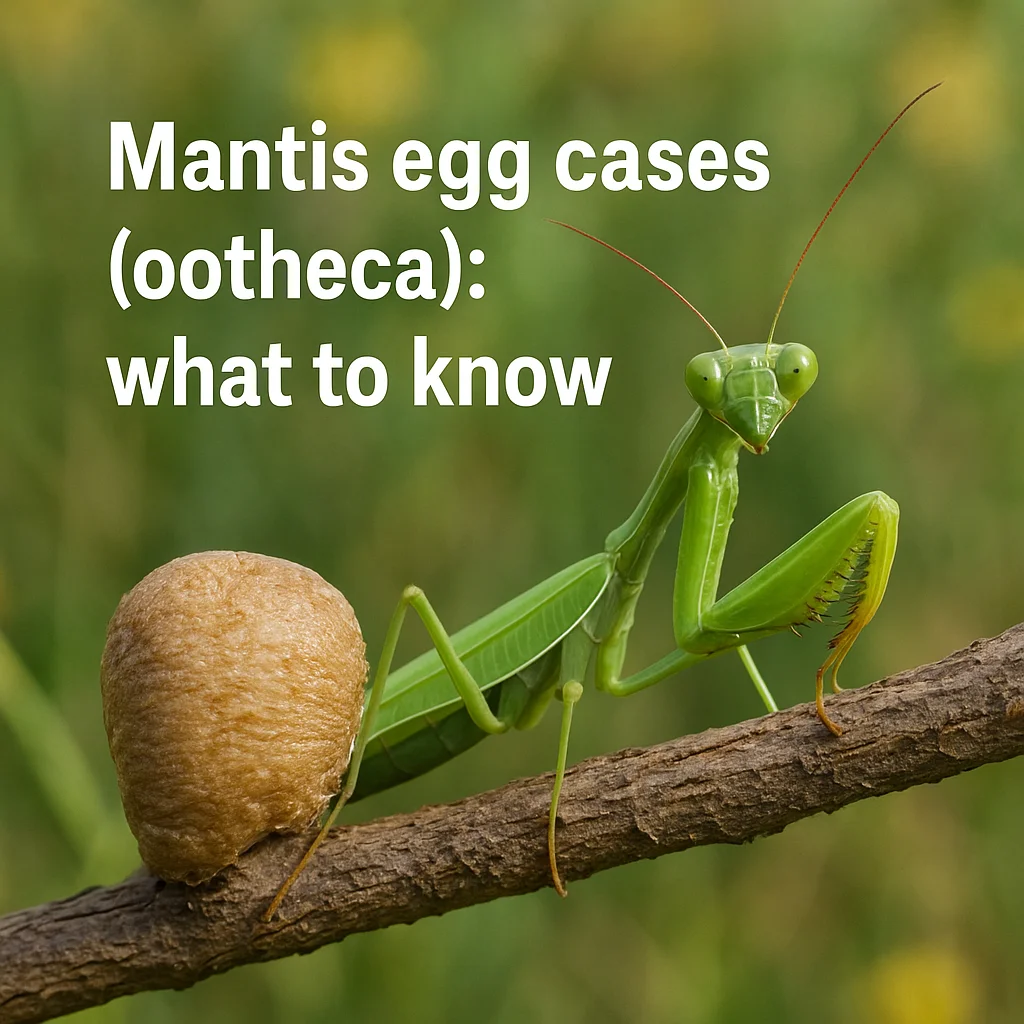
- Common names: Mantis egg case, Ootheca
- Scientific name: Varies (e.g., Tenodera sinensis for Chinese mantis)
- Insect or not: Insect, specifically invertebrate
- Order / family: Mantodea / varies
- Typical size range: 1 to 4 centimeters, depending on species
- Key colors/patterns: Brown, tan, sometimes greenish
- Activity: Daytime laying by adult females
- Typical habitats: Gardens, fields, forests, shrublands
- Where in the world it occurs: Globally, except extreme cold regions
- Seasonality: Visible in late summer to early winter; hatches in spring
🔍 Identification
Identifying mantis egg cases in the field requires observing their distinctive features. The cases are typically frothy when first laid, but quickly harden into styrofoam-like masses. They can vary in color according to the specific environment and species.
- Body shape: Bulbous and symmetrical, often attached to twigs or plant stems
- Silhouette: Oval or rounded with a distinctive seam along one side
- No antennae or wings present, as these are egg cases
- Distinguishing look-alikes: Differ from cocoon and egg masses of other insects
- Top ID Tips:
- Look for them on twigs and plant stems
- Check for a hard, foam-like texture
- Note an elongated, oval shape
- Observe color variations from brown to green
- Locate in sunny, open areas
🧠 Basic Body Structure
As egg cases, oothecae do not have a body structure like live insects. However, it is important to recognize that mantises, whose eggs develop in these cases, are insects.
Insects have a head, thorax, and abdomen, six legs, and an exoskeleton. Mantises also undergo molting as they grow and develop wings once they reach maturity.
Invertebrate refers to organisms without a backbone. Mantises, like all insects, fall into this category, relying on their exoskeleton for structure and protection.
🌍 Habitat & Distribution
Mantis egg cases are typically found in a variety of environments including gardens, fields, and forests. They are frequently attached to substrates that offer protection and support, including plant stems, twigs, and sometimes man-made structures.
The geographic ranges of mantis species vary; however, oothecae are common in temperate to tropical regions. In areas undergoing reforestation or experiencing urban expansions, sightings may increase as mantids adapt to new niches.
📅 Seasonal Appearance & Activity
Mantises lay eggs from late summer to early winter, with the cases being a common sight throughout fall. The nymphs typically emerge during spring, when temperatures rise.
During warm and dry conditions, the egg cases are less prone to predation or fungal growth. Diurnal in nature, mantids rely on daylight hours to ensure the cases are well-positioned.
- Best Time to Spot It:
- Fall, when egg laying is most active
- Sunny days post-mating season
- Morning and afternoon hours
- In environments with plenty of vegetation
🥚 Reproduction & Egg-Laying
After mating, female mantises lay eggs in oothecae, which are often attached to vegetation or other stable surfaces. The exact location may vary between species and environmental conditions.
Each ootheca can contain dozens to hundreds of eggs, protected by the hardened outer shell that forms from a frothy secretion. This strategy reduces predation and environmental threats.
🌀 Metamorphosis & Life Cycle
Mantises exhibit incomplete metamorphosis, progressing from eggs to nymphs and finally to adults. The eggs laid in oothecae hatch into nymphs that are miniature versions of the adults but without fully developed wings.
After weeks of feeding and growth, typically consuming small insects, the nymphs undergo several molts before reaching adulthood by late summer.
🍽️ Diet & Feeding Behavior
Mantis nymphs and adults are predominantly carnivorous, preying on a range of insects such as flies, aphids, and grasshoppers.
They possess chewing mouthparts designed for gripping and tearing prey apart, reflecting their role as efficient predators within their ecosystems.
🦉 Predators & Defense
Various natural predators such as birds, bats, and frogs target mantis nymphs and adults. However, oothecae are relatively resistant to predation, owing to their hardened structure and the strategic placement of their tough foam exteriors.
Defense mechanisms of mantises primarily involve camouflage and their ability to remain motionless, blending with foliage to avoid detection.
- Defense Highlights:
- Camouflage in egg and nymph stages
- Hardened exterior of oothecae
- Immobility to avoid detection
- Rapid bursts of speed
👥 Social Behavior & Swarms
Mantises are largely solitary insects. The egg cases they produce are environments of individual competition until eclosion, when the nymphs disperse rapidly to avoid conflicts.
When mating, short-term aggregations occur, but swarming is not a typical behavior. Territorial and solitary life persists throughout their life stages, except during mating periods.
🧭 Senses & Communication
While the egg cases themselves lack sensory organs, mantises are equipped with advanced visual systems that enable them to detect movement and prey.
Communication during mating involves pheromones, and visual signals such as displays from males. Sound communication is minimal among mantises.
🌱 Role in the Ecosystem
Mantids play a vital role in pest control by preying on various agricultural pests, thus helping to naturally maintain balance within ecosystems.
They are part of intricate food webs, serving as both predator and prey, and have mutualistic relationships with plants as they inadvertently assist in controlling herbivorous insect populations.
📉 Population & Conservation Notes
Mantis populations are typically stable in diverse and healthy ecosystems. Due to habitat fragmentation, pesticide use, and climate change, specific areas may see declines.
- How to Help (Low-Impact):
- Plant native vegetation to provide natural habitats
- Limit pesticide usage to protect all beneficial insects
- Preserve shrubs and grasses as habitat
- Leave leaf litter and fallen branches as natural cover
⚠️ Human Interaction & Safety
Mantises do not pose a major threat to humans and lack venom or harmful substances. However, mishandling can lead to defensive bites; avoid touching or moving egg cases.
Be respectful by observing from a distance, appreciating their role in the environment without disrupting them.
📌 Summary
- Mantis egg cases, or oothecae, house many eggs protected by a hardened foam exterior.
- Found globally in forests, fields, and gardens, they are most visible from late summer to early winter.
- The lifecycle progresses from egg to nymph to adult through incomplete metamorphosis.
- Mantises are carnivores, aiding in pest control, and the cases are rarely disturbed by predators.
- Largely solitary, mantises use advanced vision to locate prey and mates.
- Natural ecosystems benefit from mantises' predation on insects, helping to maintain balance.
- Population health depends on habitat preservation and reduced pesticide use.
- Observe mantises and their egg cases respectfully to contribute to conservation efforts.