🕷️ Stick insects: extreme mimicry explained
🧾 Quick Facts
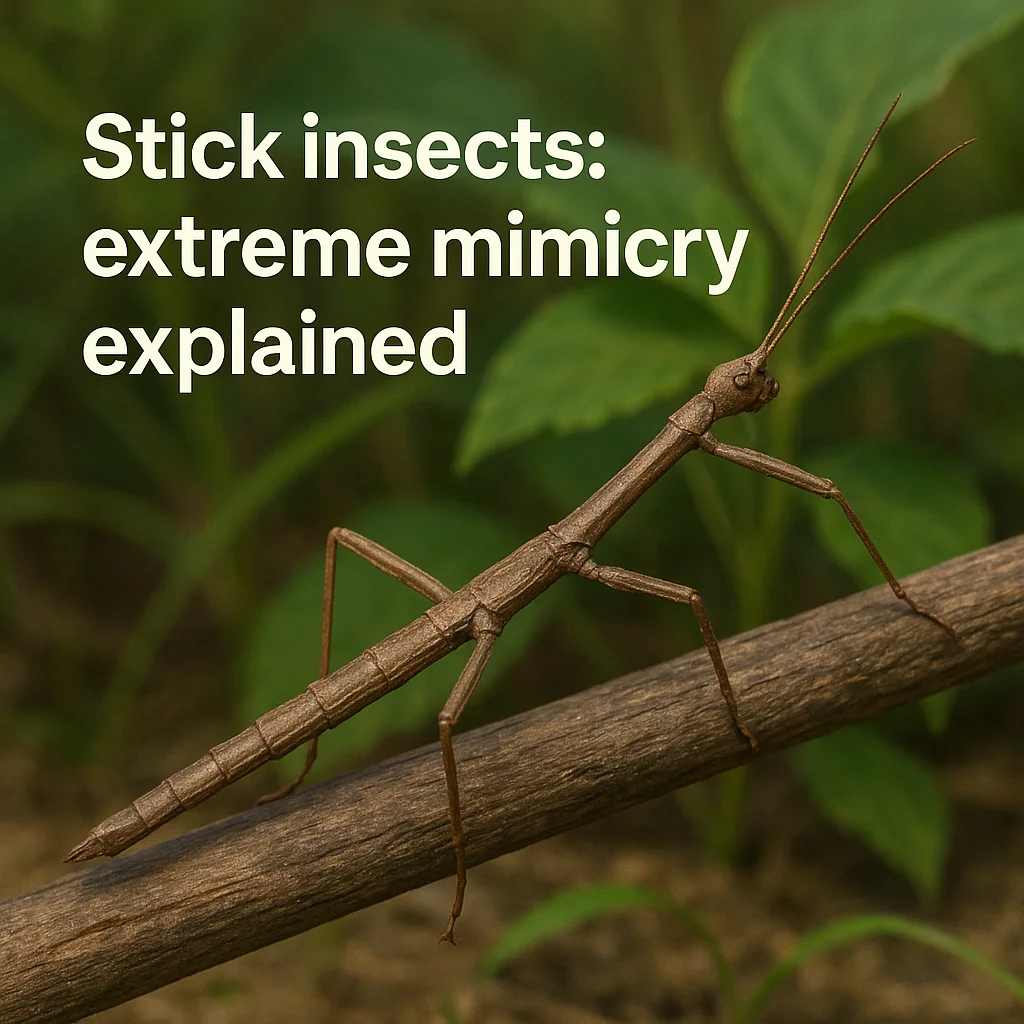
Stick insects, known for their exceptional mimicry, belong to an intriguing group of insects that closely resemble twigs or branches to avoid predators. Here are some fundamental facts about these fascinating creatures:
- Common Names: Stick insects, walking sticks, phasmids
- Scientific Name: Varies (common genera include Phasmatodea)
- Insect or Not: Yes, they are invertebrates
- Order / Family: Order Phasmatodea
- Typical Size Range: 1 to 12 inches (2.5 to 30 cm)
- Key Colors/Patterns: Green, brown, mimicry patterns resembling twigs
- Activity: Primarily nocturnal
- Typical Habitats: Forests, grasslands, tropical regions
- Where in the World: Found on all continents except Antarctica; most diverse in tropical regions
- Seasonality: Depends on region; adults typically visible in warmer months
🔍 Identification
Stick insects can be identified by their unique body shape, which closely resembles a stick or twig. Their long, slender bodies and muted colors allow them to blend seamlessly into their environment.
Key identification features include:
- Antennae: Typically long and thin, aiding in sensory perception
- Wings: Present in some species, while others are wingless
- Legs: Long, resembling twigs, helping in their mimicry
- Movement: Slow and deliberate, often swaying to mimic wind-blown branches
- Common Confusion: May be mistaken for real sticks or branches
Here are the top tips for identifying stick insects:
- Look for body shapes that mimic twigs
- Check for long, slender antennae
- Observe movement style: slow, swaying motion
- Notice coloration that matches surrounding vegetation
- Differentiate from other mimicry insects like katydids
- In habitat, use patience and careful observation
🧠 Basic Body Structure
Stick insects feature the basic structure common to all insects. They have a head, thorax, and abdomen, each with distinct roles. Their six legs are crucial for mimicry and mobility. They possess an exoskeleton that provides support and protection, shedding it through molting as they grow.
Being invertebrates, stick insects lack a backbone, unlike vertebrates such as mammals and birds. This adaptation allows them to develop their unique mimetic forms and behaviors.
🌍 Habitat & Distribution
Stick insects primarily inhabit forests, grasslands, and tropical regions where they can camouflage effectively. They are often found in microhabitats such as under logs, leaves, and amidst branches. Their geographic distribution is extensive, with the highest diversity in tropical climates and some species adapted to temperate forests.
Changes in habitat, such as deforestation and urbanization, affect stick insect populations and may reduce sightings in certain areas.
📅 Seasonal Appearance & Activity
Stick insects are most commonly observed during warmer months when adult populations peak. As primarily nocturnal creatures, they are active at night and prefer humid conditions.
- Spring through late summer for temperate regions
- Tropical areas may have year-round activity
- More visible after rainfall
- Observations best during calm, warm nights
🥚 Reproduction & Egg-Laying
Reproduction in stick insects often involves intricate courtship behaviors, including tapping and antennae contact. Females may lay eggs on the ground, attaching them to plants or scattered in leaf litter. Egg counts and laying strategies vary among species.
Depending on temperature and habitat, eggs may take several months to hatch, with some species displaying a phenomenon known as parthenogenesis, where females can reproduce without males.
🌀 Metamorphosis & Life Cycle
Stick insects undergo incomplete metamorphosis, progressing from egg to nymph to adult. The nymphs resemble smaller versions of adults, gradually molting and increasing in size with each stage.
During the nymph stage, they feed primarily on foliage, mimicking twigs for protection. They continue to grow and molt until reaching maturity, a process that can vary from months to years depending on environmental conditions.
🍽️ Diet & Feeding Behavior
Stick insects are herbivores, feeding on leaves from a variety of plants and trees. They possess chewing mouthparts adapted to cut and grind foliage efficiently.
In their ecological role, they contribute to controlling vegetation growth and provide a food source for other animals in the ecosystem.
🦉 Predators & Defense
Common predators of stick insects include birds, reptiles, amphibians, and small mammals. To evade these threats, they rely on remarkable defense strategies:
- Camouflage: Mimicking twigs and branches
- Mimicry: Resembling possibly distasteful vegetation
- Startle Displays: Some can display eyespots on wings when threatened
- Autotomy: Dropping limbs to escape predators
👥 Social Behavior & Swarms
Stick insects are largely solitary creatures, focusing on individual survival tactics. They may come together during mating but generally do not form true social groups or swarms.
Mating often occurs when individuals encounter each other during overlapping activity times.
🧭 Senses & Communication
Stick insects have well-developed senses adapted to their environments. Their primary sensory tools include:
- Vision: Adept eyesight for detecting movement, despite their cryptic lifestyle
- Smell and Taste: Chemoreception aids in identifying suitable food plants
- Touch: Sensitive antennae used to explore surroundings and communicate during courtship
🌱 Role in the Ecosystem
Stick insects play crucial roles in their ecosystems as herbivores, aiding plant community structure and serving as prey items for various predators. Their camouflage skills influence predator-prey dynamics and contribute to the diversity of their habitats.
Interactions with other species can be mutualistic or competitive, depending on available resources and environmental pressures.
📉 Population & Conservation Notes
Population status of stick insects is generally considered stable, with many species common in suitable habitats. However, habitat fragmentation, pesticide use, and climate change pose potential threats. Conservation efforts focus on habitat preservation and biodiversity support.
- Promote native planting to maintain natural habitats
- Avoid pesticides that harm insects
- Encourage habitat corridors to connect fragmented populations
- Support insect-friendly community initiatives
⚠️ Human Interaction & Safety
Stick insects are harmless to humans and do not bite or sting. They should be observed respectfully in their natural habitats without capturing or disturbing them.
If handling is necessary, it should be done gently, preferably by experienced individuals to avoid stress or injury to the insect.
📌 Summary
- Stick insects are experts at camouflage, resembling twigs and branches
- Found in diverse habitats, mainly tropical and temperate forests
- Primarily nocturnal, best observed on calm, warm nights
- Reproduction varies, with some capable of parthenogenesis
- Incomplete metamorphosis: nymphs closely resemble adults
- Herbivorous diet, crucial for plant community regulation
- Defense through mimicry, startle displays, and autotomy
- Important ecological roles, influencing food webs
- Conservation focus on habitat and biodiversity
- Safe to observe, promoting interest without disturbance