🕷️ Aphids: Why They Appear on New Growth
🧾 Quick Facts
Aphids are small sap-sucking insects that are commonly found on plants. They are known for their ability to rapidly reproduce and can be found in various habitats across the world. Here are some quick facts about aphids:
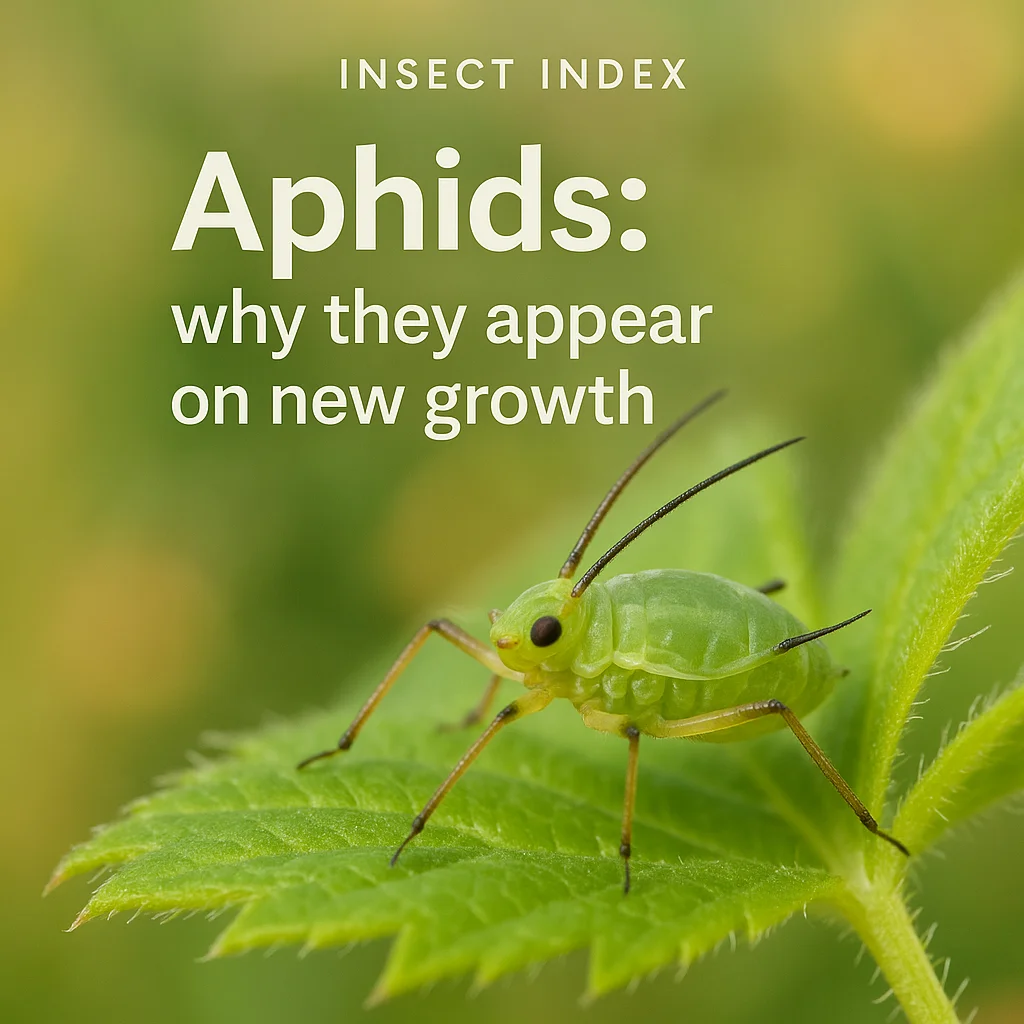
- Common names: Plant lice, greenflies, blackflies
- Scientific name: Varies by species (e.g., Aphidoidea family)
- Insect or not: Yes, they are insects (invertebrates)
- Order / Family: Hemiptera / Aphidoidea
- Typical size range: 1 to 10 millimeters
- Key colors/patterns: Green, black, brown, yellow, and pink
- Activity: Mostly diurnal (active during the day)
- Typical habitats: Gardens, fields, grasslands, and forests
- Where in the world it occurs: Worldwide, except Antarctica
- Seasonality: Most active in spring and summer
🔍 Identification
Aphids can be recognized by their soft, pear-shaped bodies and are often found in clusters on new plant growth. Here are some key features for identifying aphids:
- Small, pear-shaped body
- Antennae are long and threadlike
- Some species have wings, while others do not
- Possess two small tubes called cornicles on their abdomen
- Move slowly, often seem stationary on plants
- May be confused with small scale insects or whiteflies
- Produce a sticky substance known as honeydew, causing sooty mold
- Variety in color depending on species
- Often found in large groups
🧠 Basic Body Structure
Aphids, like all insects, have a three-part body structure consisting of the head, thorax, and abdomen. They have six legs and an exoskeleton that they must shed to grow. Some species have wings, though many are wingless. As invertebrates, aphids lack a backbone, relying on their exoskeleton for support.
🌍 Habitat & Distribution
Aphids can be found in a variety of environments, ranging from forests and grasslands to urban gardens and agricultural fields. They tend to thrive in regions with ample vegetation. Aphids are distributed globally and are especially common in temperate climates. Changes in habitat, such as deforestation and urban development, can affect aphid populations by altering the availability of suitable host plants.
📅 Seasonal Appearance & Activity
Aphids are most active and visible during the warmer months of the year. They prefer mild to warm temperatures, typically in spring and summer. During these times, they can be seen actively feeding on plant sap, especially on new growth.
- Best Time to Spot It: Early spring to late summer
- Midday when temperatures are mild
- After rain, as new growth is abundant
- In humid conditions where plant growth is rapid
🥚 Reproduction & Egg-Laying
Aphids have a fascinating reproductive strategy. In many species, females can reproduce asexually through a process called parthenogenesis, allowing them to rapidly increase their numbers without mating. Eggs are typically laid on the undersides of leaves or on stems, depending on the species.
Their reproductive strategy can vary by region and climate, with some laying eggs only in colder areas to survive the winter, while others give live birth directly to nymphs in warmer regions.
🌀 Metamorphosis & Life Cycle
Aphids undergo incomplete metamorphosis, passing through three stages: egg, nymph, and adult. Nymphs look like miniature adults without wings and go through several molts before becoming mature. This process can take as little as one week, enabling rapid population growth.
Both nymphs and adults feed on plant sap, residing on new shoots and leaves. While nymphs are wingless, some adult aphids develop wings, allowing them to disperse and colonize new plants.
🍽️ Diet & Feeding Behavior
Aphids are herbivores and feed primarily on the sap of plants, using their specialized piercing-sucking mouthparts to extract nutrients. As they feed, they excrete excess sugar in the form of honeydew, which can lead to the formation of sooty mold on plants. Their feeding can stunt plant growth and transmit plant viruses, making them significant agricultural pests.
🦉 Predators & Defense
Aphids have many natural enemies, including birds, ladybugs, lacewings, spiders, and parasitoid wasps. To defend themselves, aphids may use several strategies:
- Releasing alarm pheromones to warn others of danger
- Relying on rapid reproduction to offset predation losses
- Camouflage through their coloration
- Producing protective waxy coatings
👥 Social Behavior & Swarms
While aphids do not exhibit complex social behavior like ants or bees, they often live in large groups. These gatherings can sometimes appear swarm-like, especially when winged forms disperse to find new feeding sites. Such swarming is typically triggered by overcrowding or depletion of resources on a host plant.
🧭 Senses & Communication
Aphids are equipped with sensory structures that allow them to detect changes in their environment. They use vision for basic navigation and rely heavily on chemical cues. Pheromones play a crucial role in communicating alarm signals to fellow aphids when predators are nearby.
🌱 Role in the Ecosystem
Aphids are both a vital part of the ecosystem and a challenge for agriculture. They serve as a food source for many predators, thereby supporting ecosystem biodiversity. However, their role as pests cannot be overlooked, as they can damage crops and spread plant diseases, affecting both agricultural production and plant health.
📉 Population & Conservation Notes
Aphids are widely common and typically abundant in suitable habitats. However, their populations can be affected by environmental factors such as pesticide use, habitat loss, and climate changes. Data on specific population trends can be limited.
- Plant native flora to support natural predators
- Avoid using broad-spectrum pesticides
- Encourage beneficial insects, like ladybugs, in gardens
- Maintain plant health to reduce aphid attraction
⚠️ Human Interaction & Safety
Aphids do not bite or sting humans, making them of little direct safety concern. However, they can have significant impacts on horticulture and agriculture. It's important to manage them through environmentally friendly methods. When observing aphids, avoid tactile interactions and instead appreciate their role within the ecosystem.
📌 Summary
- Identifiable by their small, pear-shaped bodies and clusters on plant growth
- Widely found in gardens, fields, and forests worldwide
- Most visible during spring and summer, especially in mild climates
- Reproduce rapidly, often by parthenogenesis
- Undergo incomplete metamorphosis, from egg to nymph to adult
- Feed on plant sap, acting as both pests and prey in ecosystems
- Natural predators include ladybugs, birds, and wasps
- Help biodiversity but can damage crops
- Safe for human observation, no direct harm