🕷️ Lanternflies Flashy Hoppers And Invasive Risks Overview
🧾 Quick Facts
The Lanternflies are recognized for their striking appearance and role as invasive species in several parts of the world. Here are some quick facts about them:
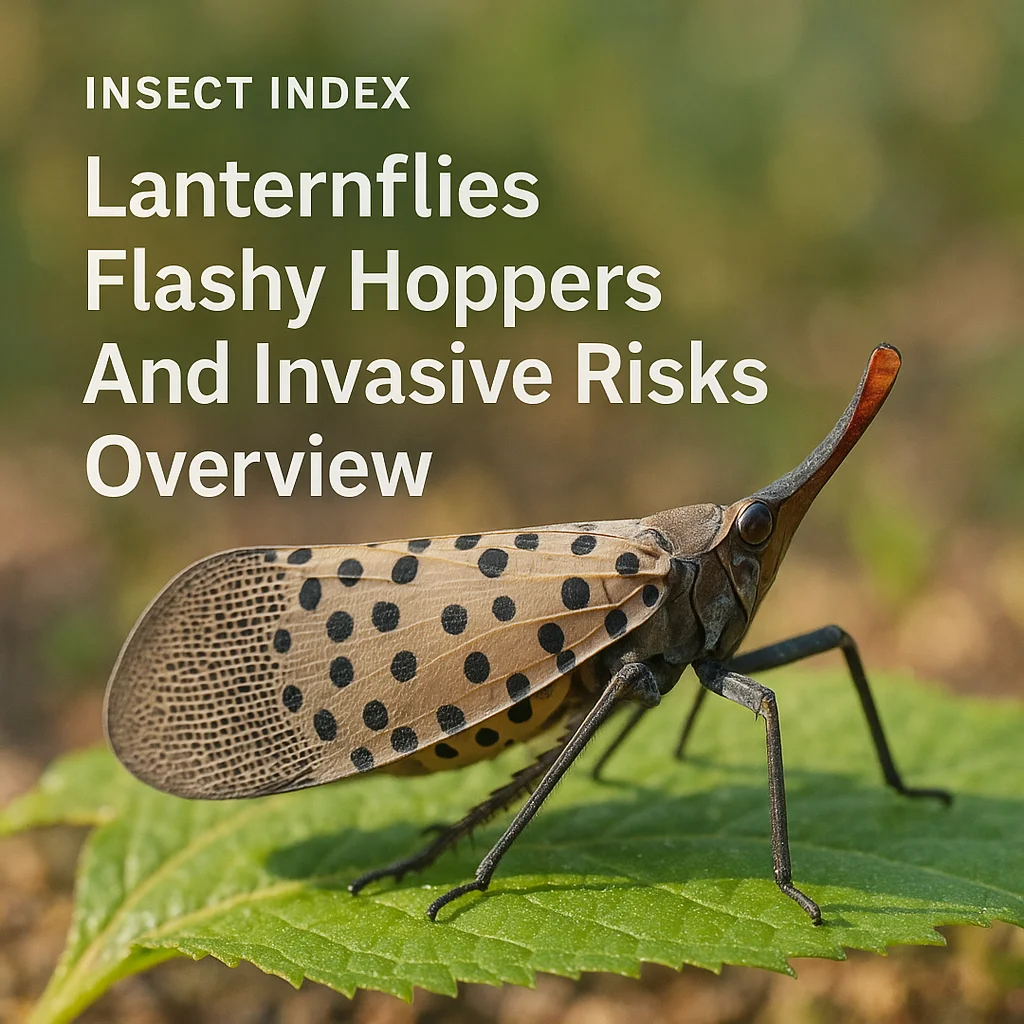
- Common names: Lanternfly, Spotted Lanternfly
- Scientific name: Lycorma delicatula (Note: varies by specific species)
- Insect: Yes, they are a true insect.
- Order / family: Hemiptera / Fulgoridae
- Typical size range: Adults range from 1 to 1.5 inches in length
- Key colors/patterns: Brightly colored wings, often with red, black, and white spots and patches
- Activity: Primarily diurnal but can be active at night
- Typical habitats: Forest edges, orchards, urban areas
- Where in the world it occurs: Predominantly in East Asia, invasive in parts of the United States
- Seasonality: Most visible in late spring to fall
🔍 Identification
Lanternflies can be easily recognized due to their vivid coloration and structure. These insects exhibit a unique silhouette with a broad, flat body and distinctive coloration.
Their wings are a primary identifying feature. While at rest, the forewings display a grey base color speckled with small black spots, and hidden underneath are hindwings with a striking red color. They have piercing-sucking mouthparts suited for their feeding habits.
- Body shape: Broad and slightly flattened
- Antennae: Short and hair-like
- Wing features: Colorful patterned forewings and bright, striking hindwings
- Leg traits: Strong hind legs adapted for jumping
- Common confusion: Often mistaken for moths or other planthoppers
🧠 Basic Body Structure
As insects, Lanternflies have a fundamental body structure divided into the head, thorax, and abdomen. Each insect has six legs and an exoskeleton that provides both support and protection.
They are invertebrates, meaning they lack a vertebral column. Their body is covered by a tough exoskeleton, which they shed multiple times through a process called molting to grow. Their wings are an essential characteristic used for both movement and display.
🌍 Habitat & Distribution
Lanternflies prefer environments with abundant host plants, including orchards, vineyards, and forests. They thrive in temperate climates but adapt well to a range of environments.
Geographically, they originated in East Asia but have displayed invasive tendencies, particularly in the United States. Their ability to adapt to various microhabitats such as tree bark makes them resilient invaders.
📅 Seasonal Appearance & Activity
Lanternflies are most active and visible from late spring through fall, with peak activity during warm weather months. Their presence is notable during daylight hours, although they may also be active at night under artificial lights.
- Best Time to Spot It: Late spring evenings
- Best Time to Spot It: Summer months in orchards
- Best Time to Spot It: Early fall on urban trees
- Best Time to Spot It: Mornings in vineyards
🥚 Reproduction & Egg-Laying
The mating behavior of Lanternflies involves courtship displays and pheromonal signals to attract mates. Their eggs are typically laid in rows on the smooth bark of trees or even on manmade surfaces.
Egg masses contain numerous eggs, often covered with a waxy, mud-like substance for protection. The quantity of eggs varies but can be substantial, allowing rapid population growth under favorable conditions.
🌀 Metamorphosis & Life Cycle
Lanternflies undergo incomplete metamorphosis, progressing through stages of egg, nymph, and adult.
The nymph stages involve several molts and are notable for their hardiness and mobility. They feed voraciously, primarily on plant sap, enriching their diets to fuel development into the adult stage. The lifecycle period can vary, depending on environmental conditions and food availability.
🍽️ Diet & Feeding Behavior
As nymphs and adults, Lanternflies primarily consume plant sap. They use specialized piercing-sucking mouthparts to feed on various plant species, often causing significant damage to agricultural crops.
They are regarded as herbivores, posing risks to crops like fruit trees and hardwoods due to their feeding habits. Their presence is marked by a sugary secretion known as honeydew, contributing to mold growth and potential crop damage.
🦉 Predators & Defense
Natural predators of Lanternflies include birds, amphibians, and some small mammals. However, their bright coloration can be a defensive mechanism, serving as a warning to potential predators.
Their primary defense strategies include camouflage among plant leaves and jumping quickly to escape threats.
- Defense Highlights: Camouflage with foliage
- Defense Highlights: Rapid, unpredictable jumps
- Defense Highlights: Tough exoskeleton
- Defense Highlights: Warning coloration to deter predators
👥 Social Behavior & Swarms
Lanternflies are generally solitary but can congregate in large numbers when feeding. This aggregation is primarily driven by food availability and environmental factors.
While they do not form social colonies like ants or bees, their swarming can be contributed to by their attraction to specific host plants and favorable living conditions.
🧭 Senses & Communication
Lanternflies rely heavily on visual cues, pheromones, and vibrations for communication and navigation. Their eyesight is adapted to detect movement and color changes in their environment.
Intraspecific communication primarily involves pheromones, which are crucial in mating and aggregation behaviors.
🌱 Role in the Ecosystem
Lanternflies play both beneficial and detrimental roles within ecosystems. They can serve as food for predators and participate in nutrient cycling.
However, as invasive species, they threaten agricultural productivity and biodiversity by competing with native species and damaging important crops and hardwoods.
📉 Population & Conservation Notes
In regions where they are invasive, Lanternflies populations are often seen as a pest and are subject to control measures. Their widespread distribution in some areas reflects their success in adapting to various habitats.
- How to Help (Low-Impact): Encourage native plants in gardens
- How to Help (Low-Impact): Limit pesticide use to protect non-target species
- How to Help (Low-Impact): Promote scientific surveys and monitoring
- How to Help (Low-Impact): Educate communities about DIY control methods
⚠️ Human Interaction & Safety
Lanternflies do not bite or sting humans, and direct interaction poses minimal risk. However, their presence can lead to significant agricultural and ecological impacts.
For those encountering them, respectful observation without collection or interference in their habitats is advised. If you experience any skin irritation from contact, rinsing the area and consulting a professional if severe symptoms develop is recommended.
📌 Summary
- Identification: Recognizable by vibrant, spotted wings and broad body
- Habitat: Common in forests and agricultural lands
- Seasonality: Visible late spring through fall
- Life Cycle: Short and involves nymph and adult stages
- Diet: Sap-sucking herbivores
- Predators: Include birds and amphibians
- Ecology: Impact both ecosystems positively and negatively
- Human Notes: Encourage conservation efforts and avoid invasive spread