🕷️ Spittlebugs: foamy “spit” on plants
🧾 Quick Facts
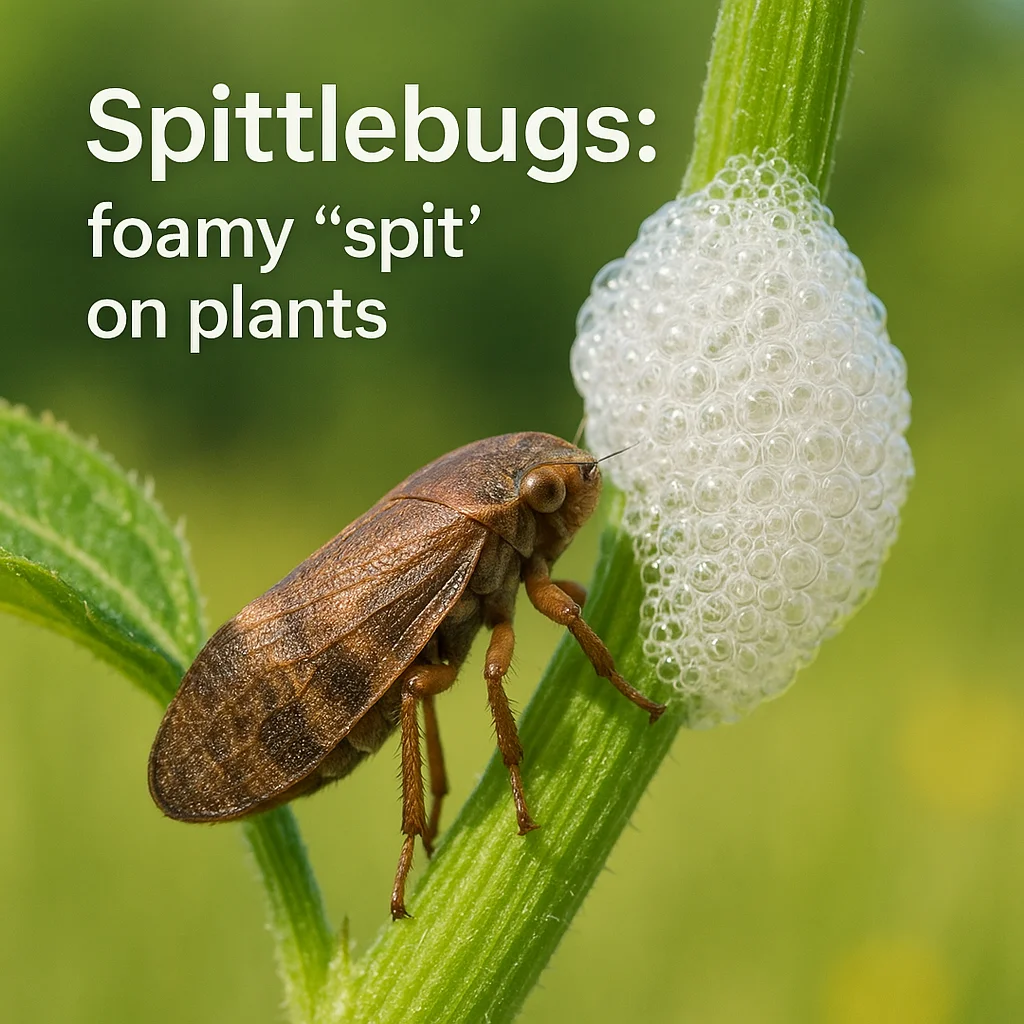
Spittlebugs are fascinating insects known for the frothy "spit" they produce on plants. They are part of a diverse group called froghoppers, named for their incredible jumping ability.
- Common names: Spittlebugs, froghoppers
- Scientific name: Varies by species
- Insect or not: Yes, it is an invertebrate
- Order / family: Hemiptera / Cercopidae
- Typical size range: 5-10 mm in length
- Key colors/patterns: Brown, green, patterned
- Activity: Primarily diurnal
- Typical habitats: Grasslands, gardens, forests
- Where in the world it occurs: Worldwide, except Antarctica
- Seasonality: Spring to late summer
🔍 Identification
Spittlebugs are recognized by their unique ability to create frothy masses on plant stems. These serve as protective habitats during the nymph stage. Adult spittlebugs have a characteristic wedge-shaped body and strong hind legs adapted for jumping.
- Body shape: Wedge-shaped and compact
- Antennae: Short and bristle-like, not often visible
- Wing features: Adults have membranous wings folded along their back
- Leg traits: Strong hind legs for jumping
- Distinguishing look-alikes: Can be confused with leafhoppers, but differ in frothy nymph stage
- Look for white frothy "spit" on plant stems
- Notice small brown or green wedge-shaped adults
- Watch for strong jumping movement
- Compare to leafhoppers, noting the foam and body shape
- Wings held tent-like over body
- Often found on herbaceous plants
🧠 Basic Body Structure
Spittlebugs possess the classic insect morphology with a body divided into three main parts: head, thorax, and abdomen. They have six legs, with the hind legs being particularly adapted for jumping, enabling rapid escape from predators. Spittlebugs have an exoskeleton that they molt several times as they grow from nymph to adult. They are invertebrates, meaning they lack a backbone, and instead rely on their stiff outer shell for structure and protection.
🌍 Habitat & Distribution
Spittlebugs thrive in a wide range of environments, from grasslands and meadows to gardens and forest edges. They are most commonly found in regions with moderate moisture, as the frothy substance they produce requires humidity to maintain its structure. Geographically, spittlebugs are present on all continents except Antarctica, favoring temperate and tropical climates. Changes in habitat, such as urban development or agriculture, can influence their local abundance.
📅 Seasonal Appearance & Activity
Spittlebugs are most visible during the spring and summer months. As the temperatures rise and plants thrive, spittlebugs emerge to take advantage of the available vegetation. Being primarily diurnal, they are active during daylight hours. Rain and humidity aid in the formation of their protective foam, making them more obvious during these conditions.
- Best spotted in late spring through summer
- Active during warm, humid days
- Diurnal activity peaks in mornings and late afternoons
- Look for frothy masses in shady, moist environments
🥚 Reproduction & Egg-Laying
Spittlebug reproduction involves courtship behaviors, though these vary among species. Once mating occurs, females lay eggs on plant tissues such as stems or leaves, ensuring the eggs are securely embedded. Egg counts are species-dependent, but batches typically contain multiple eggs. Some species lay eggs that overwinter, hatching in the spring when conditions are favorable.
🌀 Metamorphosis & Life Cycle
Spittlebugs undergo incomplete metamorphosis, transitioning from egg to nymph to adult. In the nymph stage, they encase themselves in a protective frothy mass, which provides moisture and deters predators while they feed on plant sap. Nymphs generally take several weeks to mature, during which they molt multiple times. Once they reach adulthood, they leave the foam and become more mobile, continuing to feed on plant sap.
🍽️ Diet & Feeding Behavior
Spittlebugs primarily consume plant sap, using specialized piercing-sucking mouthparts to access fluid from their host plants. Nymphs and adults share similar diets, feeding on a wide variety of herbaceous plants, shrubs, and sometimes trees. While generally considered herbivores, they play a minor role as pests in agriculture due to their feeding habits.
🦉 Predators & Defense
Natural predators of spittlebugs include birds, spiders, parasitoid wasps, and some mammals. They employ several defense strategies, the most notable being the production of white, foamy "spit" that helps nymphs remain hidden and less palatable to predators. This foam can also provide thermal regulation and prevent desiccation.
- White foam deters visual predators
- Camouflaged body coloration
- Quick jumping escape response
- Hidden within plant foliage
👥 Social Behavior & Swarms
Spittlebugs are generally solitary creatures. While multiple nymphs may inhabit a single plant, each constructs its own foam mass for protection. The adult spittlebugs do not form swarms, and encounters between adults are usually limited to mating purposes.
🧭 Senses & Communication
Spittlebugs rely on senses such as touch and vibration to interact with their environment. They are sensitive to changes in air movement and vibrations, aiding in their quick escape from threats. Communication methods primarily involve direct contact or vibrational signals during mating, as visual and chemical communication are less pronounced in many species.
🌱 Role in the Ecosystem
Ecologically, spittlebugs contribute to the food web both as herbivores and as prey for various predators. While they can impact plant health through sap extraction, they seldom reach levels that cause significant agricultural damage. Spittlebugs do not play a major role in pollination or decomposition, but they do facilitate the cycling of nutrients back into the ecosystem through their interactions with plants.
📉 Population & Conservation Notes
Spittlebugs are often considered common in suitable habitats, benefiting from diverse plant host availability. However, localized population declines may occur due to habitat loss, pesticide application, and climate changes that affect plant communities. Conservation efforts focus on habitat preservation and promoting plant diversity to support healthy populations.
- Plant native species to support host plant availability
- Avoid using broad-spectrum pesticides
- Leave areas of leaf litter and ground cover intact
- Maintain diverse, plant-rich landscapes
⚠️ Human Interaction & Safety
Spittlebugs are harmless to humans and do not bite or sting. Their presence is usually seen as a curiosity rather than a nuisance. While they can cause minor cosmetic damage to ornamental plants, this rarely warrants control measures. Observers should practice respectful viewing, avoiding disturbance to natural habitats and conserving wildlife.
📌 Summary
- Spittlebugs are small insects known for their frothy "spit" on plants.
- They thrive in varied habitats, from grasslands to gardens.
- Most active during spring and summer, especially on warm, humid days.
- Undergo incomplete metamorphosis: egg-nymph-adult stages.
- Feed primarily on plant sap using piercing-sucking mouthparts.
- Natural enemies include birds and parasitoid wasps, with foam as a defense.
- Ecologically, they serve as both herbivores and prey species.
- Population generally stable, with habitat diversity crucial for conservation.
- Harmless to humans, promoting interest in their intriguing behavior.