🕷️ Whiteflies: not true flies (quick ID)
Whiteflies are small sap-sucking insects that are often mistaken for true flies. While similar in appearance to various fly species, whiteflies belong to the family Aleyrodidae within the order Hemiptera. They are known for their powdery white appearance and are found in many regions across the world, primarily inhabiting areas with abundant vegetation.
🧾 Quick Facts
Here are some essential facts about whiteflies that can help you identify and understand them better.
- Common names: Whiteflies
- Scientific name: Varies
- Insect or not: Insect (invertebrate)
- Order / family: Hemiptera / Aleyrodidae
- Typical size range (adult): 1–3 mm long
- Key colors/patterns: Powdery white, delicate
- Activity: Primarily diurnal
- Typical habitats: Gardens, greenhouses, forests
- Where in the world it occurs: Found worldwide, especially in tropical and subtropical regions
- Seasonality: Most visible during warm seasons
🔍 Identification
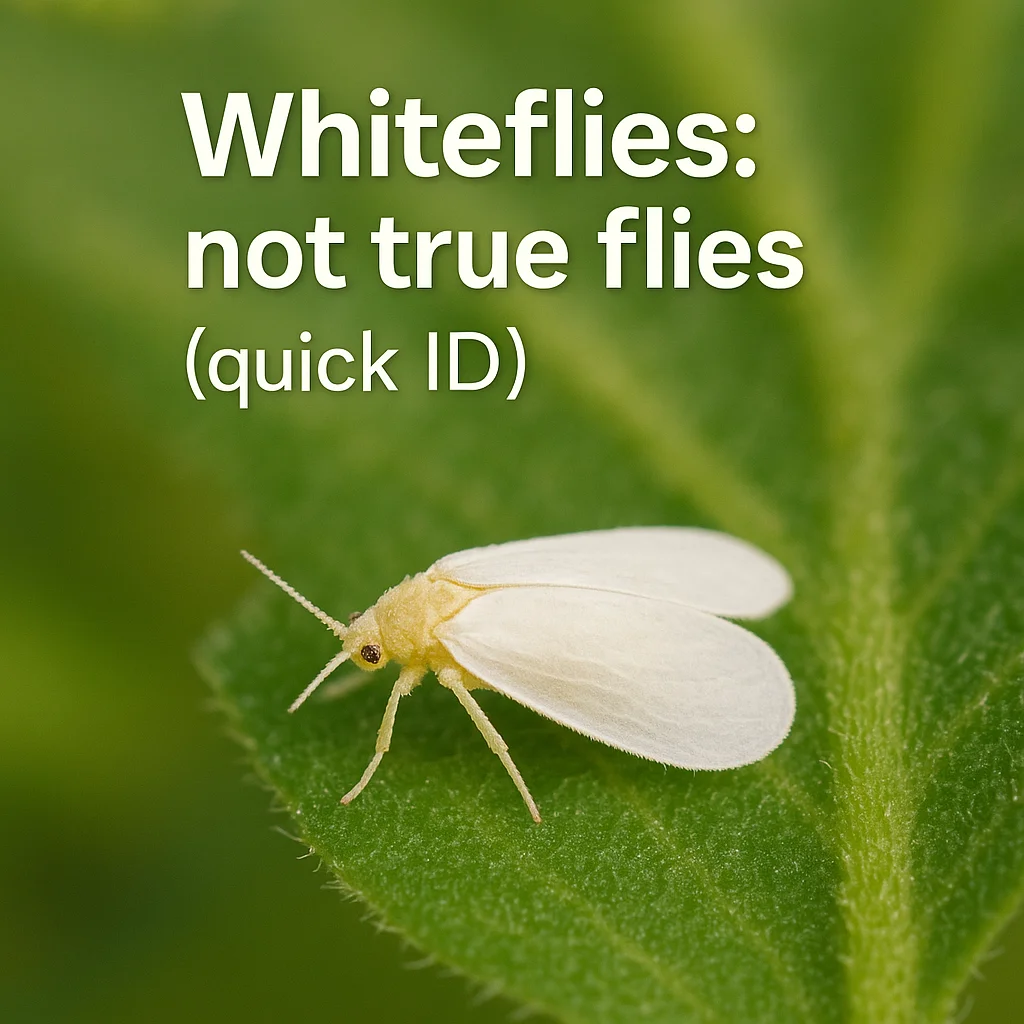
Whiteflies can be identified by their small, moth-like appearance with powdery white wings. Despite their name, they are not true flies and shouldn't be confused with them. Their rounded triangular silhouette and delicate tonality distinguish them from other small insects.
- Body shape and silhouette: Small, triangular, soft-bodied
- Antennae type: Short, bead-like
- Wing features: Powdery and white; held tent-like over the body
- Leg traits and movement style: Six legs, slow flying, clumsy walkers
- Distinguishing look-alikes and common confusion: Often mistaken for tiny moths or fungus gnats
- Top ID Tips
- Look for clusters on the undersides of leaves
- Note the characteristic powdery white appearance
- Check the wing shape for tent-like position
- Observe slow and erratic flight patterns
- Spot in bright daylight settings
- Identify infestations by wilting plant leaves
🧠 Basic Body Structure
Whiteflies, like all insects, have three primary body segments: a head, a thorax, and an abdomen. They possess six legs and two pairs of wings, which are a hallmark of the order Hemiptera. Their delicate exoskeleton demands frequent molting to accommodate growth stages. As invertebrates, whiteflies have no internal skeleton; muscle and support come from their hardened outer case.
🌍 Habitat & Distribution
Whiteflies thrive in warm, humid environments, often found in gardens, greenhouses, and fields with abundant leafy plants. In these settings, they can hide under leaves and leverage warmth and shelter for survival. Though they are dispersed worldwide, their highest concentration is in tropical and subtropical climates, where plant hosts are consistently available.
Climate shifts and human changes to agriculture and urban spaces can impact whitefly populations, making them more prominent in certain settings over time.
📅 Seasonal Appearance & Activity
Whiteflies tend to be most active during warm seasons when their plant hosts are in full leaf. These insects are primarily diurnal, seen in daylight as they move from plant to plant. High humidity and warm temperatures can spike their activity and visibility.
- Best Time to Spot It
- Late spring through summer
- During daylight hours
- Warm, humid conditions
- After rainfall may drive new activity
🥚 Reproduction & Egg-Laying
Whiteflies exhibit varied mating behaviors, typically relying on chemical cues for mate attraction. They prefer laying eggs on the underside of plant leaves, with clusters numbering in the hundreds to ensure survival. These eggs hatch into immature stages known as nymphs, which remain close to their hatching site.
Egg density and survival rates can fluctuate based on region-specific environmental conditions and host plant availability.
🌀 Metamorphosis & Life Cycle
Whiteflies undergo incomplete metamorphosis, transitioning from egg to nymph and finally to adult. The nymphal stage involves several molts while the insect remains feeding on plant juices. As nymphs mature, they progressively gain the recognizably white, powdered adult form and become mobile.
Feeding primarily on sap, nymphs and adults are generally located on the same host plants, although nymph stages can last several weeks, influenced by temperature and humidity conditions.
🍽️ Diet & Feeding Behavior
Whiteflies are sap feeders, using piercing-sucking mouthparts to extract nutrients from plant phloem. This allows them to feed efficiently without needing to move extensively on their host plants. They predominantly feed as herbivores and are recognized as agricultural pests due to their impact on crops and ornamental garden plants. In some cases, they can induce plant diseases through virus transmission.
🦉 Predators & Defense
Naturally preyed upon by birds, spiders, and parasitic wasps, whiteflies have several defenses. Their camouflaging white appearance helps them blend with plant foliage, while their rapid breeding can overwhelm predator numbers. Additionally, some species may produce protective waxes that deterrent predatory insects.
- Defense Highlights
- Camouflage in foliage
- High reproductive rate
- Some produce protective wax coatings
- Erratic, unpredictable flight paths
👥 Social Behavior & Swarms
Typically, whiteflies are not social insects and do not exhibit the structured colony behavior seen in ants or bees. However, they can appear swarm-like when populations are dense, often provoked by abundant food sources or breeding pressures. These groupings are generally opportunistic rather than cooperative in nature.
🧭 Senses & Communication
Whiteflies rely on their keen sense of smell through antennae to detect host plants and potential mates. Visual cues are secondary in their communication, although movement and pheromones play key roles in mating events. They do not produce sound or engage in advanced signaling behaviors commonly observed in other insect species.
🌱 Role in the Ecosystem
While notorious as agricultural pests, whiteflies are integral to the balance of ecosystems as prey for many insectivorous species, aiding the food web stability. They can help indicate plant health issues or imbalances and serve inadvertently in pollination processes when transferring between flowering plants. Despite their control challenges, they remain a valuable ecological component when managed sustainably.
📉 Population & Conservation Notes
Whiteflies are often abundant in suitable environments, with populations that respond rapidly to habitat variability or human agricultural practices. The use of pesticides has major impacts on whitefly populations, sometimes resulting in resistance issues or elimination imbalances. Conservation efforts focus on integrated pest management strategies that reduce chemical dependencies in favor of sustainable agricultural biodiversity.
- How to Help (Low-Impact)
- Promote local native plants
- Implement biological pest control
- Limit pesticide use in gardens and farms
- Encourage natural predator habitats
⚠️ Human Interaction & Safety
Although whiteflies do not bite or sting humans or pets, they can be problematic in agriculture and home gardening due to their feeding habits. Managing infestations involves physical plant inspections, utilizing natural enemy populations, and environmentally safe control methods. Observation and monitoring are key, as disturbing populations can disperse adults suddenly.
📌 Summary
- Whiteflies are small, white, sap-sucking insects, not true flies.
- Identifiable by their powdery wings and slow flight.
- Found globally, mostly in warm, vegetated areas.
- Active during warm seasons, favoring daylight.
- Reproduce rapidly and lay eggs under leaves.
- Sap feeders, acting as pests in agriculture.
- Preyed upon by birds and insects while showing varied defenses.
- Play roles in food webs and can impact crops.
- Best managed with balanced, non-toxic control methods.