🕷️ Annual vs periodical cicadas (key differences)
🧾 Quick Facts
Annual and periodical cicadas are fascinating insects belonging to the order Hemiptera. They are known for their unique life cycles and distinct appearances. These cicadas can be found across various parts of the world and are most famous for the characteristic sounds they produce.
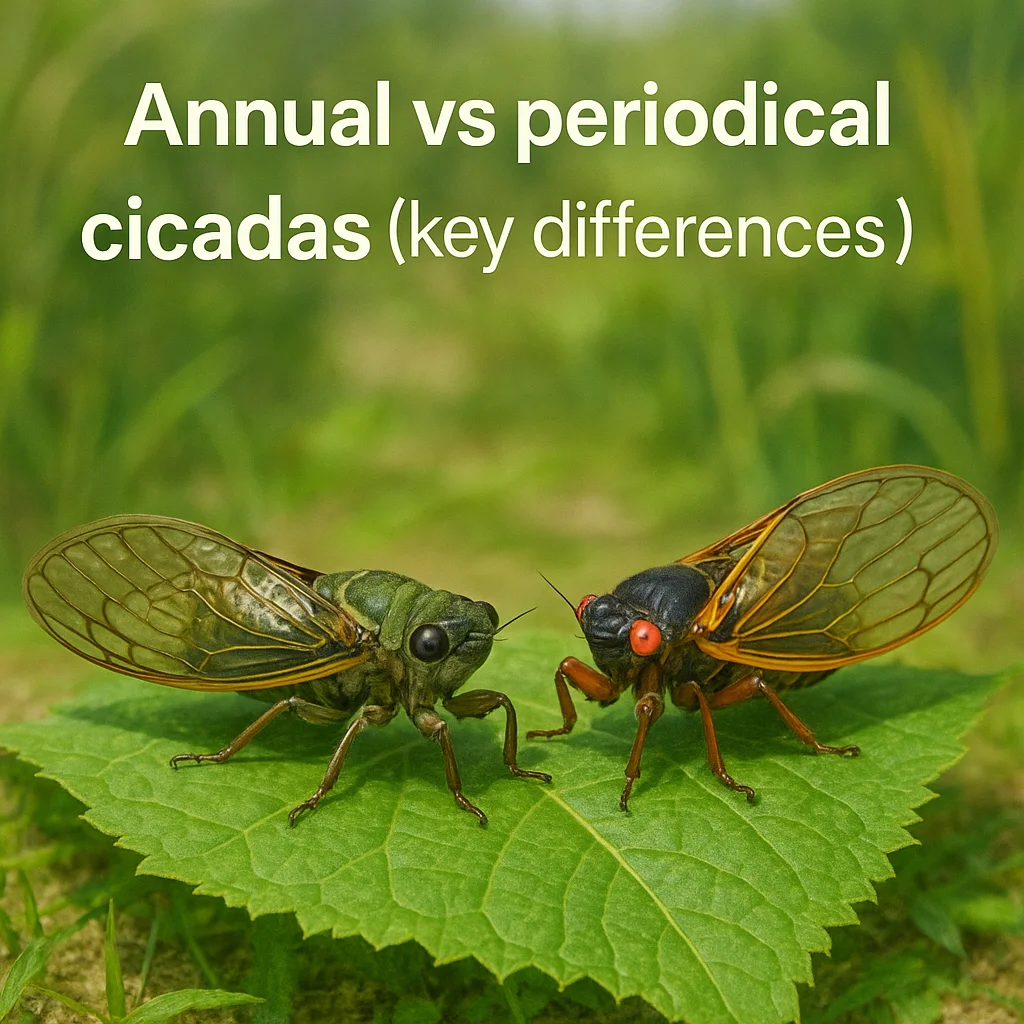
- Common Names: Cicadas, locusts (misnomer)
- Scientific Name: Varies
- Insect: Yes, an invertebrate
- Order / Family: Hemiptera / Cicadidae
- Typical Size Range: 1 to 2 inches (2.5 to 5 cm)
- Key Colors/Patterns: Black, brown, green with translucent wings
- Activity: Primarily day (diurnal)
- Typical Habitats: Forests, woodlands, suburban areas
- Where in the world it occurs: Predominantly North America, also in Asia, Australia
- Seasonality: Spring to late summer
🔍 Identification
To identify cicadas, look for their robust, elongated bodies and distinctive large, membranous wings. Their wings often form a tent-like structure over the body. Cicada antennae are short compared to their body length.
- Body Shape and Silhouette: Thick, stout body with a notable head and large eyes
- Antennae Type: Short and hair-like
- Wing Features: Two pairs of wings; front wings are larger and transparent with distinct venation
- Leg Traits and Movement Style: Strong legs for tree climbing and grasping
- Distinguishing Look-Alikes: Distinct from locusts (grasshoppers) by structure and sound
- Look for transparent wings with fine veins
- Thick-bodied with a wide head
- Large, prominent compound eyes
- Short, hair-like antennae
- Coloration varies from black to green
- Audible buzzing or chirping sound
🧠 Basic Body Structure
Cicadas have a three-part body structure consisting of the head, thorax, and abdomen. They are true insects, as evidenced by their six legs. Their bodies are covered in a protective exoskeleton that is shed through molting during growth stages. As invertebrates, they lack a backbone, which distinguishes them from vertebrates.
🌍 Habitat & Distribution
Cicadas thrive in a variety of habitats, including deciduous forests, woodlands, and even urban gardens. They are often found on trees where they feed and lay eggs. Geographic distribution is mainly focused in temperate regions such as North America, with species also present in parts of Asia and Australia. Habitat changes like deforestation may affect their populations.
📅 Seasonal Appearance & Activity
Cicadas are most visible during the warmer months, typically from late spring to late summer. They are day-active, or diurnal, creatures. Weather conditions, particularly temperature and humidity, can influence their emergence and activity.
- Late spring to midsummer
- Warm days after rain
- Midday to afternoon activity
- Temperature-dependent emergence
🥚 Reproduction & Egg-Laying
Cicadas use sound for mating calls, with males producing loud, characteristic songs to attract females. Females lay eggs in plant stems or tree branches, creating slits using their ovipositors. The number of eggs laid can vary, but typically many eggs are deposited at once.
🌀 Metamorphosis & Life Cycle
Cicadas undergo incomplete metamorphosis, passing through egg, nymph, and adult stages. Nymphs spend most of their lives underground, feeding on root sap. They can remain underground for several years before emerging to molt into adults. Adult cicadas live for a few weeks to mate and lay eggs.
🍽️ Diet & Feeding Behavior
Cicada nymphs feed on the sap from tree roots, utilizing their piercing-sucking mouthparts. Adult cicadas continue to feed on plant sap, but their primary focus is reproduction. They play a minor role as herbivores in their ecosystems.
🦉 Predators & Defense
Cicadas face predation from birds, mammals, reptiles, and even other insects. Their main defense mechanisms include camouflage and the synchronized emergence of periodical cicadas, which overwhelm predators with their sheer numbers. Startle displays and rapid flight are also used to escape threats.
- Camouflage coloration
- Mass emergence overwhelms predators
- Quick take-off and flight
- Loud sounds may deter some predators
👥 Social Behavior & Swarms
Cicadas are not inherently social insects like ants or bees, but they do gather in large numbers during the emergence of periodical cicadas. This mass gathering is not a coordinated swarm but rather a result of synchronous emergence triggered by environmental cues.
🧭 Senses & Communication
Cicadas rely heavily on sound for communication, particularly for mating purposes. The males produce loud calls using specialized membranes called tymbals. Other forms of sensory input include vision and vibrations, helping them navigate their environment and detect danger.
🌱 Role in the Ecosystem
Cicadas benefit ecosystems by aerating the soil through their burrowing behaviors, which allow rainwater and nutrients to penetrate more deeply. They also serve as a food source for numerous predators and participate indirectly in tree pruning when females lay eggs, promoting new plant growth. Additionally, their feeding helps regulate tree and plant growth.
📉 Population & Conservation Notes
Cicadas are generally common and abundant in suitable habitats, with periodical cicadas exhibiting a localized but dramatic emergence. They are not currently considered threatened but face risks from habitat loss and pesticide use. Those interested in supporting their populations can consider the following:
- Plant native flora to support habitat
- Avoid pesticide use in gardens
- Leave leaf litter undisturbed
- Promote habitat conservation
⚠️ Human Interaction & Safety
Cicadas are harmless to humans and do not bite or sting. They may be considered a nuisance due to their loud calls and mass emergences. It is encouraged to observe them respectfully without collecting or harming them. In case of any discomfort from handling cicadas, wash the area and avoid scratching. Seek professional advice if severe reactions occur.
📌 Summary
- Recognizable by large, transparent wings and stout bodies
- Found in forests and suburban regions during warm months
- Undergo incomplete metamorphosis, with lengthy nymph stages
- Feed primarily on plant sap using piercing-sucking mouthparts
- Predators include birds, mammals, and reptiles, with camouflage as a defense
- Synchronous emergence overwhelms predators
- Play roles in aerating soil and supporting ecological balance
- Generally common but dependent on suitable habitats